


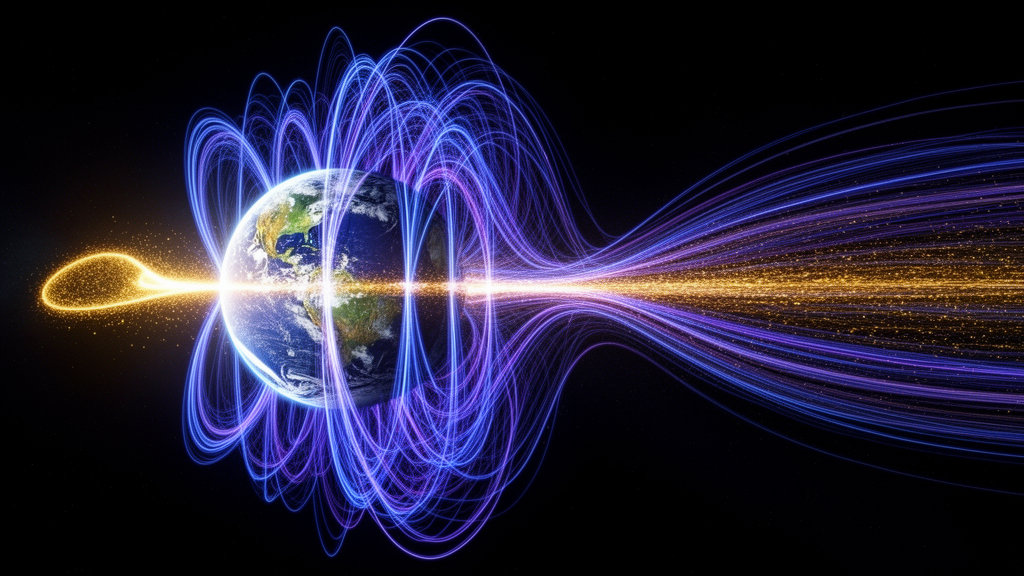
Computational space physicists have introduced an open-source Python library named geopack-vectorize that dramatically accelerates the three-dimensional geometric modeling of Earth’s magnetosphere while quantifying structural properties previously hidden within qualitative field-line tracings. Developed by researchers Ko Isono, Akimasa Yoshikawa, and Yuto Katoh, the framework integrates an analytical component designated as Mageometry to derive local curvature and torsion both along and across geomagnetic field lines. By replacing traditional scalar loops with optimized NumPy array operations, the implementation delivers processing speedups reaching up to 116 times conventional execution rates across standard magnetospheric benchmarks. This advancement resolves a persistent computational bottleneck in space physics, where empirical representations of the terrestrial magnetic environment must frequently be evaluated over vast multi-dimensional spatial grids. The software resolves eight independent derivative coefficients directly from spatial field gradients, enabling researchers to systematically examine local magnetic tension, compression, and shear across complex magnetospheric domains with high numerical efficiency and reproducibility.
Accurate characterization of three-dimensional magnetic field topology is fundamental to understanding energy transfer, charged particle dynamics, and plasma instabilities within the terrestrial magnetosphere. For decades, empirical models formulated by Nikolai Tsyganenko, including the widely utilized T89, T96, T01, and T04 formulations, have served as standard numerical representations of realistic magnetospheric field distributions. However, standard investigative practices have predominantly relied on tracing individual field lines through numerical integration, a qualitative technique that struggles to extract the detailed differential geometry of surrounding space. Previous attempts to evaluate localized field geometries generally adapted standard Frenet-Serret coordinates, which restrict analysis strictly to directional variations along the parallel axis of field lines. While alternative methods relying on global flux coordinates can assess orthogonal behaviors, they presuppose the existence of closed, topologically intact magnetic flux surfaces. Consequently, these earlier methods fail when applied to open magnetic field lines extending into the solar wind or regions characterized by localized plasma fluctuations.
To overcome these theoretical restrictions, the research team adapted a mathematical framework originally proposed by Yoshikawa and colleagues that reformulates the equations of electromagnetism within a localized orthonormal frame. At any selected point in three-dimensional space where the magnetic field possesses a positive magnitude, the system defines a right-handed basis consisting of tangent, principal normal, and binormal unit vectors. The tangent vector aligns with the local magnetic field, ensuring that the directional derivative of the tangent along itself isolates the principal normal vector. The binormal vector is defined as mutually perpendicular to both the tangent and normal vectors, completing an orthogonal triad that eliminates binormal projections along the field-parallel derivative. Because orthonormal basis vectors maintain constant mutual scalar products, the spatial covariant derivatives of the frame exhibit strict antisymmetry. This formulation extends Frenet-Serret differential geometry into perpendicular directions, facilitating the quantitative extraction of geometric distortion entirely from local magnetic field gradient tensors without assuming global flux surfaces.
Expanding the covariant derivatives of the local triad yields twenty-seven possible combinations of basis derivatives, yet fundamental metric symmetry and frame orthogonality reduce these variations to exactly eight independent spatial coefficients. These eight derivative coefficients, labeled sequentially from A through H, provide a complete analytical description of three-dimensional magnetic distortions within the magnetosphere. Coefficients A, C, D, E, and F quantify distinct curvature behaviors: coefficient A measures curvature along the field line corresponding to magnetic tension, while C and D track variations of the tangent vector under displacement along the normal and binormal directions. Coefficients E and F describe the spatial evolution of the normal and binormal vectors under orthogonal shifts. The remaining three coefficients, designated as B, G, and H, represent magnetic torsion: B quantifies the twisting of the binormal vector along the field line, whereas G and H capture torsion strictly orthogonal to the magnetic field, exhibiting direct physical coupling to field-aligned electric currents.
The practical realization of this mathematical methodology is embedded within the newly constructed geopack-vectorize software architecture, which consists of two primary interconnected components. The first component provides an array-compatible extension of standard Python geopack routines, vectorizing core coordinate transformations, empirical magnetic-field evaluations, and field-line tracing procedures. The second component, known as Mageometry, operates as an analytical layer that ingests vectorized magnetic field computations to evaluate the local orthonormal frame and its eight spatial derivative coefficients. Mageometry is implemented across core script modules, specifically field_line_geometry.py, which calculates local Frenet-Serret vectors, and field_line_directional_derivatives.py, which computes orthogonal directional derivatives. Crucially, the software does not require separate algorithmic paths to process open versus closed magnetic field lines; derivative coefficients are determined purely from local field vectors and their numerical gradients at each evaluation point. Field-line tracing integrates trajectories until reaching predefined boundary conditions, categorizing field line topology entirely by the final termination state.
A primary motivation for developing geopack-vectorize was overcoming execution bottlenecks inherent in the legacy Python geopack package. The original library faithfully ported historical Fortran GEOPACK routines, adopting a scalar architecture that evaluates magnetic field vectors at a single spatial point per function call. While a point-by-point interface naturally matched legacy workflows that evaluated fields sequentially along single spacecraft trajectories, it severely degrades performance during modern grid-based investigations. When researchers execute global field mapping, large-scale particle orbit simulations, or simultaneous tracing of thousands of field lines, legacy scalar routines force repeated function execution inside cumbersome Python loops. The geopack-vectorize architecture resolves this limitation by accepting multi-dimensional coordinate arrays within a single call, batching calculations across identical time epochs and static solar wind parameters. The authors clarify that this vectorization operates at the Python application programming interface level via NumPy array broadcasting, rather than relying on custom hardware instruction sets.
To validate performance, the authors conducted comprehensive benchmarks on a laptop configured with an Intel Core i7-11370H processor, 16 gigabytes of LPDDR4x memory, and Ubuntu 22.04.5 LTS on Windows Subsystem for Linux 2. Tests executed under Python 3.11.1 and NumPy 2.2.6 compared vectorized functions against scalar operations from geopack version 1.0.1 across 100 and 1,000 spatial points. When processing 1,000 grid points, the vectorized implementation achieved an exceptional speedup of approximately 116 times for the T89 model and 29.2 times for T96. Complex T01 and T04 formulations demonstrated speedups between 43 and 46 times, while simultaneous tracing of 1,000 field lines completed in 3.05 seconds compared to 21.6 seconds for scalar execution, representing a 7.1-fold improvement. These accelerations introduced no degradation in accuracy; evaluations of the total magnetic field combining the International Geomagnetic Reference Field and T96 revealed an average relative error of 6.72 times ten to the negative fourteenth, remaining within machine epsilon.
To establish the origin of these performance gains, the investigators devised a regression experiment decomposing execution time into a fixed per-call overhead and a marginal per-point cost. When applied to a single point, vectorized execution proved three to fourteen times slower than a scalar call, demonstrating that speedups do not stem merely from reducing Python function invocations. Instead, NumPy array operations incur a fixed initialization overhead ranging from 0.22 milliseconds in T89 to 16 milliseconds in T96, caused by memory buffer allocation and evaluating dual branches in vectorized conditionals. However, the marginal cost per point for vectorized routines is one to two orders of magnitude smaller than scalar iterations, yielding per-point cost ratios between 69 and 91 for empirical Tsyganenko models. Vectorized execution achieves superior performance beyond a break-even threshold between 4 and 35 points, proving that gains primarily reflect amortizing Python interpreter overhead across precompiled internal routines rather than hardware parallelization.
The research team demonstrated the analytical precision of Mageometry by mapping the spatial distribution of all eight derivative coefficients across canonical magnetospheric configurations. In an idealized magnetic dipole field mapped across meridional and equatorial planes, numerical calculations verified that curvature coefficient F and torsion coefficients B, G, and H vanished to zero within numerical precision. The null value of coefficient F confirmed the rotational axisymmetry of the dipole, where binormal orientations remain invariant under normal spatial displacements. Furthermore, numerical values for curvature coefficient A matched the analytical dipole solution with high fidelity, while cross-coupling antisymmetry relations strictly summed to zero. Applying the framework to the Tsyganenko 96 model under realistic solar wind forcing—with dynamic pressure of 6.02 nanopascals, interplanetary magnetic field Bz of minus 5.0 nanoteslas, and Dst of minus 30 nanoteslas—illustrated substantial daytime field line compression. Solar wind pressure broke dipole equatorial symmetry, generating intense curvature and pronounced torsion across both dawn and dusk flanks.
Introducing an interplanetary magnetic field horizontal component By of positive 5.0 nanoteslas to the T96 simulation demonstrated the diagnostic power of local-frame differential geometry. This transverse field component broke dawn-dusk symmetry in the equatorial plane, inducing sharp, quantifiable asymmetries in the spatial distribution of torsion coefficients B, G, and H that aligned with theoretical expectations. Previously discernible only as qualitative shifts in field-line trajectory plots, these twisting distortions can now be extracted as discrete physical fields directly linked to magnetospheric current systems. The geopack-vectorize codebase has been released publicly as open-source software on GitHub alongside demonstration scripts and interactive tutorial notebooks to support large-scale magnetospheric research, wave propagation analysis, and particle simulation workflows. Although the current implementation is integrated with geopack-accessible empirical models and cannot yet ingest arbitrary observational data directly, its mathematical formulation relies solely on local field vectors and spatial gradients, providing a clear path for future expansion into global magnetohydrodynamic simulations and solar coronal modeling.
Subject of Research: Three-dimensional local-frame geometric analysis and vectorized modeling of magnetospheric magnetic fields
Article Title: A local-frame approach to three-dimensional analysis of magnetospheric magnetic fields
Article References: Isono, K., Yoshikawa, A., & Katoh, Y. (2026). A local-frame approach to three-dimensional analysis of magnetospheric magnetic fields. Earth, Planets and Space, 78(1), Article 201. https://doi.org/10.1186/s40623-026-02528-2
Image Credits: AI Generated
DOI: 10.1186/s40623-026-02528-2
Keywords: geopack-vectorize, Mageometry, magnetospheric magnetic fields, local-frame analysis, Frenet-Serret system, magnetic curvature, magnetic torsion, NumPy vectorization, Tsyganenko models, T96 model, T89 model, field-line tracing, derivative coefficients, space plasma physics, field-aligned currents, interplanetary magnetic field, geomagnetic field mapping, Earth magnetosphere
Cite Scienmag News
Katie Riggs. (November 11, 2026). Vectorized Local-Frame Python Library Accelerates Three-Dimensional Magnetospheric Analysis Over Hundredfold. Scienmag. https://scienmag.com/vectorized-local-frame-python-library-accelerates-three-dimensional-magnetospheric-analysis-over-hundredfold/
Katie Riggs. "Vectorized Local-Frame Python Library Accelerates Three-Dimensional Magnetospheric Analysis Over Hundredfold." Scienmag, 11 November 2026, https://scienmag.com/vectorized-local-frame-python-library-accelerates-three-dimensional-magnetospheric-analysis-over-hundredfold/. Accessed 11 November 2026.
Katie Riggs. "Vectorized Local-Frame Python Library Accelerates Three-Dimensional Magnetospheric Analysis Over Hundredfold." Scienmag. November 11, 2026. https://scienmag.com/vectorized-local-frame-python-library-accelerates-three-dimensional-magnetospheric-analysis-over-hundredfold/




