


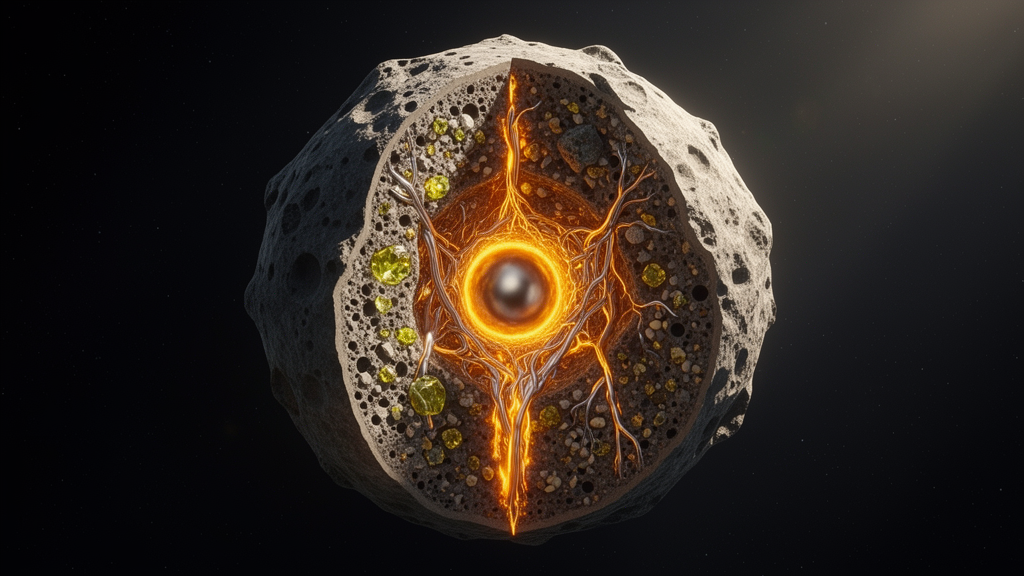
Research published in Earth, Moon, and Planets explores how core formation in early solar system planetesimals may have occurred at temperatures significantly lower than previously assumed. The study, authored by Geoffrey David Bromiley, investigates the geochemical consequences of percolation-driven segregation, a process where metallic liquids migrate through solid silicate matrices rather than separating from a fully molten magma ocean. While large planets like Earth likely formed their cores through the segregation of liquid metal from extensive silicate magma oceans, smaller bodies such as asteroids may have undergone differentiation through more localized and lower-temperature mechanisms. This distinction is critical for understanding the elemental compositions of planetary cores and mantles, as well as the meteorites that serve as physical records of these early processes.
The central finding of the research is that the immiscibility of iron-rich and iron sulfide-rich liquids is a persistent feature across all core-formation models, including those involving substantial silicate melting. The study demonstrates that the light element content of planetesimal cores, specifically silicon, oxygen, carbon, phosphorus, and sulfur, is heavily dependent on the specific conditions under which these metallic liquids segregated. Pressure and oxygen fugacity, which measures the chemical potential of oxygen in a system, emerge as dominant controls on the final composition of both cores and mantles. This suggests that the physical environment of a differentiating body is just as significant as the mechanism of segregation itself.
Percolation-driven segregation implies that metallic liquids can form interconnected networks within a solid silicate matrix, allowing them to drain toward the center of the body. For this to occur, the melt fraction must exceed a critical threshold, estimated to range from 5 to 17 volume percent for iron-sulfur liquids. Experimental studies cited in the paper indicate that high dihedral angles, which measure the angle between a melt and a solid grain, typically inhibit this network formation. However, the presence of oxygen in iron sulfide-rich liquids can significantly lower these angles, promoting percolation even at low melt fractions in more oxidized environments. This mechanism could allow a larger proportion of rocky bodies to retain sufficient heat for core formation compared to models requiring extensive silicate melting.
The study highlights a significant discrepancy between the sulfur contents of modelled parent bodies to magmatic iron meteorites and the compositions of eutectic liquids in simplified iron-nickel-sulfur systems. Modelled parent bodies contain sulfur levels ranging from 1 to 19 weight percent, which are substantially lower than the eutectic compositions observed in experiments. This ‘sulfur discrepancy’ suggests that core segregation in these bodies may have occurred at temperatures exceeding the eutectic point, possibly following substantial silicate melting. Alternatively, the missing sulfur-rich components may have been lost through degassing or remain unsampled in the meteoritic record due to the mechanical weakness of iron sulfide-rich bodies.
Experimental data reviewed in the article shows that iron sulfide-rich liquids consistently have sulfur contents between 35 and 40 weight percent, significantly exceeding those of eutectic melts. These liquids are close to ideal iron sulfide in composition, while coexisting iron-rich solids or liquids have sulfur contents below 2 weight percent. The partitioning of sulfur between these phases is not substantially modified by increasing degrees of silicate melting, reinforcing the idea that iron sulfide-rich liquids in complex systems remain consistently sulfur-rich. This immiscibility gap persists up to pressures of 6 to 8 gigapascals, which exceeds the range of conditions found in large asteroids and planetesimals.
The role of oxygen fugacity is further explored through its impact on element partitioning. Under highly reducing conditions, iron sulfide-rich liquids can incorporate nominally lithophile elements such as magnesium, manganese, and calcium. In contrast, more oxidizing conditions lead to extensive iron oxidation, which can preclude the presence of a metallic component entirely. The study notes that oxygen content in iron sulfide-rich liquids can be considerable and is controlled by iron oxide exchange between the sulfide liquid and silicate melt. This incorporation of oxygen has a significant effect on lowering sulfide-silicate mineral dihedral angles, thereby increasing the likelihood of percolation.
Trace element partitioning between iron sulfide-rich and iron-rich phases provides additional constraints on core formation processes. Chalcophile elements, such as copper, zinc, and lead, tend to partition into iron sulfide-rich liquids, while siderophile elements partition into iron-rich phases. However, the study finds that current models for solid-liquid metal partitioning, such as the Chabot and Jones method, are not specifically designed for sulfur-rich systems and may overestimate the extent of element partitioning. Direct experimental data suggests that partition coefficients are often closer to unity than modelled values, indicating that the method of segregation and the conditions of melting play a crucial role in determining trace element distributions.
The interaction between core-forming liquids and crystalline silicate phases, such as olivine and orthopyroxene, also modifies the geochemical signature of differentiating bodies. Iron-nickel exchange between olivine and sulfide is strongly dependent on oxygen fugacity, with nickel being highly incompatible in olivine under reducing conditions. The stability of minor phases like spinel and phosphates can influence the composition of core-forming melts, particularly for elements like chromium, manganese, and phosphorus. The breakdown of these phases during low-degree silicate melting can lead to marked increases in metallic phosphorus content, providing a potential indicator of the extent of silicate melting prior to core segregation.
Thermal models of planetesimal evolution suggest that rapid internal radiogenic heating by aluminum-26 and iron-60 was the primary driver of differentiation. These models predict a significant time lag between the onset of metallic melting and the formation of a silicate magma mush. The study argues that percolation-driven core formation could have contributed to differentiation in bodies that later underwent large-scale silicate melting, potentially creating a two-phase process of core formation. This would have important implications for the thermal and geochemical evolution of rocky bodies, as well as the composition of terrestrial planets to which these planetesimals accreted.
Despite the insights provided, the study acknowledges several limitations and areas of uncertainty. The light element composition of immiscible liquids remains poorly constrained, and melt relations for iron-rich components are not well understood in many systems. Current parameterizations of metallic solid-liquid trace element partitioning are limited by their reliance on ambient pressure data and their inability to account for the effects of oxygen on element partitioning. Future experimental studies are required to refine these models and better constrain the compositions of silicate, iron sulfide-rich, and iron-rich liquids under realistic core-forming conditions. Understanding these processes is essential for interpreting the geochemical records of meteorites and for exploring planetary evolution in extrasolar systems.
The meteoritic record provides direct evidence for the timing and rapidity of early differentiation. Model radioisotope ages for magmatic iron meteorites indicate that segregation of metallic liquids occurred within approximately one million years after the formation of calcium-aluminum-rich inclusions, the first solid materials in the solar system. This timeframe is earlier than the ages of many chondrites, implying that core formation was a rapid process concurrent with accretion. Thermal models of planetesimal evolution support this timeline by identifying the decay of short-lived radioisotopes, primarily aluminum-26 and to a lesser extent iron-60, as the primary heat source. These models predict that rapid accretion and fast growth allowed smaller bodies to retain sufficient heat to initiate melting, while larger or later-forming bodies experienced different thermal histories. The efficiency of this heating process is size-dependent, with larger planetesimals reaching higher maximum temperatures and undergoing more extensive internal melting.
Experimental investigations into the physical mechanics of percolation reveal significant variability in the efficiency of metallic liquid segregation. Darcy flow calculations suggest that once fully interconnected melt networks form, dense core-forming liquids can segregate rapidly, potentially completing core formation in a 100-kilometer radius body in less than one million years. However, high-pressure centrifuge experiments and deformation studies present conflicting results, with some data suggesting that segregation velocities are an order of magnitude too slow to account for core formation within the required timescales. This discrepancy highlights the difficulty of extrapolating laboratory measurements to natural planetary systems, where kinetic factors in olivine-rich metallic liquid systems are sluggish. The development of melt networks is further complicated by non-hydrostatic conditions and concurrent deformation of the silicate matrix, which can align melt pockets and facilitate network formation below critical threshold values, although the applicability of high-strain experimental results to natural low-strain environments remains uncertain.
The composition of low-fraction silicate melts in chondritic systems differs markedly from the fully molten silicate liquids typically used in partitioning models. Recent experimental data indicates that these early melts are broadly andesitic or dacitic in composition and are enriched in alkali elements. This compositional distinction is critical because alkali elements act as network modifying cations, altering melt structure and potentially enhancing the incorporation of various species into silicate melts. Furthermore, the presence of alkalis can increase the oxygen content of sulfide liquids, which in turn influences the partitioning of other elements. Existing parameterizations of silicate-sulfide partitioning, such as those developed by Steenstra et al. and Boujibar et al., are based on datasets that often lack the alkali richness of actual chondritic partial melts. While these models provide reasonable estimates for many elements, their applicability to very low melt fractions is limited by these compositional differences, suggesting that current predictions for trace element behavior in early differentiating bodies may require refinement.
Minor crystalline phases within the silicate portion of planetesimals exert a disproportionate influence on the geochemical signature of core-forming liquids. Phosphates are rapidly consumed during low-degree silicate melting, leading to marked increases in the phosphorus content of metallic melts. The stability of spinel-group minerals, which can persist up to moderate silicate melt fractions, acts as a reservoir for chromium and manganese. Under highly reducing conditions, olivine may destabilize into pyroxene-dominated assemblages, further modifying the mineralogical context in which metallic liquids percolate. The interaction between percolating liquids and these solid phases is generally not kinetically limited, as diffusion rates for elements like iron and magnesium in olivine are fast enough to allow rapid re-equilibration. However, diffusion of trivalent cations like chromium in spinel can be sluggish at the lowest temperatures of core segregation, potentially masking some signatures of matrix-liquid interaction. These phase-specific interactions provide potential indicators for distinguishing between core formation that occurred before and after the onset of significant silicate melting.
Subject of Research: Geochemical implications of low-temperature core formation mechanisms in early solar system planetesimals
Article Title: The Geochemical Legacy of Low-Temperature, Percolation-Driven Core Formation in Planetesimals
Article References: Bromiley, G. D. (2023). The Geochemical Legacy of Low-Temperature, Percolation-Driven Core Formation in Planetesimals. Earth, Moon, and Planets, 127(2), Article 4. https://doi.org/10.1007/s11038-023-09552-2
Image Credits: AI Generated
DOI: 10.1007/s11038-023-09552-2
Keywords: planetesimals, core formation, geochemistry, percolation, solar system, differentiation, meteorites, oxygen fugacity, iron sulfide, magma ocean, Geochemical, Legacy
Cite Scienmag News
Grant Pearson. (November 11, 2026). Low-Temperature Core Formation Shapes Planetesimal Geochemistry. Scienmag. https://scienmag.com/low-temperature-core-formation-shapes-planetesimal-geochemistry/
Grant Pearson. "Low-Temperature Core Formation Shapes Planetesimal Geochemistry." Scienmag, 11 November 2026, https://scienmag.com/low-temperature-core-formation-shapes-planetesimal-geochemistry/. Accessed 15 November 2026.
Grant Pearson. "Low-Temperature Core Formation Shapes Planetesimal Geochemistry." Scienmag. November 11, 2026. https://scienmag.com/low-temperature-core-formation-shapes-planetesimal-geochemistry/




