


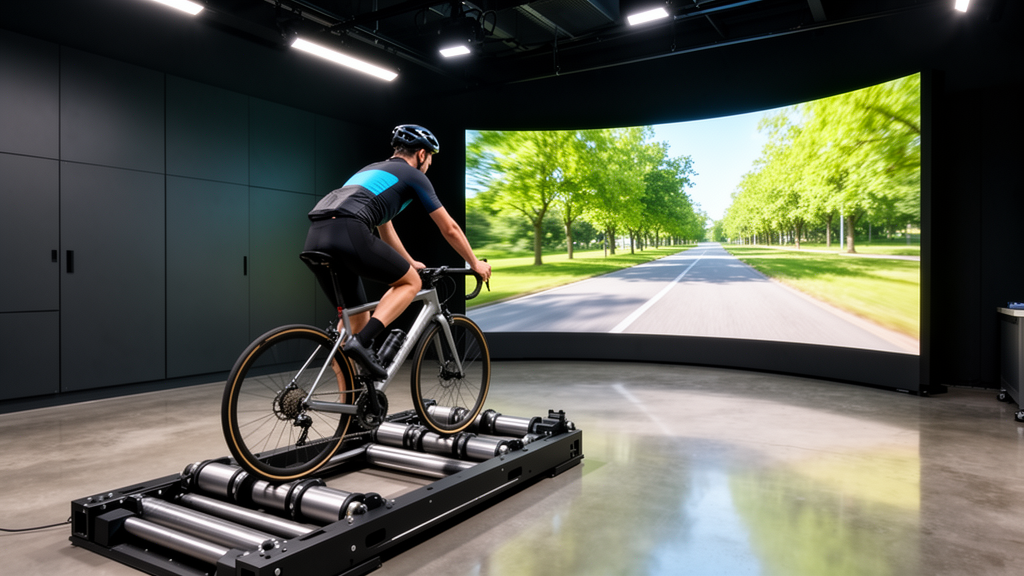
The study, published in the European Transport Research Review, utilized a convergent parallel mixed methods design to integrate quantitative and qualitative data. The primary objective was to explore the lived experience of cyclists in various situations involving interactions with other road users and to determine how these experiences contribute to their preferences for specific cycling environments.
The experimental setup involved a virtual cycling environment developed by the SimTeam at the PICS-L laboratory. Participants cycled through a 2.5-kilometer route in an urban area featuring diverse road configurations, heavy motorized traffic, pedestrian activity, and stationary vehicles. The route was divided into four distinct evaluation situations, each ranging from 130 to 470 meters in length. These situations were designed to test different levels of interaction with other road users, including cycling between vehicles, cycling with visual freedom, navigating obstacles on a segregated path, and riding on an unsegregated shared path.
A total of 33 participants were recruited for the study, all of whom were research staff from institutions within the Cité Descartes in Marne-la-Vallée, France. The participants had a mean age of 28.4 years, with 67% being male. Cycling frequency varied, with 50% of participants cycling less than once per month, and 61% had no prior experience with bicycle simulator studies. Of the 33 participants, 22 agreed to have their eye movements recorded using Tobii Pro Glasses 2, and eight of those participants further agreed to participate in explicitating self-confrontation interviews. The interviews were conducted in French and lasted between 20 and 45 minutes, allowing participants to reflect on their experiences while reviewing video footage of their rides.
To measure the emotional dimensions of the cycling experience, the researchers used the Self-Assessment Manikin (SAM), a tool that assesses pleasure, arousal, and dominance on a nine-point scale. This method was chosen to avoid the limitations of verbal emotion measures, which can be influenced by cultural backgrounds and individual interpretations of emotion-related terms. Participants rated their levels of happiness, excitement, and sense of control for each of the four situations. Additionally, they rated their willingness to cycle in each situation on a five-point scale, ranging from very unlikely to very likely. The eye-tracking data provided objective measures of visual attention, specifically fixation duration on various areas of interest such as the cycle path, moving vehicles, pedestrians, and stationary objects.
The statistical analysis revealed significant differences in pleasure levels across the four situations, with a small overall effect size. Cycling in situations S2 and S4 was rated as more pleasant than in S1, with these differences showing large effect sizes. Situation S4 was also rated as more pleasant than S3. Arousal levels did not differ significantly across situations, suggesting that participants remained relatively calm throughout the experiment. However, dominance levels showed a significant difference with a small effect size, although post-hoc tests did not identify specific pairwise differences. The qualitative data from the interviews confirmed the quantitative findings regarding pleasure, indicating that participants felt more at ease in situations where risks were lower and the environment was more manageable.
Behavioral responses varied significantly across the situations, as evidenced by changes in cycling speed. The average speed was lowest in situation S1, where participants cycled between vehicles, and highest in situations S2 and S4. In S1, participants reported feeling stuck and intimidated by the proximity of moving cars and trucks, which led to reduced pleasure and increased vigilance. They often kept a distance from vehicles and slowed down when pedestrians were present. In contrast, situation S2 offered better visual freedom due to the presence of a sidewalk, which participants found reassuring. Situation S3 involved a segregated cycle path with obstacles such as a trash bin and a pedestrian, which caused some unpleasantness and required additional actions like ringing a bell or overtaking. Situation S4, an unsegregated shared path, was perceived as pleasant with fewer risks, as participants only had to interact with pedestrians and could anticipate their movements.
Eye movement data indicated that the cycle path and shared path consistently received the most sustained visual attention across all situations. In S1, pedestrians and stationary vehicles also attracted high attention, likely due to the need to monitor potential conflicts. In S2, moving vehicles received the second highest attention, while pedestrians on the sidewalk received less focus. In S3, the trash bin and pedestrians on the cycle path drew significant attention, with the trash bin receiving a higher median normalized fixation duration than the cycle path itself. In S4, pedestrians on the shared path received the second highest attention after the path itself. These findings suggest that cyclists prioritize monitoring their immediate path and potential obstacles to maintain safe and efficient cycling performance.
Preference ratings showed that situation S1 was the least preferable, with large effect sizes distinguishing it from the other situations. No significant differences were found between situations S2, S3, and S4, indicating that participants had an equal preference for these environments. A negative association was found between preference and arousal, indicating that preference increased as participants experienced calmness.
The findings suggest that the quality and predictability of interactions with road users are crucial factors in determining cycling preference. Even when streetscape designs were comparable, differences in visibility and the predictability of pedestrian behavior influenced preference ratings. The strong correlation between pleasure and preference underscores the need to create pleasant cycling environments with minimal risk of interaction with other road users.
Several limitations of the study should be noted. The ecological validity of the bicycle simulator may be limited, as some participants were aware they were in a virtual environment and perceived reduced risk compared to real-world cycling. This could have affected the arousal and dominance levels, which may be lower in the simulator than in actual urban settings. Additionally, the study could not isolate the specific factors driving the observed effects, as multiple variables differed across the four situations. The sample size was small and homogeneous, consisting mostly of young, male, infrequent cyclists from a single campus, which may limit the generalizability of the findings. Future research should employ more controlled designs and larger, more diverse samples to better understand the complex dynamics of the cycling experience.
The study was conducted between September and December 2024, following a protocol approved by the Gustave Eiffel University Ethics Committee. Participants were not informed of the study’s specific purpose before the experiment began; instead, they were told they would cycle from an unspecified starting point to reach a train station. The virtual environment was developed by the SimTeam at the PICS-L laboratory, with specific adjustments made for this study, such as adding pedestrians and modifying the built environment. The simulator recorded participants’ movements every 15 milliseconds, capturing their positions and interactions with all components of the virtual environment.
Eye movement analysis involved manually segmenting the recordings into parts corresponding to the four situations. Eight areas of interest were defined, including the cycle path, exterior, moving vehicles, pedestrians, shared path, sidewalk, stationary vehicles, and trash bins. Fixation durations were normalized by the time each area was visible in the analyzed situation to account for differences in visibility. The qualitative analysis of the interviews was conducted collaboratively by two authors using the proofread English transcripts. The analysis followed the procedure described by Braun and Clarke, involving an iterative process of coding statements relevant to emotions, actions, and preferences. This approach allowed the researchers to capture the overall experience, including perceptions and cognitive processes, which complemented the quantitative data.
The use of a convergent parallel mixed methods design allowed for the integration of quantitative and qualitative results to generate metainferences. These metainferences indicated whether the datasets confirmed, contradicted, or expanded upon each other. For instance, while quantitative data showed low arousal in all situations, interviews revealed moments of both low and high arousal, expanding the understanding of emotional responses. Similarly, the dominance level was expanded by qualitative data suggesting less control in S1, despite inconclusive post-hoc tests. This integration provided a more comprehensive understanding of the cycling experience than either method alone could offer. The study’s focus on the PAD model, which includes pleasure, arousal, and dominance, addressed a gap in cycling research where comprehensive examinations of emotions were lacking. By incorporating eye movement data, the study also provided insights into how visual attention to specific elements of the built environment influences cyclists’ perceptions and actions.
Subject of Research: Cycling experience and preference across various situations: a convergent parallel mixed methods study
Article Title: Cycling experience and preference across various situations: a convergent parallel mixed methods study
Article References: Sitohang, I., Adelé, S., Zoli, A., Belaroussi, R., & Imine, H. (2026). Cycling experience and preference across various situations: a convergent parallel mixed methods study. European Transport Research Review, 18(1), Article 64. https://doi.org/10.1186/s12544-026-00825-1
Image Credits: AI Generated
DOI: 10.1186/s12544-026-00825-1
Keywords: Cycling, experience, preference, across, various, situations, convergent, parallel, mixed, methods, scientific research
Cite Scienmag News
Denise Maddox. (November 10, 2026). Simulator Study Links Cycling Pleasure to Preference. Scienmag. https://scienmag.com/simulator-study-links-cycling-pleasure-to-preference/
Denise Maddox. "Simulator Study Links Cycling Pleasure to Preference." Scienmag, 10 November 2026, https://scienmag.com/simulator-study-links-cycling-pleasure-to-preference/. Accessed 10 November 2026.
Denise Maddox. "Simulator Study Links Cycling Pleasure to Preference." Scienmag. November 10, 2026. https://scienmag.com/simulator-study-links-cycling-pleasure-to-preference/




