


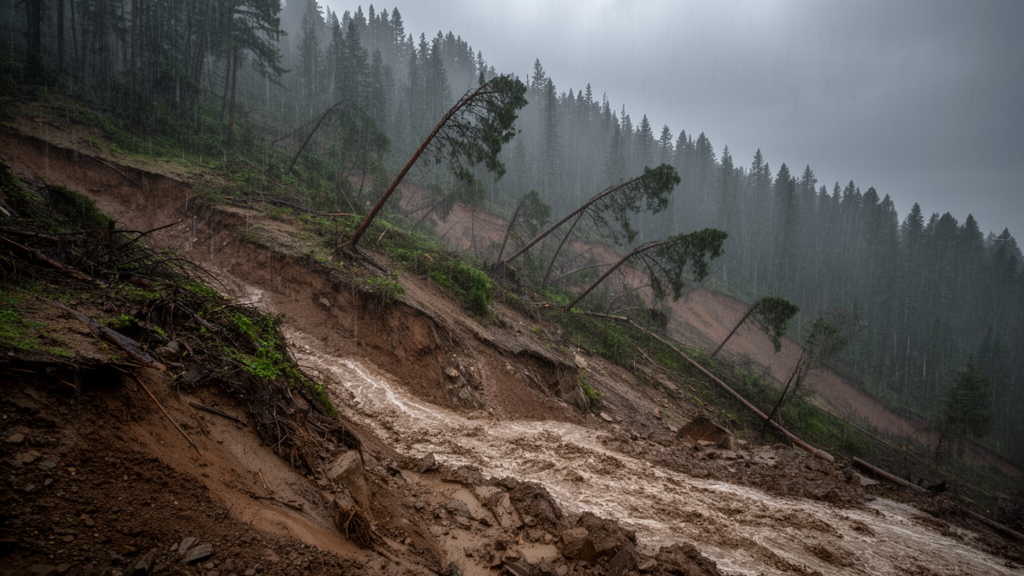
Rainfall-induced landslides present a persistent threat to infrastructure safety and human activities, yet traditional deterministic approaches and many existing probabilistic methods struggle to evaluate the cumulative risk induced by multiple rainfall events over a specified time horizon. To address this limitation, a research team led by Shunchuan Wu, Beibei Sun, Longqiang Han, Qiang Zhu, and Chaoqun Chu has proposed a new probabilistic framework based on the average maximum failure probability (AMFP). This study, published in the journal Natural Hazards, integrates rainfall occurrence uncertainty, geotechnical parameter uncertainty, and unsaturated seepage-stability coupling to quantify the extreme failure risk of unsaturated slopes within a given exposure period. The work represents a shift from single-event assessments to an exposure-period-oriented approach that accounts for the sequential nature of stochastic rainfall events.
The core of the proposed framework is the AMFP metric, which quantifies slope failure risk over a specified exposure period under multiple stochastic rainfall events. Unlike conventional methods that may focus on a single rainfall event or a static condition, this approach establishes an exposure-period-based extreme risk framework that links sequential rainfall events with time-dependent slope reliability assessment. This methodology is particularly relevant for long-term risk assessment where the timing and intensity of future rainfall events are uncertain.
To model the stochastic nature of rainfall, the study utilizes a Frank Copula based on historical rainfall records. This statistical tool allows for the modeling of the dependence between rainfall duration and intensity, including the characteristics of extreme rainfall events. The framework then couples these stochastic rainfall inputs with unsaturated seepage-stability simulations.
A significant challenge in such probabilistic assessments is the computational burden associated with large-scale Monte Carlo simulations, which are necessary to account for the uncertainty in geotechnical parameters and rainfall variables. To overcome this, the study develops a surrogate-assisted Monte Carlo framework. Several surrogate models are comparatively evaluated to approximate the complex seepage-stability simulations efficiently. These models include Support Vector Regression (SVR), Gaussian Process Regression (GPR), Extreme Learning Machine (ELM), and Random Forest (RF). The optimal surrogate model is selected based on its performance in efficiently estimating the AMFP, thereby reducing the computational cost while maintaining accuracy in the risk quantification.
The proposed framework is applied to a homogeneous slope located in Baotou, China, to demonstrate its practical utility. The application indicates that the AMFP increases monotonically with exposure duration, rising from 2.52% for a 0.5-year exposure period to 3.08% for a 5-year exposure period. This trend demonstrates the cumulative amplification of failure risk under stochastic rainfall, highlighting that longer exposure periods lead to higher probabilities of failure. For a specific one-year exposure period involving 34 rainfall events, the estimated AMFP is 2.69%, corresponding to a reliability index of 1.927. These numerical results provide a concrete basis for understanding how risk accumulates over time in a real-world geological context.
Sensitivity analysis conducted within the framework reveals the relative importance of different input parameters on the failure probability. The analysis shows that rainfall duration and intensity have comparable influences on the failure probability, indicating that both aspects of the rainfall event are critical in driving slope instability. However, soil strength parameters remain the dominant controlling factors, underscoring the fundamental role of geotechnical properties in determining slope stability. This finding suggests that while rainfall variability is a key driver of risk, the inherent strength of the soil material exerts a stronger influence on the ultimate probability of failure.
The study provides a robust exposure-period-oriented probabilistic approach for long-term rainfall-induced slope risk assessment. By integrating stochastic rainfall modeling with efficient surrogate-assisted simulations, the framework offers a viable tool for risk-informed engineering decision-making. The methodological contributions, including the use of Frank Copula for rainfall dependence and the comparative evaluation of surrogate models, offer a comprehensive toolkit for addressing the complexities of unsaturated slope stability under uncertain environmental conditions.
Limitations of the study include its application to a homogeneous slope in a specific geographic location, which may not fully capture the heterogeneity and complexity of all natural slopes. Furthermore, the reliance on historical rainfall records for modeling stochastic processes assumes that future rainfall patterns will follow similar statistical dependencies. Despite these constraints, the framework provides a significant advancement in the probabilistic assessment of slope stability, moving beyond deterministic single-event analyses to a more holistic, time-dependent risk evaluation. The results emphasize the importance of considering rainfall occurrence uncertainty in slope risk assessment, offering a clearer picture of the cumulative threats posed by stochastic rainfall events.
Subject of Research: Probabilistic risk assessment of unsaturated slopes under stochastic rainfall
Article Title: AMFP-based probabilistic risk assessment of unsaturated slopes under stochastic rainfall
Article References: Wu, S., Sun, B., Han, L., Zhu, Q., & Chu, C. (2026). AMFP-based probabilistic risk assessment of unsaturated slopes under stochastic rainfall. Natural Hazards, 122(23), Article 709. https://doi.org/10.1007/s11069-026-08488-w
Image Credits: AI Generated
DOI: 10.1007/s11069-026-08488-w
Keywords: slope stability, probabilistic risk assessment, stochastic rainfall, AMFP, unsaturated slopes, Monte Carlo simulation, surrogate models, Frank Copula, FLAC3D, landslide risk, AMFP-based, probabilistic
Cite Scienmag News
Violet Maxwell. (November 10, 2026). Probabilistic Framework Quantifies Slope Failure Risk Under Stochastic Rainfall. Scienmag. https://scienmag.com/probabilistic-framework-quantifies-slope-failure-risk-under-stochastic-rainfall/
Violet Maxwell. "Probabilistic Framework Quantifies Slope Failure Risk Under Stochastic Rainfall." Scienmag, 10 November 2026, https://scienmag.com/probabilistic-framework-quantifies-slope-failure-risk-under-stochastic-rainfall/. Accessed 10 November 2026.
Violet Maxwell. "Probabilistic Framework Quantifies Slope Failure Risk Under Stochastic Rainfall." Scienmag. November 10, 2026. https://scienmag.com/probabilistic-framework-quantifies-slope-failure-risk-under-stochastic-rainfall/




