


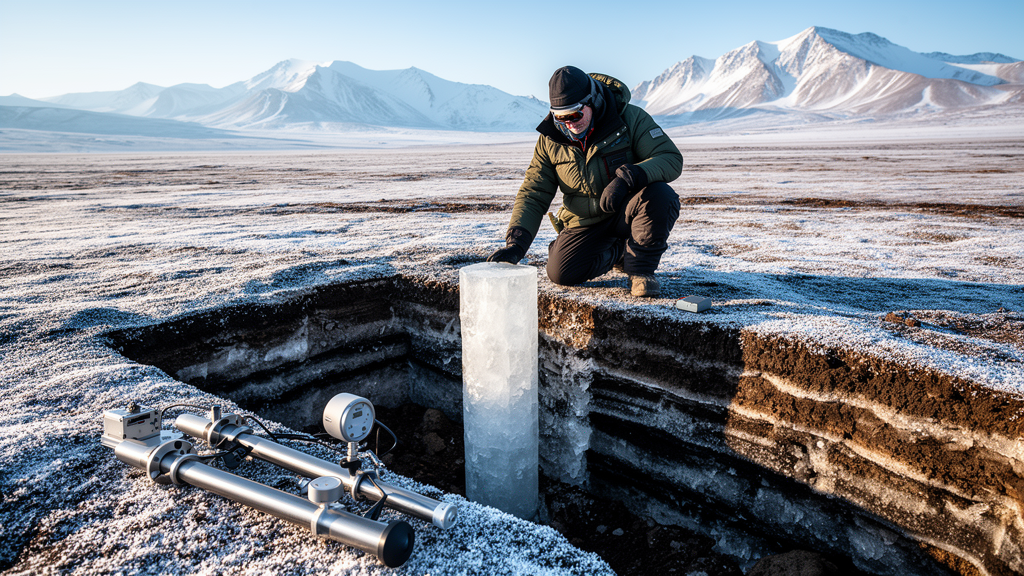
Researchers from China have developed and compared two distinct modeling approaches to estimate the maximum freezing depth of seasonally frozen ground across the northern to southwestern margins of the Qinghai-Tibetan Plateau. Published in Geoscience Letters, the study utilizes a machine learning model and an empirical model based on the improved Stefan formula to analyze 50 years of data from 1975 to 2024. The primary objective was to evaluate the rationality and accuracy of these predictions in identifying the maximum freezing depth, a critical parameter for understanding regional environmental changes and agricultural stability.
The Qinghai-Tibetan Plateau is a region of significant climatic sensitivity, where the temperature warming rate is approximately twice the global average. This rapid warming complicates the behavior of seasonally frozen ground, which is highly sensitive to shifts in air temperature, soil moisture, and snow cover. Changes in freezing depth disturb the soil environment, directly affecting agricultural production, ecological stability, and regional sustainable development. Due to the sparse distribution of observation stations in the plateau, there has been a lack of comprehensive information regarding freezing depth under the background of climate warming and humidification.
To address this gap, the study employed a machine learning model, specifically the support vector machine regression algorithm, and an empirical model derived from the improved Stefan formula. The machine learning approach utilized seven key predictors: freezing index, solar radiation, thawing index, precipitation, snow depth, bulk density, and digital elevation model data. In contrast, the empirical model relied primarily on the air temperature freezing index and static geographic coordinates, including latitude, longitude, and elevation. This distinction in input variables is crucial for understanding the performance differences observed in the results.
The researchers collected annual maximum freezing depth observations from 190 meteorological monitoring stations situated within the seasonally frozen ground area of the plateau. Data from 150 stations were used to train the models and establish empirical formulas, while the remaining 40 sites were reserved for independent validation. Additionally, a temporal validation strategy was adopted to assess the machine learning model’s ability to generalize to unseen climate conditions. Data from 1975 to 2000 were used for training, while the period from 2001 to 2024 served as a test set to evaluate the model’s performance under evolving climate conditions.
When comparing the statistical indicators of the two models, the machine learning model demonstrated superior predictive accuracy. The coefficient of determination for the machine learning model was 0.9817, compared to 0.9447 for the empirical model. Similarly, the mean absolute error and mean absolute percentage error were lower for the machine learning model, indicating a closer alignment with observed values.
However, the study emphasizes that this performance advantage stems primarily from the machine learning model’s access to dynamic environmental variables, such as snow depth and precipitation, which are absent in the empirical model. Snow cover and soil moisture are first-order physical controls on freeze-thaw processes, and any model that includes them will inevitably outperform one that does not. The authors caution that the comparison does not isolate algorithmic superiority; rather, it highlights the impact of feature engineering on prediction accuracy. Under a fair baseline where both models use identical predictors, the performance gap would likely diminish substantially.
Regional performance comparisons revealed distinct spatial patterns in the predicted freezing depth lines. The empirical model generally produced more extensive distribution areas for each freezing depth line. In contrast, the machine learning model predicted depth lines that were closer to the periphery of the permafrost area and extended toward the southwest. These lines were parallel to each other, with greater depth values observed closer to the boundary of the permafrost area. In the southeastern and southern edges of the permafrost region, the empirical model’s predictions deviated more from the permafrost boundaries and occupied a wider area than those of the machine learning model.
Despite the overall higher accuracy of the machine learning model, the empirical model demonstrated superior performance in specific areas characterized by discontinuous and island permafrost. In the southwestern part of the plateau, the distribution of freezing depth lines at the edge of the discontinuous permafrost zone was better predicted by the empirical model. At the boundary of the island permafrost area, the empirical model’s predictions of 120 cm freezing depth were more accurate than those of the machine learning model. This suggests that the empirical model’s computational efficiency and adaptability to varying terrain conditions offer distinct advantages in these complex environments.
Temporal extrapolation tests further evaluated the machine learning model’s capability to predict freezing depth under unseen warming conditions. The model achieved good agreement with observed values at three representative stations during the 2001 to 2024 test period. The coefficient of determination values exceeded 0.82 at all three sites, indicating that the model captures a substantial portion of interannual variability even under climate conditions that differ from its training period. Nevertheless, the temporal extrapolation results were lower than the spatial validation results, suggesting that the model is more adept at spatial interpolation than at predicting future freezing depth under evolving climate conditions.
The study acknowledges several limitations, including the spatial resolution of the soil data, which makes it difficult to capture small-scale spatial heterogeneity in areas with interleaved farmlands and forests. The model does not yet account for the interaction mechanisms between permafrost and seasonally frozen ground. In the future, the performance of the model can be enhanced by integrating multi-source satellite data and improving soil heat conduction parameterization schemes. Additionally, the resampling of digital elevation model data to a 0.1-degree grid smooths over slope aspect and other micro-topographic variations, which can influence freezing depth in complex terrain.
In practical engineering applications, the prediction accuracy obtained by the empirical model for freezing depth parameters was within the reasonable range of engineering design requirements. The annual maximum freezing depth generated by the empirical model effectively reflected the conditions in the eastern plateau region, and the prediction process was simpler and faster than using machine learning methods. For data-sparse regions or when simplicity and interpretability are prioritized, the empirical model remains a viable alternative, especially given that its input requirements are limited to air temperature and geographic coordinates.
The findings of this study provide critical data support for mitigating engineering risks associated with frost heave effects and for optimizing agricultural irrigation design in response to changes in the regional hydrological cycle. Freezing depth directly influences foundation stability, and attention needs to be paid to the engineering risks brought about by changes in frost heave effects. On the other hand, changes in freezing depth may alter the regional hydrological cycle, impacting agricultural irrigation and flood control. By providing more accurate freezing depth mapping through the appropriate selection of these models, the study offers a scientific basis for regional agroecological conservation and climate change adaptation strategies.
Subject of Research: Comparison of the seasonal freezing depth from the northern to southwestern surrounding regions of the Qinghai-Tibetan plateau over the past 50 years (1975–2024)
Article Title: Comparison of the seasonal freezing depth from the northern to southwestern surrounding regions of the Qinghai-Tibetan plateau over the past 50 years (1975–2024)
Article References: Wang, S., Tuerhong, A., Peng, C., & Ning, Z. (2026). Comparison of the seasonal freezing depth from the northern to southwestern surrounding regions of the Qinghai-Tibetan plateau over the past 50 years (1975–2024). Geoscience Letters, 13(1), Article 47. https://doi.org/10.1186/s40562-026-00499-6
Image Credits: AI Generated
DOI: 10.1186/s40562-026-00499-6
Keywords: Comparison, seasonal, freezing, depth, northern, southwestern, surrounding, regions, Qinghai-Tibetan, plateau, over, past
Cite Scienmag News
Teresa Odom. (November 10, 2026). Machine Learning Outperforms Empirical Models in Predicting Plateau Freezing Depth. Scienmag. https://scienmag.com/machine-learning-outperforms-empirical-models-in-predicting-plateau-freezing-depth/
Teresa Odom. "Machine Learning Outperforms Empirical Models in Predicting Plateau Freezing Depth." Scienmag, 10 November 2026, https://scienmag.com/machine-learning-outperforms-empirical-models-in-predicting-plateau-freezing-depth/. Accessed 10 November 2026.
Teresa Odom. "Machine Learning Outperforms Empirical Models in Predicting Plateau Freezing Depth." Scienmag. November 10, 2026. https://scienmag.com/machine-learning-outperforms-empirical-models-in-predicting-plateau-freezing-depth/




