


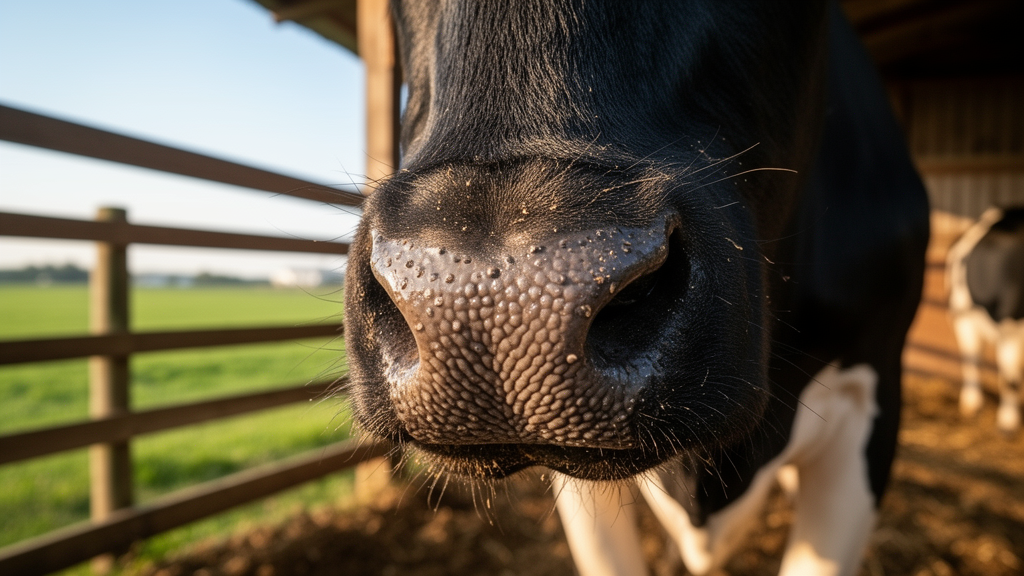
Biometric cattle identification using deep learning achieves high accuracy in controlled benchmarks but experiences substantial accuracy and latency penalties when tested on real-world farm imagery. Researchers Ahlam G. Khalifa and Ahmed S. Abdultawab developed an offline deep learning architecture combining blur rejection, YOLOv8 detection, EfficientNetV2-S feature extraction, and ArcFace angular margin loss to recognize cattle from distinctive muzzle patterns. When evaluated on a standardized benchmark dataset, the system achieved 96.2 percent identification accuracy, demonstrating that bovine muzzle patterns can function as biometric identifiers analogous to human fingerprints. This drop highlights a persistent domain gap between curated laboratory datasets and operational farm conditions, showing that practical agricultural deployment requires overcoming substantial environmental and computational hurdles.
The motivation for contactless biometric identification stems from the practical, economic, and welfare challenges accompanying conventional livestock tracking techniques. While these legacy tools have long underpinned international trade verification, meat product traceability, and disease containment efforts during outbreaks of bovine spongiform encephalopathy and foot-and-mouth disease, they remain vulnerable to loss, tampering, and physical degradation. Furthermore, invasive procedures like ear notching impose acute pain and distress on livestock, raising serious animal welfare concerns. In commercial supply chains and livestock insurance programs, lost tags or fraudulent ear-tag substitutions compromise legal ownership verification and introduce systematic identification errors into long-term agricultural trials.
To build a robust and autonomous recognition workflow, the authors devised a multi-stage image processing pipeline that evaluates image quality before feature extraction takes place. Incoming muzzle photographs are initially routed through an automated blur detection filter that calculates the variance of the Laplacian operator across the image array. By applying an empirical blur threshold set at 4.0, the system automatically detects and discards degraded, motion-blurred, or unfocused frames before downstream computation, preventing compromised imagery from degrading recognition precision. Frames that satisfy the blur threshold advance to the localization stage, where the YOLOv8 object detection model identifies, bounds, and crops the bovine muzzle region out of the broader photographic scene.
After spatial localization and contrast normalization, the isolated muzzle patch enters a deep feature extraction backbone constructed around the EfficientNetV2-S convolutional neural network. Selected for its computational efficiency, the EfficientNetV2-S backbone was initialized with ImageNet pretrained weights and configured to receive 224×224 pixel inputs normalized to standard distribution statistics. The architecture projects high-level convolutional activations through a linear layer from 1,280 dimensions down into a compact 512-dimensional embedding vector, stabilized with one-dimensional batch normalization without dropout layers. Rather than training the network with cross-entropy loss, the investigators incorporated ArcFace, an additive angular margin loss function, to enforce metric learning on a hyperspherical manifold. Configured with an angular margin penalty of 0.50 radians and a hypersphere feature scale of 30.0, ArcFace simultaneously compresses intra-class representations and expands inter-class separation distances. This geometric penalty ensures that embedding vectors from the same cow congregate closely while representations belonging to distinct animals remain widely separated.
The model was evaluated across two contrasting photographic sources to quantify its capacity to generalize between controlled and uncontrolled operational environments. The primary controlled benchmark comprised the public Kaggle Cow Muzzle Dataset, containing 1,300 images collected from 160 cattle with an average of eight images per animal, standardized at 640×640 pixels in three-channel color. The researchers partitioned this benchmark into an enrollment gallery of 820 reference images, a validation split of 320 images, and a distinct test set of 160 images. Using a commercial smartphone featuring a 64-megapixel sensor, the team captured 400 frontal macro images from 30 cows and 22 domestic water buffaloes at a fixed distance of 15 to 20 centimeters during natural daylight across two discrete sessions separated by one week. The field images contained natural variations in moisture, head orientation, and surface dirt, with 348 session-one images forming the gallery and 52 session-two images serving as test probes.
Matching query muzzles against enrolled gallery templates relies on L2-normalized cosine similarity scoring coupled with a secondary geometric rejection constraint. When an unknown query image traverses the inference pipeline, its generated 512-dimensional embedding is compared against stored identity templates to produce a cosine similarity percentage. A candidate match requires a base similarity score meeting or exceeding the decision threshold of 0.70. However, because unrelated animals can display coincidentally elevated similarity metrics, the architecture enforces an angular separation rule requiring a difference of at least 0.03 radians (approximately 1.72 degrees) between the top-ranked match and the second-ranked candidate. If a query yields a similarity score above 0.70 but exhibits an angular separation tighter than 0.03 radians, the model triggers an automated rejection. Operating point analyses on the validation partition established an Equal Error Rate of 23.95 percent, an area under the receiver operating characteristic curve of 0.8373, and defined a high-security threshold of 0.8708 where false match rates remain at or below one percent.
Empirical testing revealed substantial performance divergence between curated benchmark imagery and unconstrained field photographs. On the Kaggle test set, the deep learning pipeline achieved a 96.2 percent identification accuracy, a recall rate of 96.25 percent, a precision score of 99.35 percent, and an F1-score of 97.77 percent, accompanied by a false rejection rate of only 3.75 percent. Conversely, when tested against unedited smartphone images from smallholder herds, system accuracy dropped by an absolute 15.44 percentage points to 80.76 percent. Under field testing, the model recorded an 84 percent recall rate, a precision of 95.45 percent, an F1-score of 89.58 percent, and a false rejection rate of 16 percent. While mean cosine similarity remained relatively stable—averaging 88.44 percent on Kaggle and 86.55 percent in the field—computational latency diverged drastically. Stage profiling revealed that while Kaggle feature extraction averaged 106.53 milliseconds, field frames required 2,322.55 milliseconds, driven by larger image resolutions expanding YOLOv8 detection times from roughly 70 milliseconds up to 1,800 milliseconds.
Beyond verifying known animals in a closed herd registry, the research team evaluated the model’s capacity to handle open-set recognition tasks involving unregistered animals. In open-set deployment, the biometric system must reliably detect when a presented animal does not belong to any enrolled gallery identity, preventing foreign livestock from receiving fraudulent authorization. Testing against unregistered cattle demonstrated a positive rejection rate of 97.5 percent alongside an incorrect acceptance rate of 2.5 percent, confirming that combining ArcFace angular margins with secondary rejection thresholds effectively repels impostor probes. The entire computational workflow was deployed and benchmarked on a Windows 11 machine powered by an 11th Generation Intel Core i9-11950H central processor, leveraging ONNX Runtime version 1.23.2 under opset 14. This implementation executed blur auditing, object detection, deep feature extraction, and template comparisons in an entirely offline environment, demonstrating that automated muzzle biometrics can run locally on standalone farm hardware without relying on cloud infrastructure or persistent internet connectivity.
Despite its promise as an animal-friendly identification prototype, the authors emphasize that the system currently falls short of target industrial readiness thresholds. The field evaluation revealed vulnerability to resolution mismatches, where uncompressed 768×1024 smartphone frames imposed severe computational burdens on the detection network compared to the standardized 640×640 benchmark. Furthermore, the small-scale field trial did not assess long-term biometric stability across multiple years, seasonal coat changes, off-angle animal movement, extreme lighting contrasts, or diverse cattle breeds and housing environments. Closing this persistent domain gap will require extensive data augmentation, perspective rectification routines, lightweight model quantization for edge deployment, and expanded multi-breed training sets before non-invasive muzzle biometrics can reliably supplant conventional ear tags in commercial livestock operations.
Subject of Research: Offline deep learning biometric identification of cattle using muzzle patterns
Article Title: An offline deep learning model for bovine muzzle identification using the variance of the laplacian, YOLOv8, EfficientNetV2-S, and ArcFace
Article References: Khalifa, A. G., & Abdultawab, A. S. (2026). An offline deep learning model for bovine muzzle identification using the variance of the laplacian, YOLOv8, EfficientNetV2-S, and ArcFace. BMC Veterinary Research, 22(1), Article 622. https://doi.org/10.1186/s12917-026-05948-0
Image Credits: AI Generated
DOI: 10.1186/s12917-026-05948-0
Keywords: cattle identification, bovine biometrics, deep learning, computer vision, YOLOv8, ArcFace, EfficientNetV2-S, livestock management, offline, deep, learning, model
Cite Scienmag News
William Thompson. (November 10, 2026). Deep Learning Identifies Cattle by Muzzle Patterns but Stumbles in Field Trials. Scienmag. https://scienmag.com/deep-learning-identifies-cattle-by-muzzle-patterns-but-stumbles-in-field-trials/
William Thompson. "Deep Learning Identifies Cattle by Muzzle Patterns but Stumbles in Field Trials." Scienmag, 10 November 2026, https://scienmag.com/deep-learning-identifies-cattle-by-muzzle-patterns-but-stumbles-in-field-trials/. Accessed 17 November 2026.
William Thompson. "Deep Learning Identifies Cattle by Muzzle Patterns but Stumbles in Field Trials." Scienmag. November 10, 2026. https://scienmag.com/deep-learning-identifies-cattle-by-muzzle-patterns-but-stumbles-in-field-trials/




