

Saturday, March 21, 2026
Science
No Result
View All Result
  • Login
  • HOME
  • SCIENCE NEWS
  • CONTACT US
  • HOME
  • SCIENCE NEWS
  • CONTACT US
No Result
View All Result
Scienmag
No Result
View All Result
Home Science News Technology and Engineering

Compact quantum light processing

April 19, 2024
in Technology and Engineering
Reading Time: 2 mins read
0
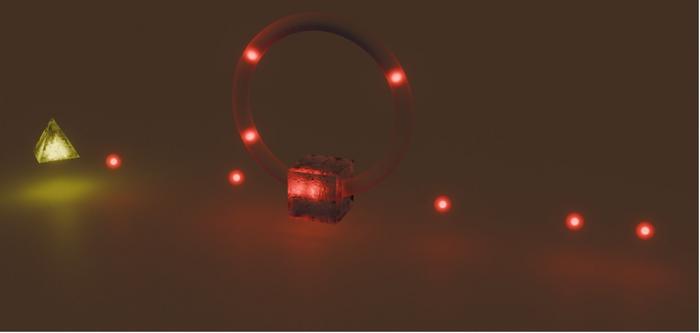
Resource-efficient multi-photon processor based on an optical fiber loop.
66
SHARES
600
VIEWS
Share on FacebookShare on Twitter
ADVERTISEMENT

An international collaboration of researchers, led by Philip Walther at University of Vienna, have achieved a significant breakthrough in quantum technology, with the successful demonstration of quantum interference among several single photons using a novel resource-efficient platform. The work published in the prestigious journal Science Advances represents a notable advancement in optical quantum computing that paves the way for more scalable quantum technologies. 

Resource-efficient multi-photon processor based on an optical fiber loop.

Credit: Marco Di Vita

An international collaboration of researchers, led by Philip Walther at University of Vienna, have achieved a significant breakthrough in quantum technology, with the successful demonstration of quantum interference among several single photons using a novel resource-efficient platform. The work published in the prestigious journal Science Advances represents a notable advancement in optical quantum computing that paves the way for more scalable quantum technologies. 

Interference among photons, a fundamental phenomenon in quantum optics, serves as a cornerstone of optical quantum computing. It involves harnessing the properties of light, such as its wave-particle duality, to induce interference patterns, enabling the encoding and processing of quantum information.

In traditional multi-photon experiments, spatial encoding is commonly employed, wherein photons are manipulated in different spatial paths to induce interference. These experiments require intricate setups with numerous components, making them resource-intensive and challenging to scale.
In contrast, the international team, comprising scientists from University of Vienna, Politecnico di Milano, and Université libre de Bruxells, opted for an approach based on temporal encoding. This technique manipulates the time domain of photons rather than their spatial statistics.
To realize this approach, they developed an innovative architecture at the Christian Doppler Laboratory at the University of Vienna, utilizing an optical fiber loop (Fig.1). This design enables repeated use of the same optical components, facilitating efficient multi-photon interference with minimal physical resources. 

First author Lorenzo Carosini explains: “In our experiment, we observed quantum interference among up to eight photons, surpassing the scale of most of existing experiments. Thanks to the versatility of our approach, the interference pattern can be reconfigured and the size of the experiment can be scaled, without changing the optical setup.”
The results demonstrate the significant resource efficiency of the implemented architecture compared to traditional spatial-encoding approaches, paving the way for more accessible and scalable quantum technologies. 


Journal

Science Advances

DOI

10.1126/sciadv.adj0993

Article Title

Programmable multi-photon quantum interference in a single spatial mode

Share26Tweet17
Previous Post

Shoe technology reduces risk of diabetic foot ulcers

Next Post

The Italian central Apennines as a source of CO2

Related Posts

blank
Technology and Engineering

Clay-Cement Composite Enables Superior Low-Frequency Sound Absorption

March 21, 2026
blank
Technology and Engineering

Dynamic Spectrum Sharing for Cognitive Radio Users

March 21, 2026
blank
Technology and Engineering

AI-Powered Tool Enhances Stroke Care and Patient Outcomes

March 20, 2026
blank
Technology and Engineering

New Research Uncovers How the Spleen-to-Lung Neutrophil Pathway Drives Antiviral Defense

March 20, 2026
blank
Technology and Engineering

Cutting-Edge AI Models Promise Major Energy Savings and Breakthrough Performance Enhancements

March 20, 2026
blank
Technology and Engineering

Innovative Biochar Technology Enhances Antibiotic Removal from Water with Low-Energy Ultrasound

March 20, 2026
Next Post
The Central Apennines in Italy

The Italian central Apennines as a source of CO2

  • Mothers who receive childcare support from maternal grandparents show more parental warmth, finds NTU Singapore study

    Mothers who receive childcare support from maternal grandparents show more parental warmth, finds NTU Singapore study

    27626 shares
    Share 11047 Tweet 6904
  • University of Seville Breaks 120-Year-Old Mystery, Revises a Key Einstein Concept

    1029 shares
    Share 412 Tweet 257
  • Bee body mass, pathogens and local climate influence heat tolerance

    671 shares
    Share 268 Tweet 168
  • Researchers record first-ever images and data of a shark experiencing a boat strike

    535 shares
    Share 214 Tweet 134
  • Groundbreaking Clinical Trial Reveals Lubiprostone Enhances Kidney Function

    520 shares
    Share 208 Tweet 130
Science

Embark on a thrilling journey of discovery with Scienmag.com—your ultimate source for cutting-edge breakthroughs. Immerse yourself in a world where curiosity knows no limits and tomorrow’s possibilities become today’s reality!

RECENT NEWS

  • ATGL Boosts Liver Cancer Drug Sensitivity via p53
  • In-Utero Chikungunya Exposure Linked to Child Health Risks
  • Clay-Cement Composite Enables Superior Low-Frequency Sound Absorption
  • Endothelial Senescence Alters T Cell Activity in COPD

Categories

  • Agriculture
  • Anthropology
  • Archaeology
  • Athmospheric
  • Biology
  • Biotechnology
  • Blog
  • Bussines
  • Cancer
  • Chemistry
  • Climate
  • Earth Science
  • Editorial Policy
  • Marine
  • Mathematics
  • Medicine
  • Pediatry
  • Policy
  • Psychology & Psychiatry
  • Science Education
  • Social Science
  • Space
  • Technology and Engineering

Subscribe to Blog via Email

Success! An email was just sent to confirm your subscription. Please find the email now and click 'Confirm Follow' to start subscribing.

Join 5,191 other subscribers

© 2025 Scienmag - Science Magazine

Welcome Back!

Login to your account below

Forgotten Password?

Retrieve your password

Please enter your username or email address to reset your password.

Log In
No Result
View All Result
  • HOME
  • SCIENCE NEWS
  • CONTACT US

© 2025 Scienmag - Science Magazine
