


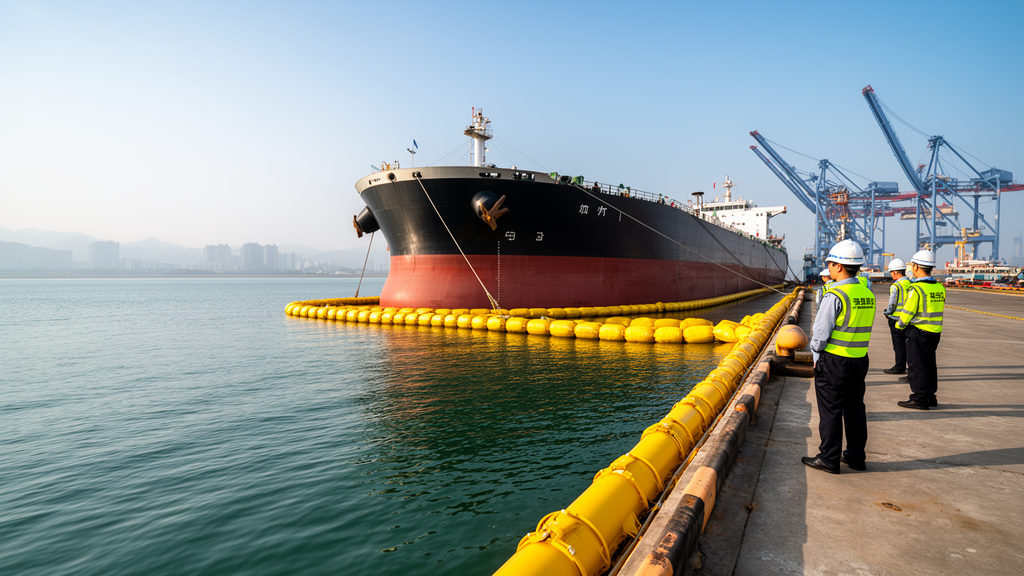
Vessel-source oil pollution continues to represent a primary challenge for marine environmental governance because catastrophic discharges can diffuse rapidly across aquatic environments, persist over extensive periods, and inflict severe ecological and socio-economic devastation. In a comprehensive policy and practice review published in Frontiers in Marine Science, legal researchers Chuanyun Chen, Yi Huang, and Siqi Sun from Shanghai Maritime University and Shanghai Communications Polytechnic evaluated the finalized text of the revised Maritime Code of the People’s Republic of China. Adopted by the Standing Committee of the Fourteenth National People’s Congress on October 28, 2025, and scheduled to enter into force on May 1, 2026, this legislation marks the first comprehensive formal overhaul of the nation’s foundational maritime code in thirty-three years. The authors grounded their doctrinal, comparative, and empirical assessment directly in the officially promulgated statutory provisions rather than earlier consultative drafts. Their analysis centers on Chapter XII, an entirely new fifteen-article division entitled Liability for Oil Pollution Damage from Ships, which elevates China’s historically fragmented marine pollution rules into a centralized statutory architecture governing the world’s largest commercial merchant fleet by gross tonnage.
The operational necessity for robust vessel-source pollution regimes is demonstrated by global maritime casualty metrics and the vast scale of commercial shipping activities. As highlighted in the review, data from the International Tanker Owners Pollution Federation indicated that between 2020 and 2025, a six-year monitoring window recorded forty-three distinct spills of seven tonnes or greater, releasing an aggregate volume of forty-two thousand tonnes of oil into marine waters. Furthermore, records from the European Maritime Safety Agency documented six hundred and two pollution cases between 2014 and 2023, with bunker fuel, lubricating oils, hydraulic liquids, and cargo residues accounting for 63.1 percent of incidents. China occupies an exceptionally prominent position within global maritime transit, possessing a merchant fleet that reached 282.9 million gross tonnage as of December 16, 2024, according to Clarksons Research data cited in the study. Consequently, maritime traffic operating under Chinese jurisdiction and registry exerts substantial systemic impacts upon the carrying capacity of coastal waters and interconnected oceanic ecosystems worldwide.
Prior to this legislative enactment, China managed vessel-source oil pollution claims through dispersed legal instruments spanning diverse administrative hierarchies and conflicting statutory objectives. Relevant provisions were scattered across the tort liability chapter of the Civil Code, the Marine Environment Protection Law, administrative regulations on marine dumping and vessel pollution prevention, and departmental rules including the 2010 Measures for the Implementation of Civil Liability Insurance for Ship Oil Pollution Damage. This fragmentation created substantial friction with multilateral treaties such as the 1992 International Convention on Civil Liability for Oil Pollution Damage and the 2001 International Convention on Civil Liability for Bunker Oil Pollution Damage. Judicial authorities frequently confronted inconsistent liability standards, ambiguous definitions, and procedural hurdles when attempting to align domestic judgments with international norms. Chen, Huang, and Sun emphasize that Chapter XII addresses this long-standing disconnect by establishing a unified three-section framework that divides overarching principles, persistent cargo oil spills, and bunker fuel incidents into coherent statutory tracks.
At the substantive core of the newly enacted Chapter XII lies the statutory codification of strict liability for registered shipowners under Article 226. Under this regime, the owner of a leaking vessel is held liable for resulting oil pollution damage regardless of subjective fault, eliminating the evidentiary burdens historically associated with tort litigation. The revised code narrows shipowner defenses to three circumscribed international statutory exemptions: acts of war or hostilities, deliberate third-party sabotage, and navigational damage caused entirely by the negligent maintenance of lights or navigational aids by responsible authorities. To address operational vessel management, the statute also imposes explicit statutory environmental duties directly upon shipmasters. Under Articles 37 and 40, masters must take necessary protective measures during routine transit and command crew members to seal tank valves and operate emergency equipment during maritime casualties. These provisions legally anchor the internationally recognized polluter-pays principle directly into Chinese maritime law.
A critical institutional breakthrough within the revised code is the codification of a dual protection mechanism that combines compulsory financial security with statutory compensation funds under Article 229. While departmental rules previously required limited insurance for specific vessel classes, the revised code establishes a universal statutory obligation requiring all oil-carrying ships engaged in domestic and international voyages to maintain valid civil liability insurance or equivalent financial guarantees. Crucially, Article 229 grants injured claimants a direct cause of action against liability insurers and financial guarantors, circumventing traditional contract privity barriers that previously prevented claimants from securing recovery when shipowners entered liquidation or insolvency proceedings. Insurers retain the legal right to invoke statutory liability limitation thresholds and defend against fraudulent claims involving intentional shipowner misconduct. Simultaneously, the statute provides statutory recognition for the China Ship Oil Pollution Compensation Fund, consolidating a national two-tier relief structure wherein commercial insurance operates as the primary layer of recovery and the domestic fund provides secondary compensation.
The revised code introduces a differentiated liability limitation structure that replaces the prior practice of subjecting environmental spills to general maritime claims limits under Chapter XI. For vessels transporting persistent cargo oil, Article 233 establishes a tiered, gross-tonnage formula aligned with the 2000 amendments to the Civil Liability Convention, providing an absolute minimum liability threshold of 4.51 million Special Drawing Rights. In contrast, Article 239 regulates bunker fuel spills from non-tanker vessels by directing calculation procedures back to general maritime limitation principles while establishing independent conditions for invocation. The authors emphasize that this statutory differentiation prevents severe disparities where large-scale environmental damages overwhelm low liability limits. Additionally, Articles 234 through 236 clarify procedural mechanics for constituting judicial limitation funds, stipulating that a fund established by any single liable party is legally deemed constituted for all liable entities, while according preventive clean-up expenses equal distribution parity with standard property and ecological compensation claims.
Notwithstanding these structural advancements, the legal review identifies substantial statutory ambiguities and substantive omissions that could impede judicial adjudication. A primary doctrinal complication concerns maritime collisions involving mutual fault where only one vessel leaks oil while a non-spilling vessel shares navigational culpability. Because Article 226 restricts direct strict liability exclusively to the owner of the leaking hull, claimants cannot directly sue the non-spilling tortfeasor under Chapter XII, forcing reliance upon internal recourse actions under Article 230 or complex tort provisions in the Civil Code. Additionally, Article 225 recognizes reasonable costs for ecological restoration measures already undertaken or planned, but omits operational definitions, evidentiary criteria, and valuation methodologies for unquantified ecological harms, including lost ecosystem services and biodiversity depletion. The statute also leaves unresolved procedural conflicts regarding distribution priorities when an individual maritime casualty concurrently triggers both persistent cargo oil pollution and bunker fuel claims.
Significant statutory gaps persist regarding non-persistent petroleum products and alternative marine propulsion systems. Chapter XII explicitly omits non-persistent cargo oils, such as light condensates, from its special liability framework, an omission previously highlighted during the catastrophic 2018 Sanchi collision and fire in the East China Sea. Claims arising from non-persistent spills remain relegated to general civil tort rules lacking compulsory insurance or dedicated fund protections. Furthermore, Chapter XII completely excludes hazardous and noxious substances, as well as emerging alternative marine fuels including liquefied natural gas, methanol, and ammonia. Although the 2010 International Convention on Liability and Compensation for Damage in Connection with the Carriage of Hazardous and Noxious Substances by Sea is scheduled to enter into force internationally on November 29, 2027, China has not yet ratified the instrument, leaving advanced low-carbon vessels without dedicated statutory compensation protocols.
To illustrate the economic repercussions of static compensation limits, the review examines the catastrophic 2021 A Symphony collision off Qingdao. In that casualty, a collision caused the release of approximately 9,419 tonnes of persistent cargo oil, contaminating 4,360 square kilometers of marine surface and 786.5 kilometers of coastline. Registered maritime court claims for fishery destruction and ecological damage totaled approximately 3.74 billion Chinese yuan, including a standalone public-interest fishery claim of 450 million yuan. However, the vessel’s limitation fund established under the 1992 Civil Liability Convention yielded only approximately 470 million yuan, generating an uncompensated recovery shortfall exceeding 3.2 billion yuan. The authors noted that Mainland China’s non-accession to the 1992 International Oil Pollution Compensation Fund Convention excludes domestic incidents from tapping the international fund’s supplementary ceiling of 203 million Special Drawing Rights, despite estimates indicating Chinese oil receivers would contribute approximately 8 million British pounds annually under historical levy rates.
To address these structural deficiencies, Chen, Huang, and Sun propose a multi-level legal implementation pathway combining domestic judicial refinement with proactive international governance. Domestically, the authors advocate using purposive statutory interpretations and Supreme People’s Court judicial interpretations to establish objective calculation standards for ecological clean-up reasonableness, clarify several liability defaults among bunker controllers, and permit recovery for high-seas preventive actions threatening Chinese waters. Administratively, joint ministerial measures must formalize scientific appraisal standards and introduce dynamic inflation-linked adjustment mechanisms for liability limits. Internationally, the authors recommend that China expand regional oil spill contingency agreements across Southeast Asia and the Maritime Silk Road, actively participate in International Maritime Organization deliberations regarding alternative fuel liabilities, and undertake preparatory legal evaluations for eventual accession to the Hazardous and Noxious Substances Convention, thereby harmonizing domestic marine environmental governance with global sustainable shipping standards.
Subject of Research: Legal analysis of vessel-source oil pollution liability under China's revised Maritime Code
Article Title: China’s revised Maritime Code and vessel-source oil pollution liability: innovations, gaps, and reform pathways
Article References: Chen, C., Huang, Y., & Sun, S. (2026). China’s revised Maritime Code and vessel-source oil pollution liability: innovations, gaps, and reform pathways. Frontiers in Marine Science, 13, Article 1967929. https://doi.org/10.3389/fmars.2026.1967929
Image Credits: AI Generated
DOI: 10.3389/fmars.2026.1967929
Keywords: Maritime Law, Oil Pollution Liability, China Maritime Code, Marine Environmental Governance, Strict Liability, Compulsory Insurance, Compensation Funds, International Maritime Conventions, China, revised, Maritime, Code
Cite Scienmag News
Violet Maxwell. (November 10, 2026). China’s Revised Maritime Code Restructures Vessel-Source Oil Pollution Liability Framework. Scienmag. https://scienmag.com/chinas-revised-maritime-code-restructures-vessel-source-oil-pollution-liability-framework/
Violet Maxwell. "China’s Revised Maritime Code Restructures Vessel-Source Oil Pollution Liability Framework." Scienmag, 10 November 2026, https://scienmag.com/chinas-revised-maritime-code-restructures-vessel-source-oil-pollution-liability-framework/. Accessed 10 November 2026.
Violet Maxwell. "China’s Revised Maritime Code Restructures Vessel-Source Oil Pollution Liability Framework." Scienmag. November 10, 2026. https://scienmag.com/chinas-revised-maritime-code-restructures-vessel-source-oil-pollution-liability-framework/




