


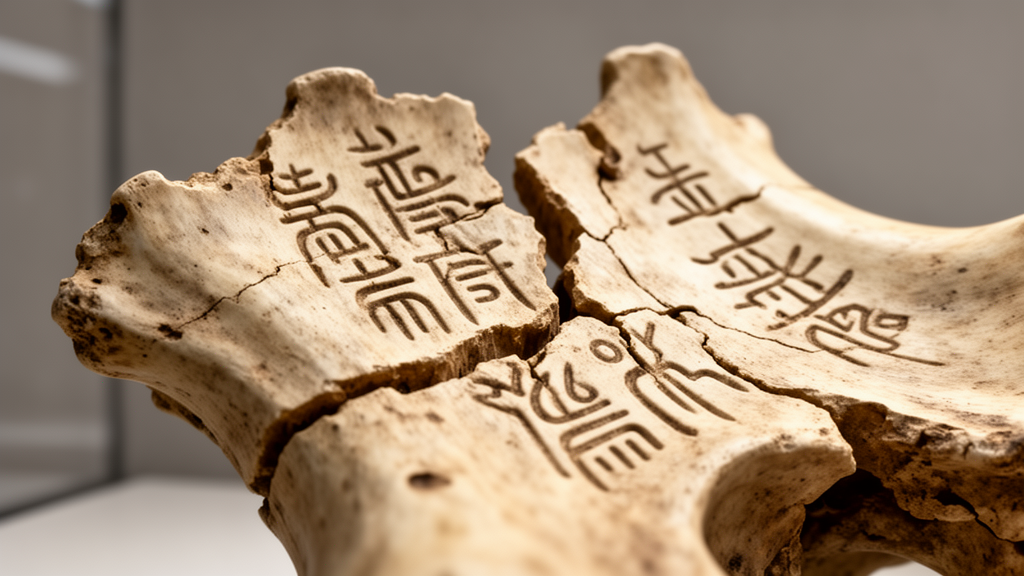
Researchers have developed AlphaOracle, a computational simulation and modeling system designed to emulate the multi-step workflows of specialist epigraphers in deciphering ancient Shang-dynasty oracle bone inscriptions. Described in a peer-reviewed study published in The Innovation by an academic team led by Yuliang Liu at Huazhong University of Science and Technology, alongside collaborators from South China University of Technology and Anyang Normal University, the deep learning framework reduced specialist analysis time by 64 percent in an evaluation involving 86 epigraphy experts.
Deciphering an unknown character carved into Shang-dynasty animal bones and turtle shells typically demands days of painstaking manual investigation by scholars navigating between rubbings, comparative bronze inscriptions, and classical historical commentaries. Epigraphers estimate that roughly 3,000 of the approximately 4,500 documented characters etched into bone and shell still lack an agreed-upon scholarly reading. Academic progress across the field has remained consistently slow because the primary epigraphic evidence is fragmented across disparate centuries, physical formats, and archival collections.
Prior computational initiatives in the field were largely restricted to identifying characters that epigraphers had already successfully deciphered. Many earlier pipelines adapted directly from standard optical character recognition methodologies infer textual readings purely from visual glyph shapes, rarely assessing whether a proposed candidate fits the syntactical sentence context or withstands scrutiny alongside transmitted classical texts. Because an epigrapher’s scholarly conclusion depends upon a cumulative chain of corroboration rather than visual resemblance alone, shape-only computational outputs frequently appear superficially plausible while remaining unusable in practice.
To mirror human epigraphic analysis, AlphaOracle operates across four sequential processing stages that narrow possibilities step by step rather than taking an ensemble vote. First, an automated parsing module locates and detects individual characters preserved on rubbings, categorizes settled forms away from disputed glyphs, and reconstructs the intended original reading order utilizing a graph neural network. Next, a specialized morphological analysis stage consults three distinct neural networks: a diffusion model projecting glyph forms chronologically forward through bronze, seal, clerical, and regular scripts; a decomposition model mapping component structures onto modern character frameworks; and a dedicated model that arranges temporal period variants onto a single evolutionary timeline to produce ranked candidate characters accompanied by confidence scores.
The framework then executes contextual alignment by retrieving every recorded occurrence of the target glyph across an extensive corpus comprising 73,883 hand-traced rubbings and 45,364 archaeological scans. A masked language model trained specifically on ancient divination text evaluates these matches to judge which candidate character accurately conforms to the established divination formula. Finally, a philological grounding module validates the remaining candidate options against 25 transmitted classical literature texts and 23,755 modern scholarly studies, systematically weighting evidentiary sources according to their historical age and academic authority.
In quantitative benchmark testing on 88 characters withheld entirely from model training, AlphaOracle achieved a top-1 identification accuracy of 23.1 percent, compared to 13.1 percent obtained by a reimplementation of Google’s SR3 image model. When evaluated on the task of restoring masked characters from surrounding context, the system recorded 56.1 percent accuracy against 22.2 percent for the top-performing general model, while candidate re-ranking reached 95.2 percent compared to 65.4 percent for the baseline. In evaluation of generated textual explanations, AlphaOracle achieved scores of 0.491 BLEU, 0.586 ROUGE, and 0.659 METEOR, outperforming the zero-shot general baseline scores of 0.171 BLEU, 0.229 ROUGE, and 0.346 METEOR.
The research authors noted that the comparative testing of general models was conducted zero-shot, highlighting the critical significance of specialized domain-specific archaeological training data. In structured blind evaluations, 86 epigraphy specialists selected AlphaOracle’s contextual explanations over comparative baselines 45.2 percent of the time. Furthermore, 78.7 percent of the participating specialist reviewers assigned the system an overall usefulness rating of 4 or 5 on a 5-point scale, affirming the practical value of transparent, interpretable reporting for professional review.
The practical utility of the platform was demonstrated in the headline investigation of the contested character 勞, whose interpretation among paleographers had long been divided between an adverb marking completion and a clan or place name. By integrating morphological evolution, ten parallel archaeological inscriptions, and sixteen academic studies, AlphaOracle generated an evidentiary chain supporting the toponym reading. This corroborated interpretation has subsequently been accepted into an authoritative epigraphic database, alongside the computational re-examination of 22 additional disputed character variants.
The study authors emphasize several critical methodological boundaries, framing AlphaOracle as a targeted advance for partially documented scripts rather than an automated universal decoder. The model fundamentally depends on an existing foundation of transmitted classical literature, does not independently adjudicate between competing readings, and leaves final decipherment verdicts entirely to expert human scholars. The authors declared no competing financial or personal conflicts of interest regarding the research.
Subject of Research: Computational decipherment of ancient oracle bone script using deep learning
Article Title: An AI that reads oracle bones the way scholars do: AlphaOracle traces form, context and classical texts to 3,000-year-old characters
Article References: An AI that reads oracle bones the way scholars do: AlphaOracle traces form, context and classical texts to 3,000-year-old characters. Original publication (Bibliographic details unavailable.)
Image Credits: AI Generated
DOI: Not provided
Keywords: AlphaOracle, oracle bone script, Shang dynasty, epigraphy, deep learning, computational archaeology, philology, ancient Chinese characters, reads, oracle, bones, scholars
Cite Scienmag News
Courtney Benton. (November 9, 2026). AlphaOracle AI Emulates Human Epigraphy to Help Decipher Ancient Oracle Bone Scripts. Scienmag. https://scienmag.com/alphaoracle-ai-emulates-human-epigraphy-to-help-decipher-ancient-oracle-bone-scripts/
Courtney Benton. "AlphaOracle AI Emulates Human Epigraphy to Help Decipher Ancient Oracle Bone Scripts." Scienmag, 9 November 2026, https://scienmag.com/alphaoracle-ai-emulates-human-epigraphy-to-help-decipher-ancient-oracle-bone-scripts/. Accessed 14 November 2026.
Courtney Benton. "AlphaOracle AI Emulates Human Epigraphy to Help Decipher Ancient Oracle Bone Scripts." Scienmag. November 9, 2026. https://scienmag.com/alphaoracle-ai-emulates-human-epigraphy-to-help-decipher-ancient-oracle-bone-scripts/




