


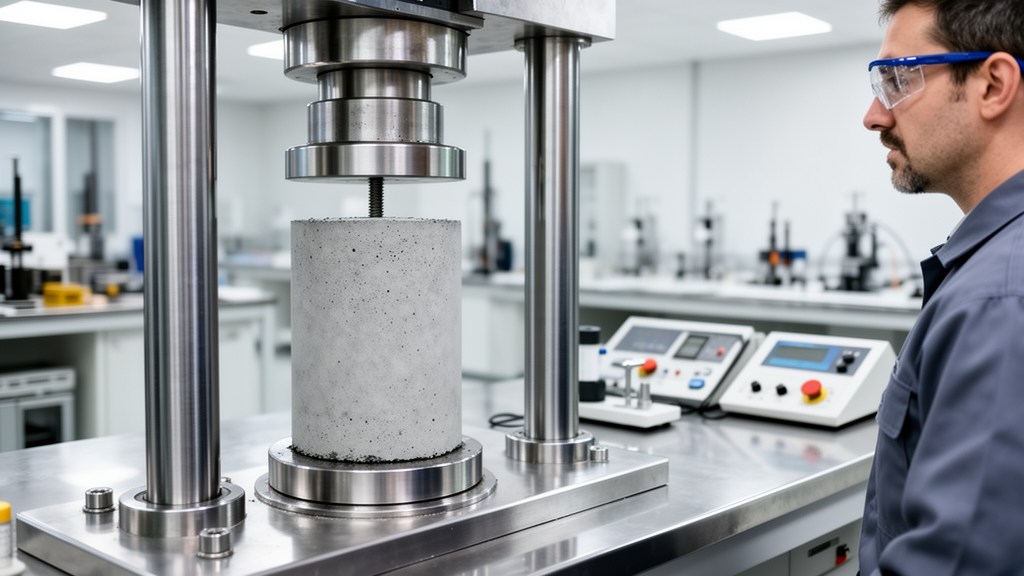
Civil engineering researchers have formulated an updated mathematical model capable of predicting the compressive strength of self-compacting concrete incorporating fly ash and volcanic tuff powder at three, seven, and twenty-eight days of curing. The newly established model builds on standard design frameworks by integrating empirical cementitious coefficients derived directly from mortar testing, allowing practitioners to account for the divergent reaction kinetics and microstructural contributions of each supplementary material across standard curing intervals. Self-compacting concrete exhibits high flowability and segregation resistance, which enables it to pass through densely reinforced structures without mechanical vibration while maintaining uniformity during placement. Because industrial mineral additives alter the hydration dynamics of Portland cement, establishing accurate early-age and mature predictive equations provides critical guidance for material proportioning and structural safety assessments.
The study was prompted by practical infrastructure demands in the Xizang Autonomous Region of southwestern China, where self-compacting concrete offers notable construction advantages in oxygen-deficient high-plateau environments. While fly ash has historically served as a conventional supplementary cementitious material due to its spherical particle morphology and pozzolanic activity, its regional availability on the plateau remains strictly constrained. Procuring fly ash requires transporting it over extended distances by rail from distant provinces, creating significant logistical delays and supply chain costs. In contrast, volcanic tuff deposits are naturally abundant across the local plateau. Crushing this rock into fine tuff powder provides an accessible alternative mineral additive that reduces delivery overhead and material costs, yet its specific cementitious behavior when substituted into self-compacting concrete mixtures had remained insufficiently quantified in standard structural engineering specifications.
To evaluate the mineralogical and chemical properties governing each raw material, the investigators examined ordinary Portland cement, fly ash, and tuff powder using X-ray fluorescence, X-ray diffraction, and laser particle analysis. The ordinary Portland cement exhibited a specific gravity of 3.147 grams per cubic centimeter and a specific surface area of 1.07 square meters per gram. Fly ash presented a specific gravity of 2.310 grams per cubic centimeter and a specific surface area of 2.37 square meters per gram, containing 35.2 percent amorphous silicon dioxide and 15.9 percent amorphous aluminum oxide. Tuff powder demonstrated a specific gravity of 2.760 grams per cubic centimeter and a notably higher specific surface area of 4.77 square meters per gram, though chemical analysis revealed only 0.10 percent amorphous silicon dioxide and 7.9 percent amorphous aluminum oxide, reflecting a substantially lower pozzolanic oxide fraction than fly ash.
The experimental program commenced with the preparation of eight distinct mortar mixtures containing variable proportions of fly ash at replacement levels of zero, ten, and twenty percent, and tuff powder at replacement levels of zero, fifteen, and thirty percent. These specimens were cast into cubes measuring 70.7 millimeters per side, cured at twenty degrees Celsius and ninety-five percent relative humidity, and subjected to axial compression tests at three, seven, and twenty-eight days. The resulting compressive strength measurements enabled the calculation of individual cementitious coefficients, defined as the relative strength contribution of a unit mass of supplementary material compared to reference Portland cement. The analysis revealed that the cementitious coefficient of fly ash increased progressively over time, rising from modest early values to surpass 1.0 at twenty-eight days in mixtures containing ten percent replacement, driven by sustained secondary reactions between its abundant amorphous oxides and calcium hydroxide released during cement hydration.
Conversely, the cementitious coefficient of tuff powder exhibited a distinct non-linear trajectory, initially increasing during early curing stages before declining toward twenty-eight days across both fifteen percent and thirty percent replacement levels. During early curing, the high specific surface area and rough angular texture of tuff particles provide substantial micro-filler packing and nucleation sites that physically accelerate the precipitation of calcium silicate hydrate and calcium aluminate hydrate gels. However, because tuff powder contains only 0.10 percent amorphous silica, its chemical pozzolanic activity ceases rapidly once available reactive phases are consumed. Simultaneously, replacing Portland cement with larger volumes of tuff powder reduces the total concentrations of tricalcium silicate and dicalcium silicate, thereby diminishing long-term hydration gel output and reducing the overall growth rate of compressive strength as curing progresses.
Building on these mortar-derived cementitious coefficients, the research team designed nineteen self-compacting concrete mixtures across variable water-to-binder volume ratios, polycarboxylate superplasticizer dosages, sand ratios, coarse aggregate volumes, and mineral admixture proportions. Cube specimens measuring 150 millimeters per side were cast and cured under identical standard conditions for testing at three, seven, and twenty-eight days. Using linear regression on the experimental data, the authors revised standard model equations by establishing age-dependent fitting coefficients, designated as A and C, where coefficient A reflects the evolving strength contribution of the binder system and coefficient C serves as an empirical correction factor. The calibrated parameters yielded coefficients of determination of 0.65 at three days, 0.70 at seven days, and 0.80 at twenty-eight days, indicating progressive statistical alignment with ongoing hydration development.
Microstructural evaluations conducted via scanning electron microscopy and mercury intrusion porosimetry validated the physical mechanisms underlying the measured strengths. Microscopic imaging confirmed that both fly ash and tuff particles became embedded within hydration products, with fly ash particles bridging matrix microcracks and tuff surfaces anchoring dense gel networks. Mercury intrusion porosimetry demonstrated that total porosity and the proportion of harmful pores larger than 100 nanometers increased when tuff powder replacement rose from zero to thirty percent, shifting total porosity from 18.01 to 23.47 percent and harmful pore volumes from 11.18 to 14.47 percent. In mixtures incorporating fly ash, replacing ten percent of cement minimized total porosity and reduced harmful pore fractions from 4.76 to 3.65 percent, confirming that fly ash actively refines the pore matrix at mature curing stages.
To evaluate the generalizability of the model, the investigators tested five independent validation self-compacting concrete mixtures prepared with varied coarse aggregate types and gradations, including crushed coarse aggregate, recycled coarse aggregate, and crumb recycled rubber tyre particles. In standard crushed aggregate systems, the model achieved reliable predictions at twenty-eight days, yielding a mean absolute error of 4.5 megapascals and a mean absolute percentage error of 9.9 percent, outperforming the uncalibrated original standard model. However, the model consistently overestimated compressive strength at three and seven days across the validation sets, exhibiting a non-conservative early-age bias. Furthermore, mixtures containing recycled rubber tyres recorded experimental strengths far below model forecasts across all testing intervals, as the calculation framework does not incorporate terms accounting for the low particle stiffness and interfacial weakness characteristic of rubber inclusions.
Integrating their predictive formulas with established paste rheology theory, the authors outlined a comprehensive mix proportioning procedure aimed at satisfying both mechanical capacity and fresh workability criteria. The methodology identifies an acceptable binder formulation by intersecting a compressive strength compliance zone with a rheological self-compacting paste threshold zone. The researchers cautioned, however, that because the current model relies on empirical coefficients derived under specific laboratory conditions and omits explicit parameters for aggregate absorption, stiffness, and grading, early-age predictions must not be used as the sole criterion for structural operations such as formwork stripping or prestressing without direct verification testing, with future modeling efforts slated to explore response surface methodologies and broader aggregate matrices.
In the baseline mortar testing, the physical measurements quantified how fly ash moderates initial hydration while sustaining strength gains over extended curing. At three days, compressive strengths reached 16.4 megapascals for the plain Portland cement mortar, 15.9 megapascals at ten percent fly ash replacement, and 13.1 megapascals at twenty percent replacement, before rising to 29.3, 28.4, and 23.0 megapascals at seven days. From seven to twenty-eight days, mortar strength climbed by 18.1 percent in control mixtures, 34.5 percent in ten percent fly ash mixtures, and 49.1 percent in twenty percent fly ash formulations. For self-compacting concrete, the improved mathematical framework demonstrated progressively smaller relative error margins across aging intervals. The three-day model produced a mean absolute error of 4.7 megapascals, a mean absolute percentage error of 16.0 percent, a root mean square error of 5.4 megapascals, and a normalized root mean square error of 14.4 percent. At seven days, the mean absolute error fell to 4.4 megapascals with a mean absolute percentage error of 12.0 percent, a root mean square error of 5.0 megapascals, and a normalized root mean square error of 13.5 percent.
In the validation trials examining coarse aggregate variations, the replacement level of recycled coarse aggregates exerted a greater effect on twenty-eight-day compressive strength than adjustments to the aggregate size ratio. Increasing the recycled aggregate substitution from 25 to 50 percent reduced the measured compressive strength from 43.4 to 35.2 megapascals, whereas mixtures containing 25 percent recycled aggregate maintained compressive strengths between 41.2 and 44.9 megapascals across differing particle gradation ratios. To address current analytical constraints, the investigators outlined specific research priorities. Future modeling plans involve implementing response surface methodology with central composite designs alongside artificial neural networks to capture nonlinear interactions among mixture components. Furthermore, the team aims to incorporate explicit parameters for air content, aggregate characteristics, and fresh rheology, while compiling extended curing data at 56 and 90 days to track prolonged pozzolanic reactions.
Subject of Research: Compressive strength prediction modeling of self-compacting concrete with mineral additives
Article Title: Improved prediction model for compressive strength of self-compacting concrete incorporating fly ash and tuff powder at different curing ages
Article References: Pingcuo, Z., Li, Z., Zhang, J., Hu, C., Liu, Z., Sui, H., & Zhang, Y. (2026). Improved prediction model for compressive strength of self-compacting concrete incorporating fly ash and tuff powder at different curing ages. Discover Concrete and Cement, 2(1), Article 96. https://doi.org/10.1007/s44416-026-00140-x
Image Credits: AI Generated
DOI: 10.1007/s44416-026-00140-x
Keywords: self-compacting concrete, compressive strength, tuff powder, fly ash, cementitious coefficient, concrete technology, materials engineering, mix design, Improved, prediction, model, compressive
Cite Scienmag News
Denise Maddox. (November 9, 2026). Scientists Develop Model Predicting Compressive Strength of Self Compacting Concrete. Scienmag. https://scienmag.com/scientists-develop-model-predicting-compressive-strength-of-self-compacting-concrete/
Denise Maddox. "Scientists Develop Model Predicting Compressive Strength of Self Compacting Concrete." Scienmag, 9 November 2026, https://scienmag.com/scientists-develop-model-predicting-compressive-strength-of-self-compacting-concrete/. Accessed 9 November 2026.
Denise Maddox. "Scientists Develop Model Predicting Compressive Strength of Self Compacting Concrete." Scienmag. November 9, 2026. https://scienmag.com/scientists-develop-model-predicting-compressive-strength-of-self-compacting-concrete/




