


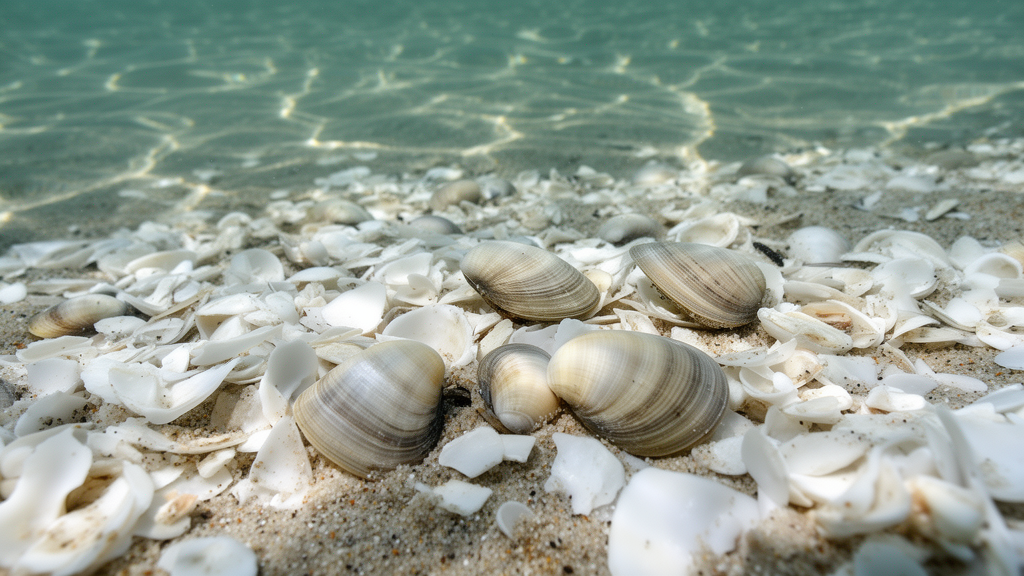
New research from the University of California, Davis reveals why adding crushed shells to beach sand helps protect shell-making animals, such as clams, oysters, and mussels, from the detrimental effects of ocean acidification. The study, appearing in the journal Biogeosciences, demonstrates that this practice, known as shell hash, alters the chemistry of the water filling the tiny spaces between sand particles. By decreasing overall acidity in these pore waters, the shell hash creates a more favorable environment for shell growth, allowing juvenile clams to thrive despite broader oceanic acidification trends.
The researchers designed an experiment at the UC Davis Bodega Marine Laboratory to investigate the biological and chemical mechanisms behind this protective effect. They mixed crushed shells, or shell hash, into sand where baby Pacific littleneck clams burrowed and grew. Over a 90-day period, the team monitored the clams’ growth and the water’s chemistry to understand how the local environment responded to the addition of the shell material.
Adding shell hash significantly altered the chemistry of the interstitial water, decreasing its overall acidity and creating a better environment for shell formation. Study first author Hannah Kempf, an environmental scientist at the California State Water Board who graduated from UC Davis with a Ph.D. in earth and planetary sciences in 2024, noted that clams grew larger shells on average when shell hash was present in their treatment.
The findings suggest that shell hash can buffer the impacts of acidification on a very local level, promoting clam growth even when the surrounding seawater is acidic. To understand this mechanism, the researchers raised baby Pacific littleneck clams in four different conditions: seawater with sediment, acidified seawater with sediment, control seawater with sediment plus shell hash, and acidified seawater with sediment plus shell hash.
Over the 90-day study period, the researchers sampled the seawaters three times a week, monitoring acidity, salinity, temperature, and dissolved oxygen. They also tracked the clams’ shell growth and, after 90 days, sampled the clams’ mantle tissue for follow-up gene sequencing. The results showed that not only were the clams raised in shell hash-rich sediments larger on average, but the gene expression profiles of those raised in acidified seawater with shell hash were largely indistinguishable from those raised in non-acidified waters. This indicates that the shell hash effectively removed the negative genetic changes that typically occur when young clams are raised in acidified water.
Study corresponding author David Gold, an associate professor of earth and planetary sciences at UC Davis, emphasized that this was the first time the question was studied from a genetic perspective.
Indigenous communities have long added shell hash to sands to keep coastal ecosystems healthy, and the research illuminates the biology underlying why this method is effective. Study co-author Tsim Schneider, an associate professor of anthropology at UC Santa Cruz, noted that there is significant evidence from traditional ecological knowledge that shell hash is beneficial to the health of shell-making animals. In the Pacific Northwest, some Indigenous communities create large-scale structures that enlarge intertidal spaces, promoting habitats for invertebrates and other marine organisms. Schneider highlighted the potential to engage more fully with tribes on designing projects that promote their long-standing expertise and Indigenous science, suggesting that western science might better support communities interested in reawakening dormant cultural knowledge and coastal stewardship practices.
The research was supported by a California Sea Grant and the Russell J. and Dorothy S. Bilinski Fellowship.
Subject of Research: Experimental study on the effects of shell hash on Pacific littleneck clam growth and gene expression under acidified conditions
Article Title: How crushed shells protect against ocean acidification
Article References: How crushed shells protect against ocean acidification. Original publication (Bibliographic details unavailable.)
Image Credits: AI Generated
DOI: Not provided
Keywords: ocean acidification, shell hash, Pacific littleneck clams, UC Davis, marine biology, Indigenous science, pore water chemistry, gene expression, coastal ecosystems, benthic habitats, crushed, shells
Cite Scienmag News
Violet Maxwell. (November 9, 2026). Crushed shells buffer local acidity, aiding clam growth. Scienmag. https://scienmag.com/crushed-shells-buffer-local-acidity-aiding-clam-growth/
Violet Maxwell. "Crushed shells buffer local acidity, aiding clam growth." Scienmag, 9 November 2026, https://scienmag.com/crushed-shells-buffer-local-acidity-aiding-clam-growth/. Accessed 9 November 2026.
Violet Maxwell. "Crushed shells buffer local acidity, aiding clam growth." Scienmag. November 9, 2026. https://scienmag.com/crushed-shells-buffer-local-acidity-aiding-clam-growth/




