


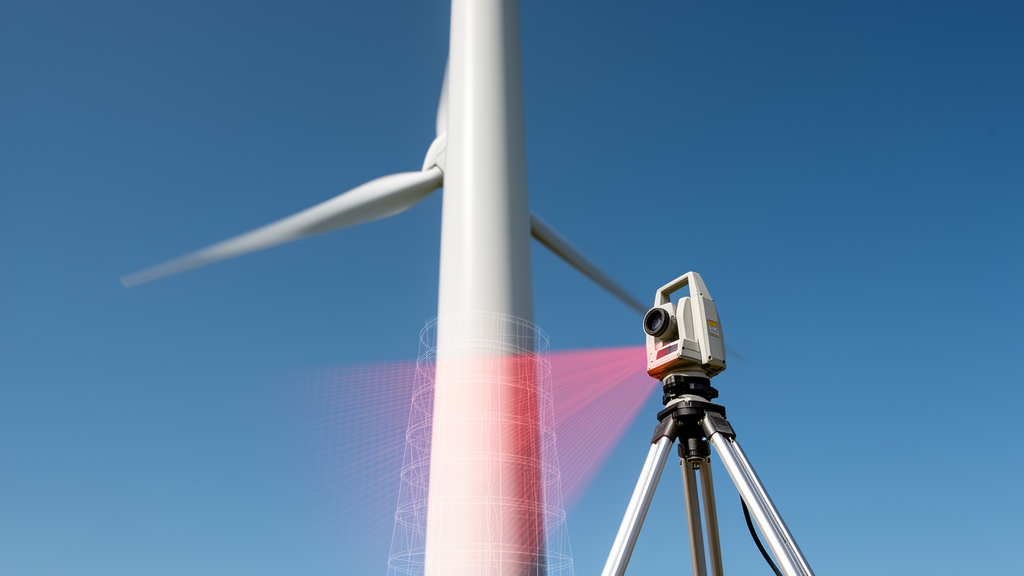
Researchers from the University of Porto and Nadara have demonstrated that terrestrial laser scanning can significantly improve the accuracy of aerodynamic load predictions for wind turbines. Published in Wind Energy Science, the study addresses a persistent challenge in the wind energy sector: the high uncertainty associated with aeroelastic models used to assess turbine lifetime. By combining laser-scanned blade geometry with operational data and structural health monitoring measurements, the team developed a more reliable method for simulating the forces acting on wind turbine rotors. This approach helps bridge the gap between theoretical simulations and the physical reality of operating turbines, which is critical as many wind farms approach the end of their design life.
The motivation for this work stems from the increasing demand for renewable energy and the need to extend the operational life of existing wind turbines. In the European Union alone, 65 gigawatts of wind turbine capacity will be older than the typical 20-year design life by 2030. To safely extend these assets, engineers require detailed models that can accurately estimate fatigue and structural integrity. However, standard aeroelastic models often rely on manufacturer-provided blade geometry data, which is frequently unavailable due to intellectual property protections. Furthermore, model validation has traditionally depended on Supervisory Control and Data Acquisition (SCADA) data, which offers limited insight into the specific structural loads experienced by the turbine.
To overcome these limitations, the study focused on an onshore multi-megawatt wind turbine with an 80-meter rotor diameter. The research team utilized three distinct experimental data sources to build and validate their model. First, they employed a terrestrial laser scanning (TLS) system to measure the outer geometry of a blade. Second, they used a tower structural health monitoring (SHM) system to measure bending moments at two different cross-sections. Third, they incorporated standard SCADA data, which provided operational variables such as rotor speed, blade pitch angle, and electrical power output. The continuous monitoring data were collected between August and December 2024, providing a comprehensive dataset for model development.
The laser scanning process involved placing the scanner at 13 different positions around the parked turbine to capture both the pressure and suction sides of the blade. This generated a three-dimensional point cloud containing approximately 5.29 million points in the blade region. A significant challenge during data acquisition was the presence of blade vibrations caused by low ambient wind speeds, which introduced scatter into the measurements, particularly towards the blade tip. To mitigate this, the researchers developed a consensus-based alignment procedure. This iterative method aligned the individual scan cross-sections to a common reference curve, effectively reducing the scatter and allowing for a more accurate reconstruction of the blade’s spanwise chord, twist, and airfoil distributions.
Once the blade geometry was reconstructed, the team used these measurements as inputs for an aeroelastic model built using the OpenFAST software. OpenFAST is a widely used open-source tool in the wind energy community that simulates the coupled aerodynamic, structural, and control dynamics of wind turbines. The aerodynamic module, AeroDyn, used blade element momentum theory to calculate the interaction between the wind and the turbine. The structural module, ElastoDyn, modeled the tower and blades using a combined modal and multi-body formulation. The control system was modeled using ROSCO, an open-source controller tool, based on the behavior characterized from the SCADA data.
Validation of the model was performed by comparing simulation results with the experimental data from both the SCADA system and the SHM system. The SHM system provided measurements of tower bending moments at two cross-sections, one near the top and one near the base of the tower. Using a static equilibrium model, the researchers estimated the rotor thrust and torque from these bending moments. This estimation provided additional validation metrics beyond what is available from SCADA data, offering a more direct insight into the rotor’s aerodynamic loads. The simulations were conducted under both steady and turbulent wind conditions across the operational wind speed range.
The results showed a good overall agreement between the simulated and experimental data, supporting the proposed methodology. However, the study identified specific discrepancies: the model slightly overpredicted power capture below rated wind speed, overpredicted rotor thrust below rated wind speed, and overpredicted the pitch angle above rated wind speed. These discrepancies were consistent across both the SCADA and SHM datasets, suggesting they were due to systematic modeling errors rather than measurement noise. The overprediction of thrust was particularly relevant because it corresponds to the highest magnitude loads experienced by the turbine structure.
To investigate the sources of these discrepancies, the team conducted a parametric study assessing the sensitivity of the model to five key uncertainties: blade chord scale, blade twist offset, aerodynamic polar degradation, yaw misalignment, and SCADA wind speed uncertainty. The study found that while blade geometry parameters could be tuned to match the measurements, the required perturbations were much larger than the expected uncertainty in the laser-scan-based estimates. This finding highlights the value of laser scanning in reducing uncertainties in blade geometry, as it prevents the incorrect attribution of model errors to geometric inaccuracies.
More plausible sources of the observed discrepancies included the aerodynamic polars and the wind field characterization. The airfoil polars, which determine the lift and drag coefficients, were generated using XFOIL with additional corrections. The study suggested that a degradation in these polars, possibly due to surface roughness or other factors, could contribute to the overprediction of loads. Additionally, errors in the wind speed measurement, which relies on a nacelle-mounted anemometer, were identified as a realistic source of uncertainty. The parametric study indicated that a mixture of these uncertainty sources is likely responsible for the discrepancies, rather than a single factor.
The study concludes that experimental measurements are essential for developing and validating aeroelastic models. The laser-scanned geometry provided a realistic representation of the blade, enabling a more reliable attribution of discrepancies to other sources of uncertainty. The SHM measurements provided additional validation metrics, allowing for a more comprehensive assessment of the model’s ability to predict structural loads. This integrated approach offers a robust strategy for obtaining highly reliable models for load estimation, which is crucial for the safe extension of wind turbine lifetimes.
Future work suggested by the authors includes performing a constrained optimization of uncertain model inputs using realistic parameter bounds. They also noted that for a more holistic modeling improvement, such as lifetime estimation, the next step should focus on calibrating the structural part of the model, such as blade mass and stiffness distributions, rather than further tuning the aerodynamic model. This study provides a valuable framework for the wind energy industry, demonstrating how advanced measurement techniques can be leveraged to improve the accuracy and reliability of turbine performance predictions.
The study utilized a specific methodology to derive aerodynamic parameters from the raw laser scan data, addressing the challenge of establishing a consistent zero-twist reference. The researchers defined the twist angle as the angle between the chord line and the rotor plane, a definition that requires a non-ambiguous reference frame. By including points from the nacelle and tower in the laser scan, the team could rigorously determine the rotor plane, allowing them to calculate the local twist angle using the fitted airfoil orientation and the blade pitch angle recorded by the SCADA system at the time of the scan. This approach ensured that the twist distribution used in the numerical models was consistent with the definitions employed in standard aeroelastic simulations, preventing small offsets from causing significant performance errors.
To generate the aerodynamic polars required for the model, the team used the XFOIL software to compute lift and drag coefficients over a range of angles of attack from −20 to 20 degrees. The local Reynolds number for each airfoil shape was determined based on the average chord length, the inflow velocity calculated from rated wind speed and rotor speed, and the kinematic viscosity of air at 15 degrees Celsius. To reflect the typically high surface roughness of wind turbine blades, the transition to turbulence was forced at 10 percent of the chord. Since XFOIL provides polars for two-dimensional flow, three-dimensional corrections were subsequently applied using the Du-Selig method for lift and the Eggers method for drag. The polars were then extrapolated to cover the full angle of attack range from −180 to 180 degrees using the Viterna method, ensuring the model could handle the full operational envelope of the turbine.
The structural modeling of the turbine presented specific challenges due to the unavailability of detailed blade mass and stiffness distributions from the manufacturer. To address this gap, the researchers scaled these properties from the IEA 3.4 MW reference turbine, preserving the ratio of stiffness to mass along the span. This scaling approach was justified because the study focused on the 10-minute means of loads and performance, where dynamic structural response is not the primary variable of interest. The drivetrain was modeled as a torsional spring with parameters copied from the same reference turbine, while the gearbox efficiency was calculated by comparing the aerodynamic power derived from SHM-measured rotor torque and SCADA-measured rotor speed against the generator power output.
The effect of turbulence on the simulation results was evaluated to determine whether steady-wind assumptions were sufficient for capturing the mean behavior of the turbine. Additional simulations were performed with turbulence intensities of 5, 10, and 15 percent, corresponding to realistic values logged by the SCADA system. The results indicated that turbulence has a smoothing effect around transition regions, such as the point where rated power is reached. In these regions, turbulence smooths the transition between different controller regimes, yielding results closer to the experimental data. However, away from these transition regions, the effect of turbulence was negligible, and steady-wind simulations provided a good approximation of the mean behavior. This finding supports the use of steady-wind simulations for general load assessment while highlighting the importance of turbulence in capturing peak loads near rated conditions.
Subject of Research: Validation of wind turbine aeroelastic models using laser scanning and structural health monitoring
Article Title: Predicting wind turbine aerodynamic loads using laser-scanned blade geometry with validation based on operational and structural data
Article References: Galhardo, A., Biscaya, A., Santos, J. P., & Magalhães, F. (2026). Predicting wind turbine aerodynamic loads using laser-scanned blade geometry with validation based on operational and structural data. Wind Energy Science, 11(11), 4059-4075. https://doi.org/10.5194/wes-11-4059-2026
Image Credits: AI Generated
Keywords: wind energy, aeroelastic modeling, laser scanning, structural health monitoring, wind turbine loads, OpenFAST, renewable energy, blade geometry, Predicting, wind, turbine, aerodynamic
Cite Scienmag News
Faith Mcneil. (November 8, 2026). Laser Scans Improve Wind Turbine Load Predictions. Scienmag. https://scienmag.com/laser-scans-improve-wind-turbine-load-predictions/
Faith Mcneil. "Laser Scans Improve Wind Turbine Load Predictions." Scienmag, 8 November 2026, https://scienmag.com/laser-scans-improve-wind-turbine-load-predictions/. Accessed 17 November 2026.
Faith Mcneil. "Laser Scans Improve Wind Turbine Load Predictions." Scienmag. November 8, 2026. https://scienmag.com/laser-scans-improve-wind-turbine-load-predictions/




