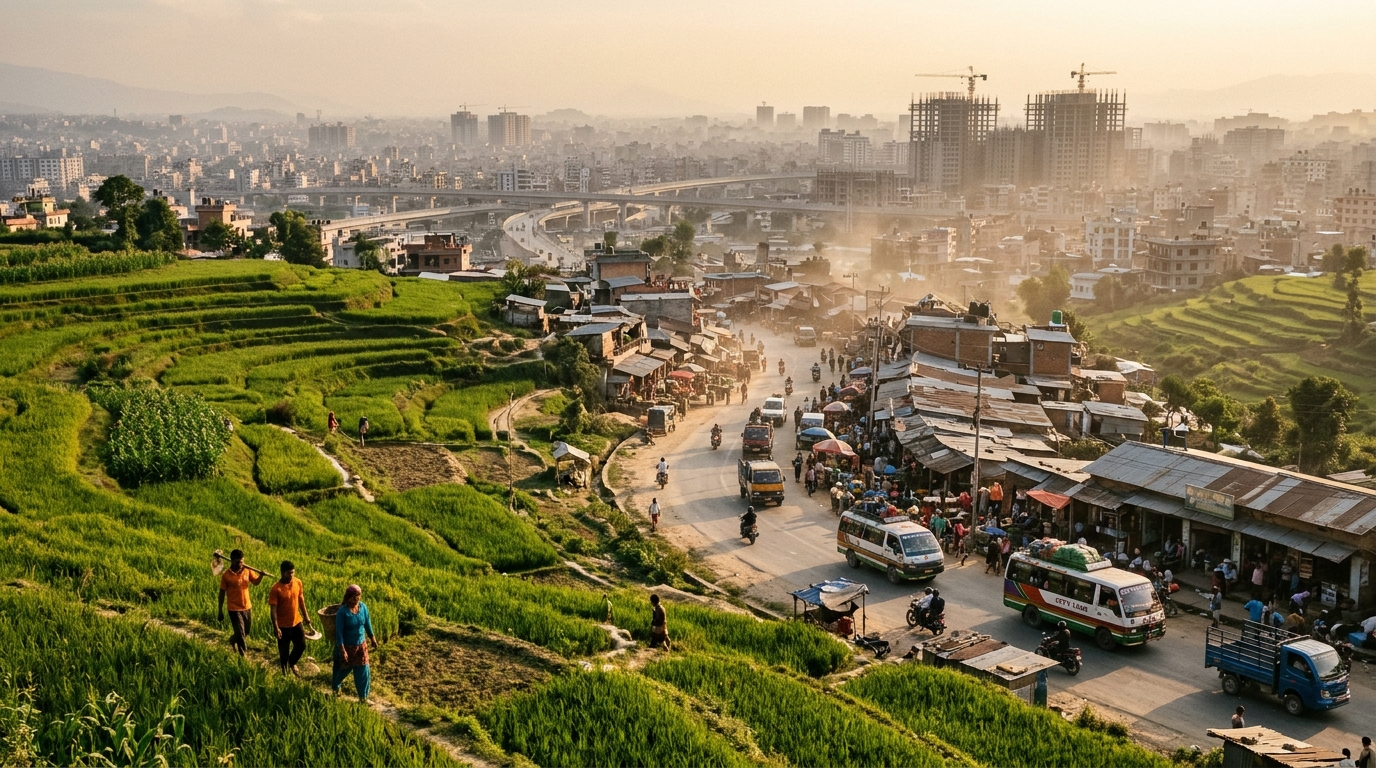
Internal migration in developing countries does not follow a static pattern but evolves systematically as nations urbanize, according to a new comparative study published in the European Journal of Population. Researchers Mathias Lerch, Wenxiu Du, and Dorothee Beckendorff analyzed census data from 41 developing countries to track how the geographic origins and destinations of migrants shift across the rural-urban continuum. The study provides robust evidence supporting the mobility transition hypothesis, which posits that migration patterns change predictably as societies develop economically and demographically. By examining more than 8,000 distinct settlements, the authors demonstrate that the propensity to migrate diffuses from larger, denser urban centers to smaller, sparser rural areas over time, while migrant destinations shift from the largest cities to intermediate and small urban centers.
The research addresses a significant gap in demographic geography, where evidence on the underlying spatial patterns of internal migration has been limited. While urbanization is recognized as the most important transformation in the population geography of developing countries, previous studies often relied on country-specific case studies or dichotomous urban-rural classifications that overlooked the heterogeneity of migration patterns. This study offers an internationally comparative perspective, utilizing population censuses fielded between 1970 and 2017. The authors argue that understanding these spatial dynamics is crucial for improving city population projections and informing regional development policies, particularly in contexts where urban primacy constrains balanced subnational economic growth.
To ensure international comparability, the study employed internationally consistent definitions of the spatial extent of urban agglomerations. The researchers used the URBDEMO collection of Integrated Public Use Microdata Samples (IPUMS) to reunify 85 census rounds across 41 countries. They spatially matched administrative census geographies to the functional urban areas (FUAs) defined by the European Commission, which are based on the Global Human Settlement Layer. This approach allowed the team to identify 1,201 FUAs, 114 other small cities, and 7,507 predominantly rural administrative areas. By applying consistent boundaries, the study avoided confounding effects attributable to the reclassification of administrative units over time, ensuring that observed changes in migration gradients reflected actual demographic shifts rather than definitional artifacts.
The analytical framework involved a two-step regression modeling procedure to estimate urban gradients in migration. In the first step, the researchers estimated country- and period-specific gradients by relating settlement-specific rates of in- and out-migration to the settlements’ relative position within the national rural-urban continuum. They used spatial econometrics to adjust for neighborhood effects, which can bias regression coefficients when neighboring units exhibit similar migration intensities. In the second step, these country-specific gradients were regressed on the national level of urbanization to assess how spatial patterns evolve over the course of the urban transition. This method allowed the authors to distinguish between total migration and disaggregated directional flows, including rural-to-urban, urban-to-rural, inter-urban, and inter-rural movements.
The results confirm that total out-migration diffuses down the rural-urban continuum as countries urbanize. At the onset of urbanization, out-migration rates are highest in large cities, reflecting their role as vanguard centers of development. As urbanization progresses, the propensity to migrate spreads to proximate and dense rural settlements and eventually reaches the remote and sparsely populated countryside. This diffusion is particularly marked for rural-to-urban migration, which emerges in dense rural areas and spreads to sparser ones. The study also identifies a spatially diverted form of rural-to-urban migration, where migrants move to the immediate surroundings of urban agglomerations, known as city hinterlands, rather than into the cities themselves. This pattern suggests that some aspiring urban migrants may lack the resources to establish a living base in cities or seek multi-sectoral livelihoods.
Regarding destination patterns, the study finds a significant shift from larger cities to smaller and sparser populated settlements over the unfolding urbanization. In early stages of urbanization, larger cities constitute the main migrant destinations, overshadowing alternative options. However, in later stages, inter-city and rural-to-urban migrants increasingly head towards intermediate-sized and small cities. This process, described as polarization reversal, indicates a move from population concentration in the largest urban centers to demographic dispersion within a more balanced network of cities. The shift is statistically significant for rural exodus to non-adjacent cities and for upward inter-urban migration, which initially focuses on the top of the city-size distribution before generalizing to all possible destinations.
The study further investigates the role of socioeconomic development in shaping these migration geographies. Robustness tests regressing migration gradients on Gross Domestic Product per capita and the Human Development Index revealed that while the direction of changes is consistent with urbanization, the magnitudes are generally smaller and sometimes lose statistical significance. However, for inter-urban migration, socioeconomic transformations play a more important role than improved spatial connectivity in driving the rising attractiveness of intermediate-sized and small cities. This suggests that the diversification of migrant destinations is closely linked to broader economic and human development processes, which reduce inter-city disparities in residential attractiveness and create new opportunities in smaller urban centers.
International heterogeneity in migration patterns is also evident, with stronger spatial neighborhood effects observed in in-migration compared to out-migration. The geography of in-migration is more generalized, while out-migration from cities is particularly marked in African countries, where migrants also more systematically focus on large urban destinations. The study acknowledges that the sample of countries is more representative in Latin America than in Africa and Asia, and that the cross-sectional comparison implicitly assumes that the geography of migration evolves similarly across world regions. Despite these limitations, results for the 23 countries with repeated censuses tend to confirm the general patterns, although regional heterogeneities, such as the dominant inter-city migration in low-urbanized African countries, highlight the need for further research with longer time-series and expanded samples.
The findings have significant implications for regional development policies. Governments should prepare for a rising rural exodus and the spatial concentration of population in remote regions as countries develop. This trend is key to capitalizing on the development potential constituted by young migrants who swell local working-age populations in increasingly small cities. The study suggests that policy measures promoting inter-city interactions can strengthen regional centers and support balanced subnational economic growth. By understanding the spatial diffusion of migration, policymakers can better anticipate demographic changes and design infrastructure and public service initiatives that accommodate the shifting geographies of population mobility.
The authors conclude that the mobility transition hypothesis remains a useful framework for informing migration trends, urban population projections, and regional development policies. The study’s detailed subnational perspective and wide temporal scope provide a comprehensive assessment of how migration gradients across the full spectrum of rural and urban settlements evolve over the course of the urban transition. By confirming the conjectured changes in the sending and destination areas of migration, the research offers valuable insights into the heterogeneity of city growth and the spatial dynamics of development in the world’s less developed regions.
This study underscores the importance of geographically disaggregated evidence in understanding the demographic components of urban population growth. As developing countries continue to urbanize, the patterns of internal migration will play a crucial role in shaping their economic and social landscapes. The findings highlight the need for continued research into the local determinants of migration and the long-term effects of demographic transitions on regional development. By providing a robust empirical foundation for the mobility transition hypothesis, this work contributes to the broader understanding of how social transformations and spatial connectivity interact to drive population mobility in the modern era.
Subject of Research: Spatial patterns of internal migration across the rural-urban continuum in developing countries
Article Title: The Spatial Diffusion of Internal Migration Across the Rural-Urban Continuum in Developing Countries
Article References: Lerch, M., Du, W., & Beckendorff, D. (2026). The Spatial Diffusion of Internal Migration Across the Rural-Urban Continuum in Developing Countries. European Journal of Population, 42(1), Article 19. https://doi.org/10.1007/s10680-026-09774-w
Image Credits: AI Generated
DOI: 10.1007/s10680-026-09774-w
Keywords: internal migration, urbanization, rural-urban continuum, mobility transition, demographic geography, developing countries, spatial econometrics, population dynamics, urban agglomerations, census data, Spatial, Diffusion
Cite Scienmag News
Courtney Benton. (November 8, 2026). Migration Patterns Shift Across Rural-Urban Continuum in Developing Nations. Scienmag. https://scienmag.com/migration-patterns-shift-across-rural-urban-continuum-in-developing-nations/
Courtney Benton. "Migration Patterns Shift Across Rural-Urban Continuum in Developing Nations." Scienmag, 8 November 2026, https://scienmag.com/migration-patterns-shift-across-rural-urban-continuum-in-developing-nations/. Accessed 8 November 2026.
Courtney Benton. "Migration Patterns Shift Across Rural-Urban Continuum in Developing Nations." Scienmag. November 8, 2026. https://scienmag.com/migration-patterns-shift-across-rural-urban-continuum-in-developing-nations/