


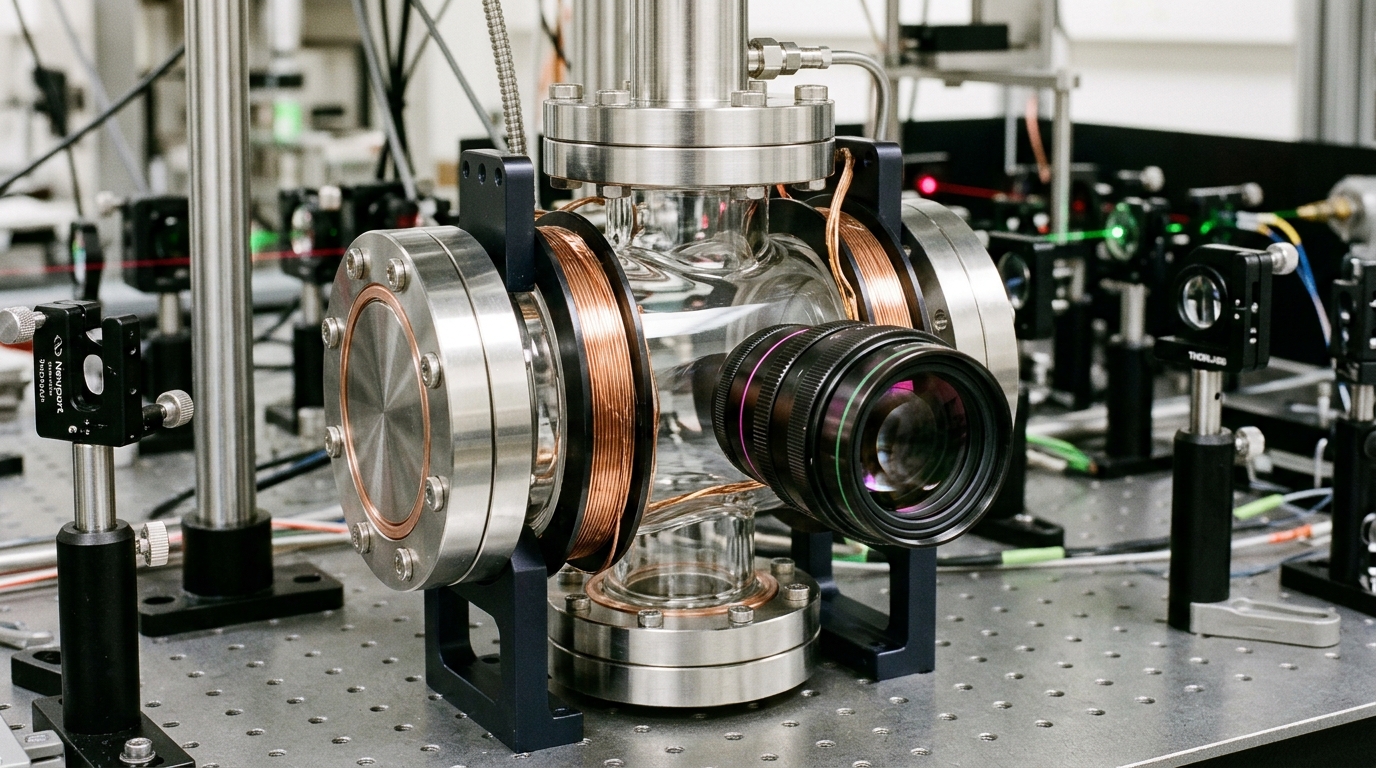
In an experimental study published in Science, an international team of researchers from Germany, Thailand, India, China, and the United States has for the first time created a three-component Hubbard system with tunable interactions in the laboratory. Led by Peter Schauss, who conducts research at the University of Hamburg and within the Cluster of Excellence called CUI: Advanced Imaging of Matter, the researchers used a quantum gas microscope to make individual atoms visible with spatial resolution. The peer-reviewed investigation, titled “Quantum gas microscopy of three-flavor Hubbard systems” and published on November 5, 2026, sought to detect fundamental quantum states and phases directly within the laboratory experiment, establishing an empirical foundation for future quantum simulations in materials science and nuclear physics.
Ultracold atoms held in an optical lattice provide an established platform for conducting quantum simulations by constructing systems that closely resemble those encountered in solid-state physics. Within this experimental framework, fermionic atoms occupy the lowest energy state of the optical lattice and effectively play the role of electrons moving through a solid material. These atoms form a quantum system in which they tunnel from one lattice site to another, effectively swapping places. Under fundamental quantum mechanics, identical fermions cannot occupy the exact same location. However, when distinguishable fermions meet at a single lattice site, an interaction energy arises that depends directly on an externally applied magnetic field.
This arrangement realizes the Hubbard model, which stands as one of the most important theoretical models used to describe the interactions of fermions on a lattice. The Hubbard approach is considered particularly promising for understanding high-temperature superconductivity. The standard Hubbard model typically considers only two spin states, specifically spin-up and spin-down. By contrast, incorporating a tunable third component makes the system significantly more versatile, enabling researchers to investigate substantially richer quantum mechanical phases. Adding this third state also allows physicists to observe how the conventional two-component model reacts to an additional component, offering new avenues to explore major open questions.
Theorists have long encountered major computational and conceptual hurdles when trying to resolve the Hubbard model. Study co-author Kaden Hazzard, an associate professor of physics and astronomy at Rice University, highlighted the deep challenges associated with analyzing these lattice systems. “Although the Hubbard model is important and simple to write down, it isn’t easy to solve. Theorists have been banging our heads on the two-component Hubbard model for decades, yet there are still major open questions. Adding a third tunable component lets us see how the two-component model reacts to it, potentially helping us answer these major questions,” Hazzard said. Hazzard further emphasized the close collaboration between theory and experiment: “The experiments are a wonderful testing ground for the theoretical ideas. [First name] Sohail and I were able to compare sophisticated numerical calculations to the experiments, which are already pushed to the boundaries of our capabilities. These comparisons will feed back into helping us refine our theoretical tools. It’s an exciting and fast-developing time.”
To observe individual particles with precise spatial resolution, the researchers implemented a quantum gas microscope that detects each individual atom. By utilizing atoms prepared in different internal states, the experiment realized distinct types of fermions, allowing the team to ultimately employ three distinct states. This architecture results in a physical system that is very different from the conventional electrons on a lattice known from solid-state physics. Instead, the three-component setup resembles systems in nuclear physics, where quarks can possess three different colors.
A critical milestone of the investigation was the direct observation of a Mott state. “It was particularly important to us to observe a so-called Mott state, in which the interactions suppress the double occupation of sites,” Schauss explained. In this regime, strong interactions prevent particles from flowing freely between lattice sites, leading directly to insulating behavior. Paradoxically, it is near such Mott states that high-temperature superconductivity emerges. Maintaining the stability of the ultracold atomic gas was essential to making these observations. “It turned out that the experimental realization is surprisingly stable,” Schauss said. “Usually, one fears that three-body collisions could quickly destroy the system. Despite this potential danger, we were able to successfully carry out the measurements and observe a Mott insulator.”
Beyond observing the Mott insulator, the research team identified many other quantum phases, which depend directly on the interaction strengths between the three distinct states in each configuration. In the same experimental system, the researchers found that ferromagnetic correlations between two states and antiferromagnetic correlations between two others can occur simultaneously. In addition, the researchers developed a specialized method for determining the number of triple-occupied lattice sites. The experimental values measured by the team agreed with the results of numerical calculations performed by collaborators at Rice University.
Looking ahead, the researchers plan to further refine the tunable interactions within their laboratory model so they can study lattice models of quantum chromodynamics in the laboratory. The research was supported by multiple funding bodies, including the National Science Foundation under grant awards PHY-1848304 and DGE-2346014, the Robert A. Welch Foundation under grant C-1872, and the W. M. Keck Foundation under grant 995764, under Science digital object identifier 10.1126/science.adv1247.
Subject of Research: Quantum gas microscopy of a three-component Hubbard system
Article Title: Quantum gas microscope: Interactions in a 3-component Hubbard system can be precisely controlled
Article References: Quantum gas microscope: Interactions in a 3-component Hubbard system can be precisely controlled. Original publication (Bibliographic details unavailable.)
Image Credits: AI Generated
DOI: Not provided
Keywords: Quantum gas microscope, Hubbard model, Ultracold atoms, Mott insulator, Quantum simulation, Fermions, Condensed matter physics, Nuclear physics, Quantum, microscope, Interactions, component
Cite Scienmag News
Katie Riggs. (November 8, 2026). Researchers Control Three-Component Hubbard System Using Quantum Gas Microscope. Scienmag. https://scienmag.com/researchers-control-three-component-hubbard-system-using-quantum-gas-microscope/
Katie Riggs. "Researchers Control Three-Component Hubbard System Using Quantum Gas Microscope." Scienmag, 8 November 2026, https://scienmag.com/researchers-control-three-component-hubbard-system-using-quantum-gas-microscope/. Accessed 10 November 2026.
Katie Riggs. "Researchers Control Three-Component Hubbard System Using Quantum Gas Microscope." Scienmag. November 8, 2026. https://scienmag.com/researchers-control-three-component-hubbard-system-using-quantum-gas-microscope/




