


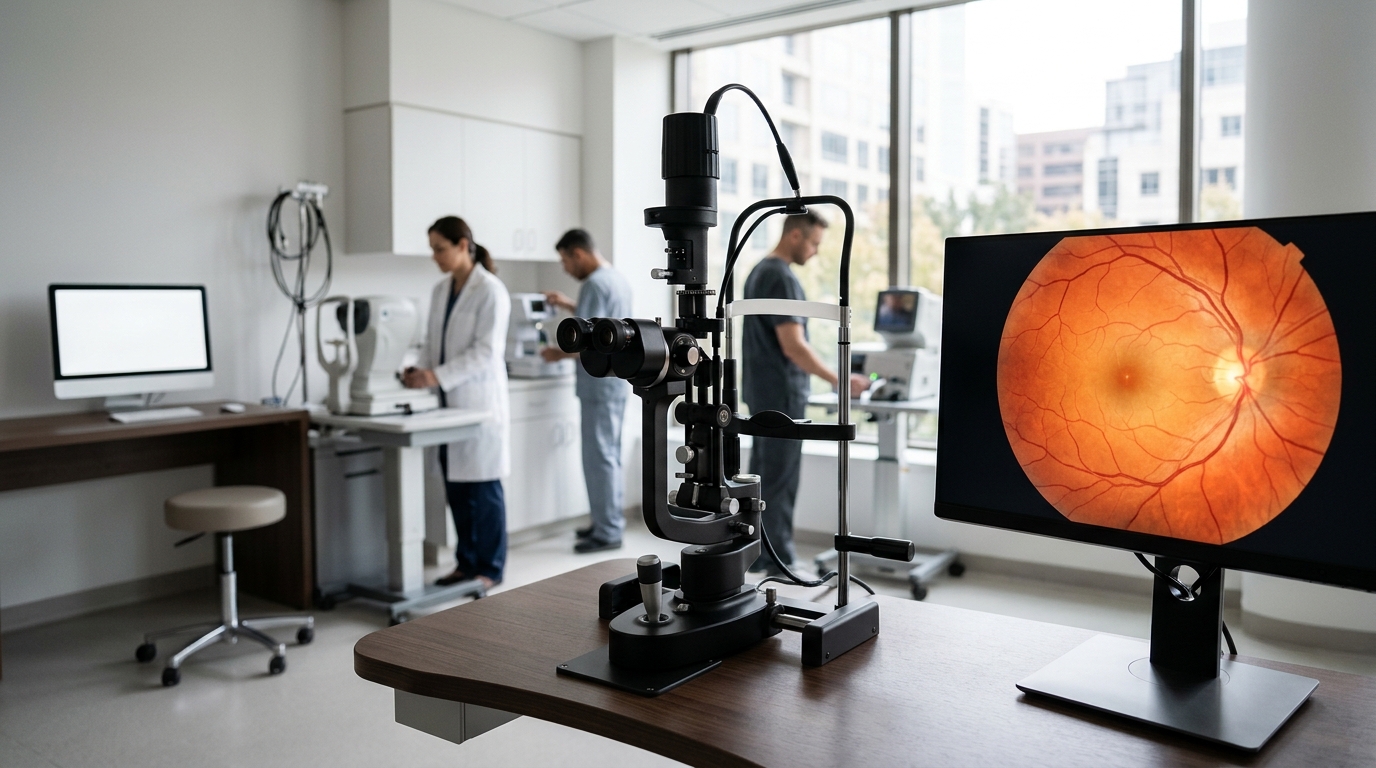
The patient, a cigarette smoker with no known systemic or ocular disease, arrived approximately four hours after the onset of sudden, painless, severe visual loss in the left eye. His visual acuity measured hand motion at 30 centimeters in the affected eye, while the right eye remained at 20/20. Intraocular pressure was 21 mmHg in both eyes. Initial color fundus photography revealed two traceable refractile emboli within retinal arteries: one sitting in a superotemporal arterial branch, the other at the optic disc and peripapillary arterial segment near the nerve head.
During an approximately 30-minute interval before any ophthalmic treatment could begin, while the patient was undergoing emergency neurological evaluation, his visual acuity improved on its own from hand-motion perception at 30 centimeters to counting fingers at the same distance. Repeat fundus photography captured a remarkable divergence: the superotemporal embolus remained fixed at the same arterial branch location, while the disc and peripapillary embolus had migrated into an inferior retinal arterial branch.
Optical coherence tomography added a second layer of evidence. Initial macular scans showed preserved foveal architecture without conspicuous diffuse inner-retinal thickening or hyperreflectivity, an intriguing finding given the severity of the presenting visual loss. Serial peripapillary OCT scans then provided supportive evidence of short-interval positional change in vascular-associated hyperreflective material corresponding to the migrating embolus.
Fluorescein angiography performed after the visual improvement showed near-complete retinal vascular filling, a pattern consistent with reperfusion of the retinal circulation. Same-day brain magnetic resonance imaging showed no acute infarction, an important negative finding given that retinal ischemia can signal broader cerebrovascular risk.
The authors are careful about what this temporal sequence does and does not prove. Papaverine was administered only after the spontaneous improvement had already occurred, so a treatment effect cannot be inferred from the recovery. The report’s conclusions state plainly that the temporal association is descriptive and does not establish that embolus migration caused the visual recovery. The case documents contrasting short-interval behavior of two traceable emboli during spontaneous recovery from transient retinal ischemia, but the mechanism linking migration to improved perfusion remains an association observed on imaging rather than a demonstrated causal chain.
The report emphasizes that rapid symptom resolution should not defer systemic vascular and cardiac evaluation. In this patient, cardiology evaluation was recommended, but dedicated cardiac investigations were not completed, leaving the full embolic workup unfinished.
Acute retinal ischemia can cause profound monocular visual loss, and visible retinal emboli are known to move, fragment, disappear or remain stable. What makes this report uncommon, according to its background section, is the spontaneous short-interval documentation of different behaviors among independently traceable emboli.
The multimodal imaging approach proved central to the observation. Color fundus photography established the baseline positions of both refractile emboli and documented the superotemporal embolus holding its position while the disc and peripapillary embolus shifted into an inferior branch. Macular OCT ruled out conspicuous diffuse inner-retinal structural damage at presentation, and serial peripapillary OCT tracked the positional change of hyperreflective material associated with the migrating embolus. Post-improvement fluorescein angiography then verified near-complete vascular filling.
At one week, the patient’s visual acuity had recovered to 20/20, completing a striking arc from hand-motion perception to full acuity within days.
Subject of Research: Short-interval imaging of two retinal emboli showing contrasting behavior during spontaneous visual recovery in transient retinal ischemia
Article Title: Contrasting short-interval behavior of two retinal emboli during spontaneous visual recovery in transient retinal ischemia: a multimodal imaging case report
Article References: Fu, R., & Wang, J. (2026). Contrasting short-interval behavior of two retinal emboli during spontaneous visual recovery in transient retinal ischemia: a multimodal imaging case report. BMC Ophthalmology. https://doi.org/10.1186/s12886-026-05501-5
Image Credits: AI Generated
DOI: 10.1186/s12886-026-05501-5
Keywords: retinal emboli, retinal ischemia, optical coherence tomography, fluorescein angiography, carotid stenosis, visual recovery, BMC Ophthalmology, case report, fundus photography, embolus migration, Contrasting, short-interval
Cite Scienmag News
Ophelia Keating. (November 8, 2026). Two Retinal Emboli, Two Behaviors: One Migrated While Vision Spontaneously Returned. Scienmag. https://scienmag.com/two-retinal-emboli-two-behaviors-one-migrated-while-vision-spontaneously-returned/
Ophelia Keating. "Two Retinal Emboli, Two Behaviors: One Migrated While Vision Spontaneously Returned." Scienmag, 8 November 2026, https://scienmag.com/two-retinal-emboli-two-behaviors-one-migrated-while-vision-spontaneously-returned/. Accessed 17 November 2026.
Ophelia Keating. "Two Retinal Emboli, Two Behaviors: One Migrated While Vision Spontaneously Returned." Scienmag. November 8, 2026. https://scienmag.com/two-retinal-emboli-two-behaviors-one-migrated-while-vision-spontaneously-returned/




