


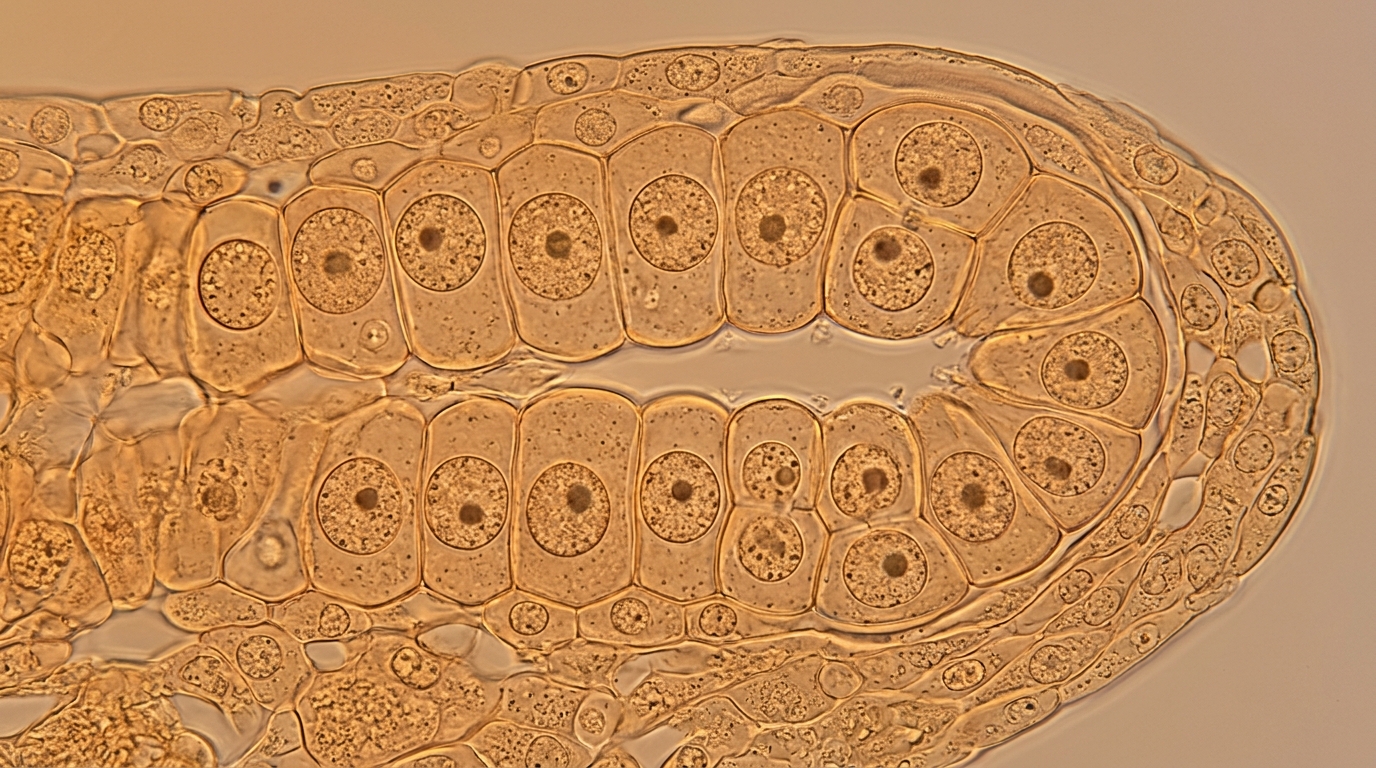
Researchers have identified a specific mode of stem cell division that drives brain formation in Oikopleura dioica, a small marine invertebrate belonging to the subphylum Tunicata. Published in Development Genes and Evolution, the study demonstrates that reiterated unequal stem cell divisions are involved in generating the neural cells of this simple chordate. The findings provide the first examples of this particular type of stem cell division during brain formation in non-vertebrate deuterostomes, offering new insights into the evolutionary conservation of neural development mechanisms.
The study focused on the larval development of O. dioica, an organism that serves as a promising model for developmental biology due to its transparent body, small size, and invariant cell lineages. The larvae hatch three hours after fertilization and complete organogenesis by seven hours after hatching, reaching a fully functional juvenile state at ten hours after fertilization. The brain, or cerebral ganglion, is located in the rostral region of the trunk and comprises 96 cells in the functional juvenile, compared to 28 cells in the brain-forming region of the hatched larva.
Using live imaging techniques, the researchers observed two large neuroblasts in the anterior and middle regions of the brain-forming area in hatched larvae. These neuroblasts underwent a series of oriented unequal divisions, producing a chain of small daughter cells that differentiate into neural cells. The anterior neuroblast produced at least 19 neural cells, while the posterior neuroblast generated at least 11, accounting for a total of at least 30 neural cells out of the 96 total brain cells before the completion of brain formation.
The process of stem cell division in the anterior neuroblast was characterized by a consistent pattern of movement and alignment. The daughter cells, which were postmitotic, first moved toward the dorsal side of the brain and then turned in the anterior direction. They aligned in a single line according to their birth order and exhibited collective movement to accumulate in the anterior part of the brain. This migration took approximately one hour and 50 minutes for the daughter neural cells to reach the anterior tip of the brain after their birth.
The origin of the anterior neuroblast was traced back to the right-anterior blastomeres of the eight-cell embryo and the right a222 blastomere of the 64-cell embryo. This lineage was confirmed through photo-convertible fluorescent labeling and serial block face scanning electron microscopy. The neuroblast showed two rounds of nuclear membrane breakdown before hatching, suggesting that stem cell division may have already been initiated during the embryonic stage. The cell cycle duration for the anterior neuroblast averaged 20 minutes in some specimens, with the number of cell divisions after hatching being at least 19.
In contrast, the posterior neuroblast, located in the middle region of the brain, also exhibited reiterated unequal stem cell divisions but ceased dividing earlier, at five hours after hatching. The number of cell divisions for the posterior neuroblast was counted as 11 in the best-recorded specimen. Unlike the anterior neuroblast, the daughter cells of the posterior neuroblast were not aligned in a single line, making it more difficult to determine their final accumulation site within the brain.
The study highlights the distinct nature of stem cell divisions in O. dioica compared to other animals. In mammals, stem cell divisions in the cerebral cortex involve equal-sized daughter cells because the stem cells grow during each cell cycle. In O. dioica, however, the neuroblasts are large and divide unequally in size to generate small progeny, likely due to the rapid development of the organism and the lack of space for neuroblast growth.
The findings suggest that the formation of the brain by stem cell divisions is a widely conserved feature of brain-forming processes in various animals, independent of the size of the brain. The study also notes that the types and functions of individual brain cells in O. dioica remain largely unknown, with the exception of a few sensory neurons and GABAergic neurons. The neuroblasts may sequentially generate different types of neural cells in a stereotypical order, similar to what is observed in Drosophila embryos.
The research was conducted using a combination of live imaging, fluorescent protein labeling, and serial block face scanning electron microscopy. The larvae were immobilized by cutting off their tails or suppressing notochord development using Brachyury DNAi. Time-lapse movies were recorded using a wide-field microscope, and cell lineages were traced using SIMI BioCell software. The datasets of 4D time-lapse images are available in the Dryad repository for further analysis.
This study contributes to the understanding of the evolutionary origins of brain formation in chordates. It raises questions about whether this type of stem cell division is retained in other chordates or if it was lost in deuterostome lineages and regained in appendicularians. Further exploration of sequential unequal stem cell divisions in other deuterostomes, such as ascidians, could provide additional insights into the conservation and deep homology of stem cell divisions and mechanisms of brain formation.
The study, conducted by a team including Misako Konishi, Kanae Kishi, Ryo Morita, Atsuko Yamada, Takeshi A. Onuma, and Hiroki Nishida, utilized Oikopleura dioica as a model organism due to its specific developmental advantages. The embryos and larvae are transparent and small, measuring approximately 100 micrometers, and consist of a small number of cells, with adults containing around 4,000 cells. A critical feature of this organism is that cell lineages are invariant between individuals, a characteristic documented since early twentieth-century studies. Furthermore, the organism exhibits rapid development, with organ formation proceeding within seven hours from the hatching of larvae at three hours after fertilization to the completion of organ formation in fully functional juveniles at ten hours. At this juvenile stage, most somatic cells are postmitotic, and each cell increases in size to grow into a sexually mature adult on the fifth day. These features make larvaceans a promising model for developmental studies of chordates, particularly for investigating organ formation processes using live imaging at the single-cell level.
The experimental design involved immobilizing swimming larvae for time-lapse movies by cutting off their tails immediately after hatching with a fine knife made of tungsten wire. In other experiments, notochord development in the tail was suppressed by Brachyury DNAi to facilitate observation. Double-stranded PCR products of Brachyury were injected into the ovarian cytoplasm, a method that did not affect trunk development. Live imaging of nuclei and chromosomes was performed using fluorescent proteins at 20 degrees Celsius. Histone 2B-EGFP mRNA was injected into the ovary syncytium of females on day five, approximately half a day before spawning. After spawning and fertilization, embryos with the highest fluorescence intensity were selected and imaged after hatching. Larval development was recorded using a wide-field microscope equipped with DeltaVision technology. Twenty optical z-sections at a resolution of 896 by 896 pixels were recorded at 2 micrometer slice intervals through the trunk in most cases. The time-lapse interval was one or two minutes. To visualize the cell membrane, FM-1-43 FX was used in seawater, with larvae transferred into FM seawater for at least 15 minutes before imaging to ensure adequate staining.
To trace the embryonic origin of the neuroblast, the researchers employed photo-convertible nls-Kaede protein. This protein was injected into the ovary syncytium, and specific blastomeres were exposed to ultraviolet light to convert fluorescence from green to red. In one experiment, the left or right blastomeres at the two-cell stage were labeled, and the descendants were detected five to seven hours after hatching. The anterior region of the brain showed red fluorescence when the right blastomere was labeled, indicating that the neuroblast was derived from the right blastomere of the two-cell embryo. In another experiment, the animal or vegetal hemisphere at the eight-cell stage was labeled. The results clearly showed that the neuroblast had an animal-hemisphere origin. Finally, serial block face scanning electron microscopy data of the hatched larvae and cell lineage data were used to trace the embryonic origin of the neuroblast. A cell with a relatively large nucleus and a huge amount of cytoplasm was recognized within the brain-forming region, demonstrating a clear boundary between the surrounding epidermal and endodermal cells just after hatching. The maximal cell size in the serial section was 14.7 micrometers, and the length along the anterior-posterior axis was 21.0 micrometers. A nucleus was observed in the anterior region of the cell with a size of 5.2 micrometers. No remarkable differences in the cytoplasmic architecture were observed between the neuroblast and the surrounding cells.
The study also examined the evolutionary context of these findings. Sequential unequal stem cell divisions without stem cell growth have been observed in protostomes, such as insects and annelids. In Drosophila neurogenesis, larval neuroblasts in the ventral neurogenic region generate a chain of small ganglion mother cells by three to 18 sequential unequal stem cell divisions. In leech embryogenesis, blastomeres called M, N, O/P, and Q teloblasts generate a chain of several dozen blast cells by highly unequal stem cell divisions. The results from Oikopleura dioica provide the first examples of this kind of stem cell division during brain formation in non-vertebrate deuterostomes. It is unknown whether this type of stem cell division is retained up to chordates or lost in deuterostome lineages and regained in appendicularians. In ascidians, which constitute tunicates together with appendicularians, the formation and cell lineages of the larval brain have been well described. The larvae of Ciona intestinalis have 177 neurons in the central nervous system. To date, no evidence of stem cell division has been obtained in ascidian larval brain formation, although stem cell divisions may occur during the formation of the adult brain during metamorphosis.
Subject of Research: Stem cell divisions in brain formation of Oikopleura dioica
Article Title: Formation of the brain by stem cell divisions of large neuroblasts in Oikopleura dioica, a simple chordate
Article References: Konishi, M., Kishi, K., Morita, R., Yamada, A., Onuma, T. A., & Nishida, H. (2023). Formation of the brain by stem cell divisions of large neuroblasts in Oikopleura dioica, a simple chordate. Development Genes and Evolution, 233(1), 35-47. https://doi.org/10.1007/s00427-023-00704-y
Image Credits: AI Generated
DOI: 10.1007/s00427-023-00704-y
Keywords: Oikopleura dioica, stem cell division, neuroblast, brain formation, chordate, deuterostome, developmental biology, unequal division, larval development, neural cells, Formation, brain
Cite Scienmag News
Cassandra Pierce. (November 8, 2026). Large Neuroblasts Build Brain in Simple Chordate. Scienmag. https://scienmag.com/large-neuroblasts-build-brain-in-simple-chordate/
Cassandra Pierce. "Large Neuroblasts Build Brain in Simple Chordate." Scienmag, 8 November 2026, https://scienmag.com/large-neuroblasts-build-brain-in-simple-chordate/. Accessed 20 November 2026.
Cassandra Pierce. "Large Neuroblasts Build Brain in Simple Chordate." Scienmag. November 8, 2026. https://scienmag.com/large-neuroblasts-build-brain-in-simple-chordate/




