


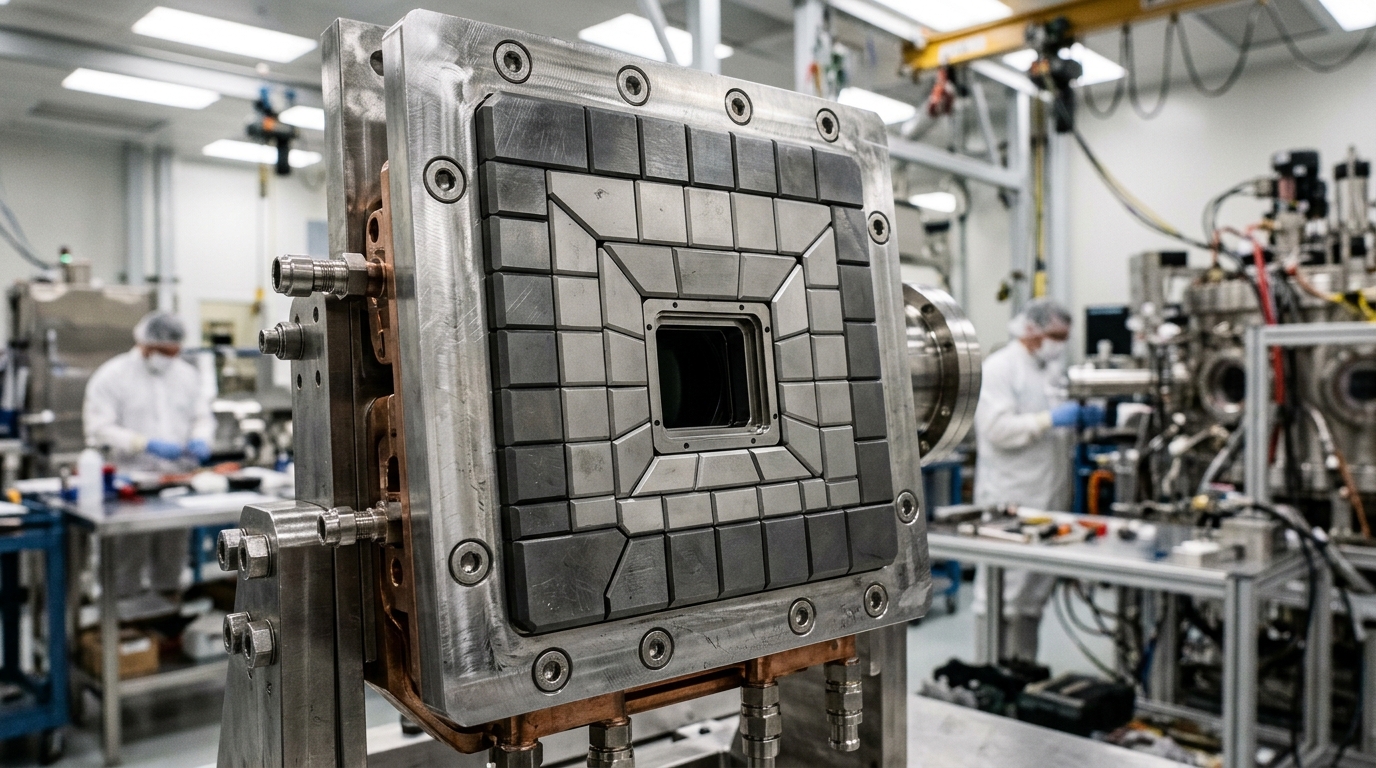
Researchers at the ITER Organization in France have demonstrated a mesoscale Porous-Media Approach capable of estimating steady-state temperature fields within actively cooled Diagnostic First Walls in quasi-real time, achieving agreement within about seven percent of high-fidelity simulations at critical plasma-facing hot spots. The investigation, conducted by Nathaniel Saura, Joao Nunes, Joris Paret, and Daniel Iglesias, adapts porous homogenization principles to drastically reduce the computational burden of monitoring reactor plasma-facing components. In this framework, the Diagnostic First Wall is mathematically treated as an equivalent homogeneous medium where microscopic cooling conduits are replaced by volume-averaged closure terms embedded in an enthalpy transport equation. Slice-wise steady-state thermal profiles are generated by the meshfree finite element solver MkniX in roughly ten to fifteen seconds, after which a signed distance function-based linear interpolation scheme reconstructs the complete three-dimensional temperature field in under one second. Validated against detailed numerical data from an Equatorial Port Plug component, the surrogate approach successfully reproduces dominant thermal gradients, marking a significant step toward automated thermal surveillance within the ITER Tokamak System Monitor.
As the world’s largest experimental fusion facility currently under construction to demonstrate controlled nuclear fusion at power plant scale, ITER subjects internal hardware to severe environmental conditions characterized by extreme thermal loads, high-energy neutron bombardment, and powerful magnetic fields. Among the most vulnerable structures are the Diagnostic First Walls, which shield diagnostic port plugs from direct plasma interactions while sustaining intense surface radiative heat fluxes and volumetric nuclear heating. Official operational criteria specify a uniform radiative heat flux of 350 kilowatts per square meter applied across the front boundary, combined with steep radial volumetric heat generation profiles induced by fusion neutrons penetrating the steel shielding. These extreme energy inputs generate intense internal temperature gradients capable of producing severe static and cyclic fatigue stresses. Active internal water cooling is therefore mandatory to maintain overall structural integrity, keeping peak material temperatures and thermal strain levels safely below strict regulatory thresholds during regular fusion plasma operations.
To protect these diagnostic assemblies, engineers have designed intricate cooling networks embedded deep within thick stainless steel shielding blocks, but verifying their thermal behavior remains computationally demanding. Traditional engineering design workflows rely on high-fidelity numerical solvers such as ANSYS CFX, which utilize finite volume meshes consisting of millions of elements to capture turbulent coolant hydraulics and conjugate heat transfer. Although these high-fidelity simulations provide accurate thermal distributions, solving a single actively cooled diagnostic component requires days or weeks of high-performance computing, making them impractical for operational inter-shot assessments or quasi-real-time monitoring. To address this computational bottleneck, the ITER Organization has been developing the Tokamak System Monitor, a centralized software platform designed to ingest multi-channel sensor data, identify anomalies, evaluate electromagnetic loads during disruption events, and reconstruct real-time thermal distributions across Equatorial Port Plugs. Integrating rapid surrogate models into this monitoring architecture is essential to deliver instant feedback on component health between consecutive plasma pulses.
The mesoscale Porous-Media Approach resolves this speed limitation by reformulating the conjugate heat transfer problem through volume-averaging theory, bypassing the need to resolve microscopic boundary layers around individual fluid pipes. Under this mathematical formulation, the physical cooling channels are eliminated from the computational mesh and replaced by effective thermohydraulic properties representative of the coupled solid-fluid domain. The volume-averaged specific enthalpy transport equation governs heat conduction through the solid body while incorporating fusion nuclear heating and a localized volumetric heat exchange term. This thermal exchange is governed by an effective volumetric resistance defined by the local fluid volume fraction, the hydraulic diameter of the cooling conduits, and the convective heat transfer coefficient. Because coolant water flows in a fully turbulent regime through smooth cylindrical passages, the heat transfer coefficient is calculated directly from empirical Dittus-Boelter Nusselt correlations using Reynolds and Prandtl numbers, eliminating the necessity to evaluate cross-sectional flow profiles explicitly.
The researchers tested this homogenized formulation on the Generic Equatorial Diagnostic First Wall, a standardized shielding block composed of 316L(N)-IG grade stainless steel measuring 0.247 meters in radial thickness, 0.513 meters in toroidal width, and 0.955 meters in poloidal length. The underlying cooling architecture consists of four distinct radial pipe layers separated by distances calibrated against the radial penetration depth of nuclear heating. The front layer situated closest to the burning plasma contains twenty-five small pipes with diameters of 15.2 millimeters, whereas the three deeper internal layers contain twelve pipes each with larger diameters of 22 millimeters. To apply the homogenization methodology, the authors partitioned the cross-section into four rectangular porous regions bounded by the mid-planes between adjacent cooling rows and the outer front and back walls. Local fluid porosity was assigned to each layer based on the ratio of cumulative pipe cross-sectional area to region volume, yielding porosity values of 0.236, 0.162, 0.127, and 0.105 from front to back.
A critical innovation in the model formulation is the spatial localization of heat extraction, which prevents artificial uniform heat sinks from overcooling entire porous sub-regions. Instead of spreading thermal absorption evenly across each layer, the authors constructed a radial heat extraction profile by superimposing Gaussian-like distribution functions centered directly on the centerline radial coordinates of each pipe row. The amplitude of each Gaussian curve is governed by the analytical volumetric thermal resistance closure, while its standard deviation is constrained by setting the full width at half maximum equal to half of the corresponding pipe diameter. This formulation confines cooling effects strictly to the radial vicinity of the physical pipes. The resulting homogenized governing equations were solved on two-dimensional radial-toroidal slices using the MkniX meshfree finite element solver, utilizing unstructured grids ranging between 10,000 and 100,000 elements with high refinement along the front wall, converging to steady-state thermal equilibrium in approximately ten to fifteen seconds per plane.
To construct full three-dimensional temperature distributions without solving a massive three-dimensional system, the authors established a geometric interpolation procedure operating along the poloidal axis. This dimensional reduction is physically justified by the dominance of radial heat conduction over poloidal heat transport, as diagnostic evaluations demonstrated that poloidal heat fluxes remain negligible across most of the component and peak only in confined regions surrounding diagnostic apertures. The reconstruction framework first projects two-dimensional finite element nodal solutions onto a shared regular grid, defining valid domain binary masks. Next, intermediate geometric cross-sections are determined by performing linear interpolations between Signed Distance Functions representing adjacent reference planes, seamlessly capturing smooth geometric transitions and shape variations. Finally, temperature values are linearly blended across the intermediate domains using the calculated blending parameters. Because individual two-dimensional slices are thermally independent, they can be computed concurrently in parallel, allowing an entire three-dimensional temperature field to be assembled in roughly twenty seconds.
The surrogate architecture was evaluated quantitatively against detailed high-fidelity ANSYS CFX simulation data extracted from an approved internal report for the bottom section of Equatorial Port Plug 12. For this evaluation, the surrogate model reconstructed the steady-state thermal field across 110 poloidal planes interpolated from fourteen coarse reference slices, setting the coolant velocity to 5.0 meters per second to match mean front-channel velocities. In the narrow region near the plasma-facing surface, high-fidelity CFX calculations reported a minimum temperature of 218.65 degrees Celsius, a maximum peak of 353.66 degrees Celsius, an average temperature of 274.05 degrees Celsius, and a standard deviation of 31.45 degrees Celsius. In comparison, the MkniX surrogate model calculated a minimum of 242.73 degrees Celsius, a maximum of 328.49 degrees Celsius, a mean of 305.02 degrees Celsius, and a standard deviation of 13.14 degrees Celsius, capturing the prominent plasma-facing hot spot with a maximum relative error of 7.12 percent.
Despite accurately capturing peak surface temperatures, the quantitative comparison revealed systematic deviations attributable to the model’s simplifying assumptions. Over the entire component cross-section, the surrogate model produced an average temperature of 104.78 degrees Celsius compared to 160.53 degrees Celsius in the CFX benchmark, indicating significant overcooling across internal regions away from the plasma front. This discrepancy arose because applying a uniform 5.0 meter per second coolant velocity across all layers overpredicted heat removal in the larger rear conduits. Statistical distribution analyses demonstrated a consistent mean temperature shift of approximately 30.97 degrees Celsius near the front surface, with Wasserstein-2 distance calculations revealing that 97 percent of the mathematical transformation effort between the surrogate and reference distributions stemmed directly from this uncalibrated offset. Furthermore, the radial-only porosity formulation failed to resolve toroidal temperature gradients caused by coolant warming between inlets and outlets, while linear poloidal interpolation across widely spaced reference planes generated localized artificial hot spots near diagnostic apertures.
To overcome these limitations before operational deployment in fusion reactors, the researchers outlined targeted improvements for upcoming iterations of the Tokamak System Monitor platform. Future developments will incorporate multidimensional porosity formulations featuring toroidal and poloidal resistance kernels to resolve directional temperature variations and eliminate artificial interpolation artifacts near structural openings. Additionally, fluid flow velocities will be dynamically distributed across cooling branches using conservation principles analogous to Kirchhoff’s electrical circuit laws, preventing internal overcooling. The research team also plans to introduce temperature-dependent thermophysical properties for the 316L(N)-IG stainless steel structure, noting that its thermal conductivity increases by roughly 40 percent and specific heat by 18 percent between 70 and 400 degrees Celsius. While the Tokamak System Monitor software and underlying operational datasets remain proprietary under ITER Organization data governance policies, efforts toward an open-source software release are underway, establishing a pathway toward certified quasi-real-time thermal monitoring for future nuclear fusion facilities.
Subject of Research: Quasi-real-time thermal surrogate modeling for actively cooled ITER diagnostic first walls
Article Title: Thermal surrogate modelling for the monitoring of actively cooled first wall components in ITER
Article References: Saura, N., Nunes, J., Paret, J., & Iglesias, D. (2026). Thermal surrogate modelling for the monitoring of actively cooled first wall components in ITER. Frontiers in Physics, 14, Article 1947382. https://doi.org/10.3389/fphy.2026.1947382
Image Credits: AI Generated
DOI: 10.3389/fphy.2026.1947382
Keywords: ITER, diagnostic first wall, thermal surrogate modeling, porous media approach, MkniX solver, signed distance functions, plasma-facing components, nuclear fusion, Thermal, surrogate, modelling, monitoring
Cite Scienmag News
Ophelia Keating. (November 7, 2026). Engineers Develop Fast Thermal Surrogate Model for ITER Diagnostic First Walls. Scienmag. https://scienmag.com/engineers-develop-fast-thermal-surrogate-model-for-iter-diagnostic-first-walls/
Ophelia Keating. "Engineers Develop Fast Thermal Surrogate Model for ITER Diagnostic First Walls." Scienmag, 7 November 2026, https://scienmag.com/engineers-develop-fast-thermal-surrogate-model-for-iter-diagnostic-first-walls/. Accessed 10 November 2026.
Ophelia Keating. "Engineers Develop Fast Thermal Surrogate Model for ITER Diagnostic First Walls." Scienmag. November 7, 2026. https://scienmag.com/engineers-develop-fast-thermal-surrogate-model-for-iter-diagnostic-first-walls/




