


Published in Applied Physics B, the study proposes a novel method for handling the large datasets generated by computational imaging systems. By treating one-dimensional light intensity measurements as audio signals, the team utilized codecs such as FLAC, MP3, and Ogg Vorbis to compress data before reconstruction. This approach addresses a fundamental bottleneck in single-pixel imaging, where increasing image resolution leads to a proportional increase in the volume of measured light intensity data.
Single-pixel imaging reconstructs an object’s image using a single-point photodetector and a sequence of mask patterns. Unlike conventional sensors like charge-coupled devices or complementary metal-oxide-semiconductors, which face inherent trade-offs between resolution, frame rate, and sensitivity, single-pixel imaging decouples sensitivity from spatial resolution. The technique modulates the scene with pre-designed spatial patterns, and the resulting modulated light is integrated onto the detector. This produces a one-dimensional time-series of intensity measurements, which are then computationally reconstructed into a target image. However, as target resolution scales toward gigapixel levels, the required number of patterns and the resulting data volume increase substantially, creating a significant challenge for storage and transmission.
The study focuses on compressing the raw one-dimensional intensity data directly, rather than compressing the final two-dimensional image after reconstruction. This distinction is critical for applications involving resource-constrained edge devices, where reducing the memory footprint during data storage and transmission is essential. Furthermore, single-pixel imaging can be extended beyond two-dimensional imaging to three-dimensional profiling and complex-amplitude measurements. For these multidimensional modalities, directly compressing the raw signal offers greater versatility than conventional two-dimensional image compression formats. The researchers noted that to their knowledge, the application of dedicated audio compression to single-pixel imaging data had not been extensively explored prior to this work.
The proposed method involves calculating differential intensity signals before compression. In Hadamard single-pixel imaging, the researchers calculated the difference between light intensities measured under positive and negative mask projections. For Fourier single-pixel imaging, they determined the real and imaginary parts using a phase-shifting technique. Compressing these differential signals, rather than individual raw measurements, eliminates common-mode components such as background ambient light and low-frequency spatial biases. This process reduces information entropy and narrows the dynamic range of the input signal. Because lossy audio codecs introduce quantization noise proportional to the signal’s peak amplitude, reducing the dynamic range significantly minimizes absolute quantization errors, thereby preserving critical structural details of the target image.
The team evaluated the performance of three audio codecs: FLAC, MP3, and Ogg Vorbis. FLAC is a lossless compression format based on linear pulse code modulation, which partitions signals into short-duration blocks and applies variable-length coding to residuals. MP3 is a lossy format that discards information of low perceptual importance to human hearing, while Ogg Vorbis is a more modern lossy standard that offers higher audio quality at the same bitrate and excels in variable bitrate control. The researchers tested these codecs on ten distinct 128 by 128 pixel images, measuring file size, peak signal-to-noise ratio, and structural similarity index. The peak signal-to-noise ratio measures pixel-level error, while the structural similarity index assesses structural preservation by considering luminance, contrast, and structural changes.
In terms of compression efficiency, Ogg Vorbis consistently achieved smaller file sizes compared to MP3. At sampling rates of 16 kHz and 22.05 kHz, Ogg Vorbis yielded compact file sizes ranging from 8.24 to 11.51 kB, whereas MP3 required up to 22.54 kB under similar conditions. More importantly, this superior data reduction did not compromise reconstruction quality. Ogg Vorbis maintained high peak signal-to-noise ratio values between 18.44 and 26.88 dB, which scaled predictably with the quality level. In contrast, the peak signal-to-noise ratio for MP3 stagnated around 15 to 17 dB regardless of bitrate increases, indicating that the MP3 psychoacoustic model failed to effectively adapt to raw single-pixel imaging data sequences. The structural similarity index further validated this trend, with Ogg Vorbis achieving optimal values of 0.88 to 0.93 at Quality 9, while MP3 exhibited severe structural degradation, dropping to a minimum of 0.50 at 44.1 kHz.
Simulation results demonstrated that FLAC achieved compression ratios of 22.6% for Fourier single-pixel imaging and 24.7% for Hadamard single-pixel imaging. For lossy formats, MP3 and Ogg Vorbis reduced file sizes to 22.3% and 22.0% respectively for Hadamard single-pixel imaging, representing higher compression ratios than FLAC. However, the lossy formats introduced some degradation in image quality. Images reconstructed using MP3 exhibited low peak signal-to-noise ratio and structural similarity values, with banding noise appearing in the reconstructed images. Ogg Vorbis performed better, yielding a peak signal-to-noise ratio of 37.01 dB and a structural similarity index of 0.95 for Fourier single-pixel imaging, although slight noise was observed at the top of the image. FLAC, being lossless, fully preserved the bandwidth information, resulting in reconstructed images indistinguishable from the original uncompressed reconstructions.
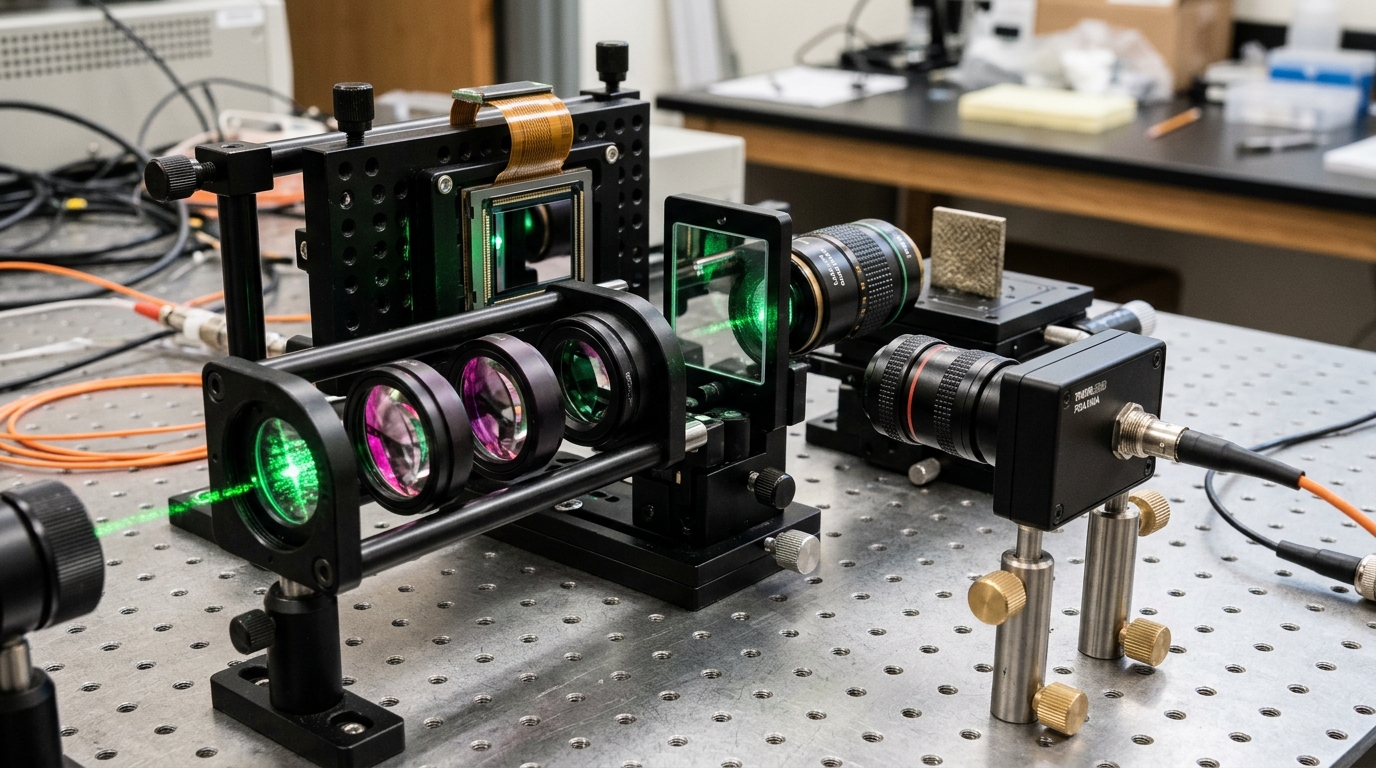
The optical experiments confirmed the findings from the simulations. The setup used a white LED as the light source, with light reflected by a digital micromirror device and focused by a lens onto a single-pixel sensor. The target object was a portion of a number “3” circled in red. In the optical experiments, the peak signal-to-noise ratio and structural similarity values for all compression formats were higher than those obtained in the simulations. The banding noise observed in the simulation results could not be confirmed in the optically reconstructed images using MP3 and Ogg Vorbis. This difference is likely because the environmental noise in the optical experiments was relatively larger than the impact of the noise introduced by compression, effectively masking the artifacts.
The choice of sampling rate and bitrate played a crucial role in determining the fidelity of the reconstructed images. The relationship between bitrate, sampling rate, and average bits per sample dictates a fundamental trade-off between quantization noise and aliasing. As the sampling rate decreases while keeping the bitrate constant, the bit-budget allocated to each measurement increases, resulting in higher precision for each light intensity value. However, when the sampling rate falls below a certain threshold, the system fails to satisfy the Nyquist-Shannon sampling theorem relative to the pattern modulation speed, leading to temporal aliasing and the loss of high-frequency spatial details. An optimal sampling rate of 32 kHz emerged in the experiments, representing an equilibrium point where the audio codec’s psychoacoustic model and bit-allocation algorithm best matched the statistical characteristics of the single-pixel imaging signal.
The study concludes that audio compression technologies offer a viable method for reducing data volume in single-pixel imaging. FLAC successfully reduced file size to approximately 22 to 24% for both Fourier and Hadamard single-pixel imaging without any degradation in reconstructed image quality. Lossy formats like MP3 and Ogg Vorbis achieved equivalent or higher compression ratios but introduced characteristic noise in the reconstructed images. MP3 produced prominent banding noise, leading to significant degradation, while Ogg Vorbis maintained image quality with minimal degradation despite some slight noise. The optical experiments yielded results generally consistent with the simulations, with image quality appearing better due to the dominance of environmental noise over compression-induced noise.
Subject of Research: Data compression for single-pixel imaging using audio codecs
Article Title: Data compression for single-pixel imaging using audio codecs
Article References: Aoki, R., Kondo, R., Sugimoto, K., Wang, F., Ito, T., & Shimobaba, T. (2026). Data compression for single-pixel imaging using audio codecs. Applied Physics B, 132(7), Article 88. https://doi.org/10.1007/s00340-026-08695-0
Image Credits: AI Generated
DOI: 10.1007/s00340-026-08695-0
Keywords: Data, compression, single-pixel, imaging, audio, codecs, scientific research
Cite Scienmag News
Denise Maddox. (November 7, 2026). Audio Codecs Compress Single-Pixel Imaging Data. Scienmag. https://scienmag.com/audio-codecs-compress-single-pixel-imaging-data/
Denise Maddox. "Audio Codecs Compress Single-Pixel Imaging Data." Scienmag, 7 November 2026, https://scienmag.com/audio-codecs-compress-single-pixel-imaging-data/. Accessed 7 November 2026.
Denise Maddox. "Audio Codecs Compress Single-Pixel Imaging Data." Scienmag. November 7, 2026. https://scienmag.com/audio-codecs-compress-single-pixel-imaging-data/




