


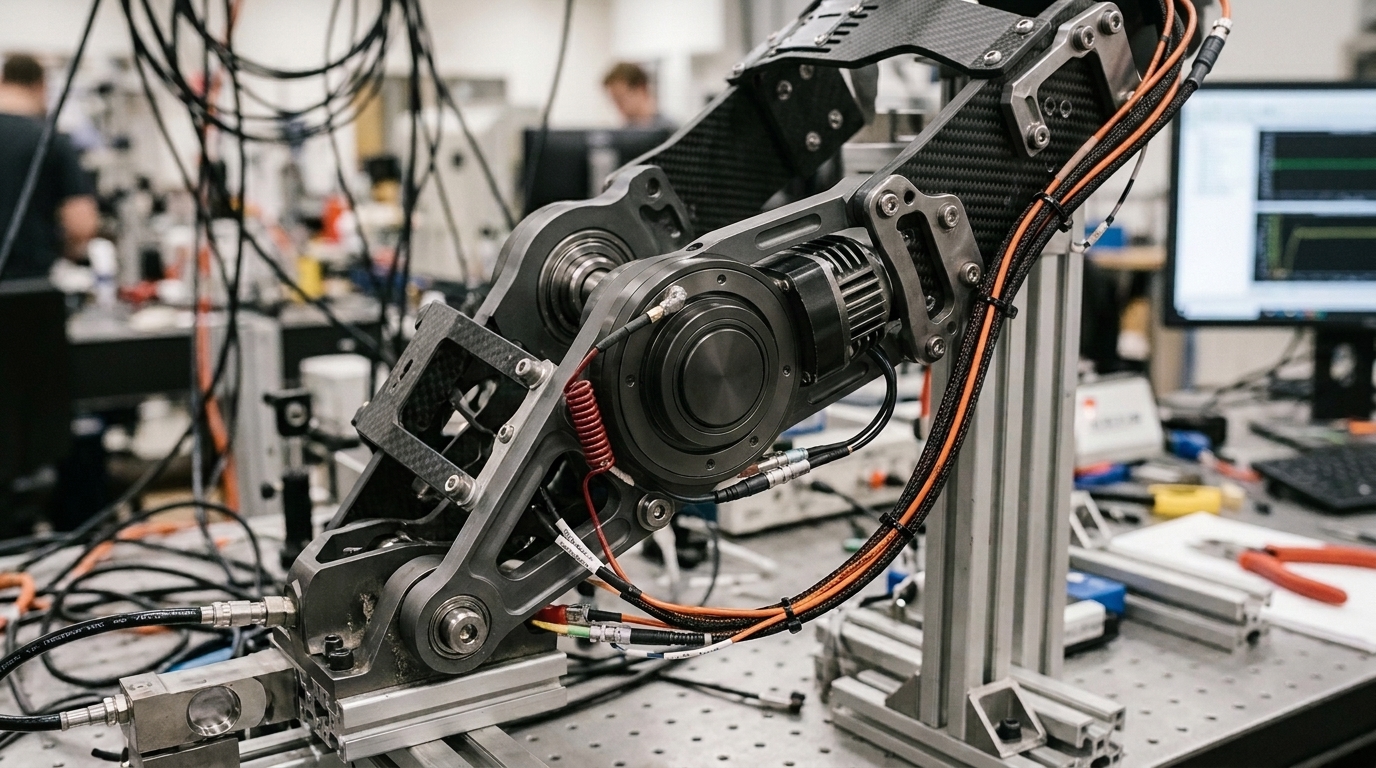
A computational study published in Discover Robotics demonstrates that combining two bio-inspired optimization algorithms enhances the transient response and stability of robotic lower-limb exoskeletons. Engineering researchers Nirbhay Raut, Ayush Karapagale, Akshit Gangwar, Harsh Goud, and Hari Narayan Bhargaw evaluated a hybrid algorithm termed GWBC, integrating Grey Wolf Optimization with the Artificial Bee Colony algorithm. Applied to Proportional-Integral-Derivative controllers across dynamic models of human hip and knee joints, the hybrid framework significantly curtailed settling delays and transient oscillations. Benchmark simulations revealed that the GWBC controller reduced settling times by seventy-one percent for the femur joint and by seventy-two point seven-nine percent for the tibia joint compared to classical tuning. Furthermore, peak overshoot dropped by seventy percent in the femur and ninety-eight percent in the tibia, highlighting the potential of hybrid swarm intelligence in assistive rehabilitation robotics.
Lower-limb robotic exoskeletons provide essential motor assistance for individuals recovering from spinal cord injuries, stroke conditions, and traumatic accidents. However, establishing stable joint control remains difficult due to nonlinear, time-varying human-robot interaction dynamics. Traditional control schemes often rely on fixed-gain controllers tuned through conventional offline procedures, including the classical Ziegler-Nichols method, the Chien-Hrones-Reswick rule, or built-in auto-tuning packages. While these deterministic approaches function adequately for stationary linear processes, they struggle to accommodate dynamic operating shifts, leading to tracking errors during gait motion. Modern metaheuristics and adaptive strategies, such as active disturbance rejection control, fuzzy logic, and neural networks, have been proposed to address these limitations. Nevertheless, such alternative frameworks frequently introduce excessive design complexity, heavy training requirements, or elevated computing costs, rendering their real-time application in rehabilitation exoskeletons challenging and motivating the development of more efficient controller tuning methodologies.
To rigorously evaluate optimization strategies without re-deriving biomechanical mechanics, the researchers utilized validated reduced-order linear dynamic models from established robotics literature. Adopted from previous work by M. S. Amiri, the equations represent the dominant physical behavior of the hip and knee joints linearized around a nominal upright walking posture. In this framework, the femoral joint transfer function G1 is defined as one divided by the polynomial s squared plus fifteen point thirty-three s plus thirty-one point ninety-six. Similarly, the tibial joint transfer function G2 is modeled as one divided by s squared plus forty-eight point sixty-seven s plus forty-seven point thirty-two. While simplified transfer functions omit higher-order coupling effects, they retain primary inertia, damping, and stiffness properties observed under moderate gait variations, providing a standardized benchmark to analyze controller convergence, transient trajectories, and tracking accuracy.
The control framework relies on a Proportional-Integral-Derivative architecture where the controller generates corrective inputs based on error between reference set-points and actual system outputs. Each component of the control law addresses distinct dynamic characteristics. The proportional term accelerates rise times but can introduce steady-state error if uncompensated. The integral term eliminates residual offsets by integrating accumulated tracking discrepancies, though excessive integral gains risk slowing system response and destabilizing loop margins. The derivative term provides damping against sudden overshoot by monitoring the rate of error change, though it increases sensitivity to measurement noise. Calibrating the three gains is crucial for dynamic stability. To assess candidate configurations quantitatively, the study utilized the Integral Time Absolute Error criterion, integrating time multiplied by absolute error. Minimizing this objective function ensures that optimization algorithms prioritize rapid error reduction and smooth transient settling.
The first standalone algorithm evaluated by the authors is the Grey Wolf Optimizer, a nature-inspired metaheuristic that mimics the social leadership hierarchy and hunting behavior of wolf packs. The population is categorized into four hierarchical tiers: alpha, beta, delta, and omega, where the top three individuals represent the primary guiding solutions. During optimization, other wolves update their spatial positions relative to these leaders through randomized coefficient vectors and a linearly decaying distance parameter. This mechanism enables rapid global exploration, allowing the algorithm to swiftly locate near-optimal solution regions and yielding fast rise times in step responses. However, simulations revealed that the algorithm’s persistent reliance on the top three leaders restricts its exploitation capacity during final iterations. Consequently, while standalone grey wolf optimization reaches reference levels rapidly, it struggles with fine-tuning, resulting in minor overshoot and slight transient oscillations.
In contrast, the Artificial Bee Colony algorithm demonstrates complementary strengths by simulating the distributed foraging strategies of honeybee colonies across three groups: employed, onlooker, and scout bees. Employed bees investigate assigned food sources by perturbing parameter coordinates relative to randomly selected neighboring solutions, evaluating fitness through an inverse error function. Onlooker bees evaluate shared nectar information at the hive, probabilistically selecting high-quality food sources for localized exploitation. When a candidate solution fails to yield improvement over a specified iteration limit, it is abandoned. The associated bee transforms into a scout bee that conducts random global exploration within bounded parameter limits. This mechanism preserves diversity and prevents premature convergence into local sub-optima. In exoskeleton joint simulations, the artificial bee colony method generated smoother trajectories with minimal overshoot, though its distributed search dynamic produced slower initial convergence than the wolf optimizer.
Recognizing these distinct operational traits, the authors developed the hybrid GWBC framework to sequentially harness rapid early convergence and stable local refinement. In Phase I, the algorithm initiates global search utilizing modified Grey Wolf Optimization. To promote a smoother transition between exploratory searching and exploitative refining, the authors incorporated a logarithmic decay function for the control parameter rather than conventional linear decay. Once the best fitness stalls beyond a defined threshold limit, Phase I terminates early. The algorithm then transfers the top-performing parameter set to Phase II, which deploys localized Artificial Bee Colony refinement. Candidate solutions are generated in the immediate neighborhood of the wolf-derived optimum, where employed and onlooker bees systematically optimize gain parameters while stagnation replacement prevents local trapping. By maintaining an identical population size across both phases, the hybrid structure facilitates consistent data transfer without inflating computational complexity.
To rigorously validate algorithm performance, the authors conducted comparative simulations in MATLAB across thirty independent runs, recording average metrics and standard deviations to assess stochastic variability. Convergence plots demonstrated that the GWBC framework stabilized its optimal parameters noticeably faster than standalone techniques. For the femoral joint model, the hybrid algorithm achieved constant best fitness within eighteen generations, whereas standalone grey wolf optimization required twenty-one iterations and the artificial bee colony algorithm required twenty-six iterations. In the tibial joint model, GWBC achieved constant fitness within just four generations, substantially outpacing standalone grey wolf optimization at eight iterations and the artificial bee colony algorithm at twelve iterations. Because subsequent iterations produced no change in best fitness values, these plateaus confirmed that the hybrid controller rapidly converged to estimated optimal parameter configurations, demonstrating higher computational efficiency across multiple independent trials.
Transient response evaluations confirmed marked improvements in rise time, settling duration, and overshoot suppression under the proposed hybrid tuning framework. For the femoral joint, GWBC recorded an average rise time of zero point one three zero plus or minus zero point zero zero six seconds, performing favorably against standalone bee optimization at zero point one six two seconds and standalone grey wolf optimization at zero point one one six seconds, while outperforming classical tuning at zero point four eight nine seconds. In the tibial joint, GWBC achieved a rise time of zero point two eight one plus or minus zero point zero two one seconds, outperforming standalone bee tuning at zero point three zero five seconds and conventional control at zero point eight one six seconds. Furthermore, GWBC restricted maximum overshoot to zero point zero nine plus or minus zero point zero four percent in the femur and zero point one plus or minus zero point zero two percent in the tibia, delivering substantially smoother reference tracking.
Dynamic robustness was verified using alternating pulse wave tracking and abrupt reference disturbance tests. The pulse wave response, which periodically alternated set-point values between zero and one, forced the controllers to execute continuous readjustments, confirming that GWBC maintained stable tracking across repeated transitions without destabilizing. When an abrupt fifty percent increase in reference magnitude was introduced to simulate severe disturbance conditions, the GWBC controller demonstrated faster error correction and a smoother return to steady state with visibly fewer oscillations than standalone algorithms. Furthermore, frequency response evaluations through Nyquist plots substantiated closed-loop stability across both joint models. The Nyquist contours avoided encirclement of the critical minus one point on the real axis, while exhibiting tighter spread along the imaginary axis. This reduced imaginary dispersion indicates enhanced damping against oscillatory behavior, verifying that the hybrid controller provides superior phase and gain margins during dynamic reference tracking.
In addressing parametric characteristics, the researchers noted that deterministic methods like Ziegler-Nichols and the MATLAB built-in PID tuner yield zero standard deviation because their analytical formulas compute identical gains for static plants, yet their overall dynamic performance remains substantially inferior to metaheuristic tuning. While the GWBC framework achieved strong performance across both second-order transfer functions, the authors recognized explicit limitations inherent to simulation-based validation. Specifically, simplified linear models cannot fully reflect physical hardware factors, such as mechanical noise, actuator saturation, sensor measurement errors, or complex biomechanical variations during human-robot interaction. Consequently, retuning would be required if the framework is applied to systems with divergent dynamic properties. The researchers concluded that future investigations will focus on experimental implementation, higher-order nonlinear plant modeling, and hardware-in-the-loop validation on physical robotic exoskeleton platforms to further examine control scalability and real-world clinical applicability.
Subject of Research: Hybrid metaheuristic optimization for robotic lower-limb exoskeleton control
Article Title: A hybrid grey wolf bee colony optimized PID controller for improved transient response and stability of lower limb exoskeleton system
Article References: Raut, N., Karapagale, A., Gangwar, A., Goud, H., & Bhargaw, H. N. (2026). A hybrid grey wolf bee colony optimized PID controller for improved transient response and stability of lower limb exoskeleton system. Discover Robotics, 2(1), Article 9. https://doi.org/10.1007/s44430-026-00022-8
Image Credits: AI Generated
DOI: 10.1007/s44430-026-00022-8
Keywords: lower-limb exoskeletons, PID controller, grey wolf optimizer, artificial bee colony, biomechanical modeling, transient response, control systems, rehabilitation robotics, hybrid, grey, wolf, colony
Cite Scienmag News
Denise Maddox. (November 7, 2026). Hybrid Swarm Algorithm Optimizes Exoskeleton Joint Control and Stability in Simulation. Scienmag. https://scienmag.com/hybrid-swarm-algorithm-optimizes-exoskeleton-joint-control-and-stability-in-simulation/
Denise Maddox. "Hybrid Swarm Algorithm Optimizes Exoskeleton Joint Control and Stability in Simulation." Scienmag, 7 November 2026, https://scienmag.com/hybrid-swarm-algorithm-optimizes-exoskeleton-joint-control-and-stability-in-simulation/. Accessed 8 November 2026.
Denise Maddox. "Hybrid Swarm Algorithm Optimizes Exoskeleton Joint Control and Stability in Simulation." Scienmag. November 7, 2026. https://scienmag.com/hybrid-swarm-algorithm-optimizes-exoskeleton-joint-control-and-stability-in-simulation/




