


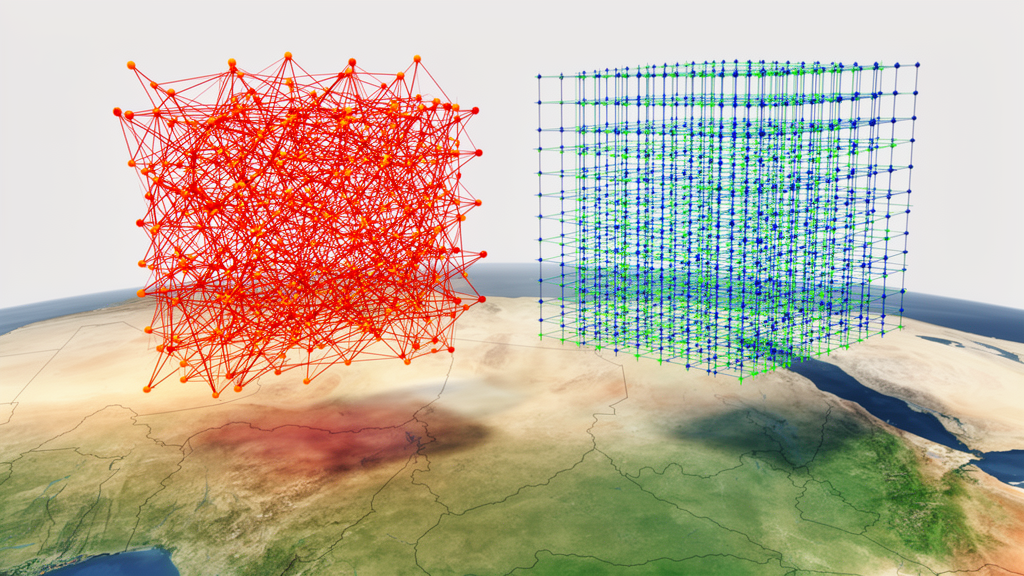
A new study published in Theoretical and Applied Climatology demonstrates that climate risk estimates for Kenya vary significantly depending on the conceptual frameworks and data sources used to generate them. The research, led by Lubana Tasnim Mazumder and colleagues, provides a county-level analysis that highlights the sensitivity of climate risk assessments to methodological choices. By comparing different approaches, the authors show that while the identification of high-risk counties remains consistent, the magnitude and spatial distribution of risk and vulnerability differ substantially across models. This finding underscores that climate risk is not a fixed measure but is shaped by the specific analytical tools and inputs applied to the data.
The study integrates historical climate data, specifically the Standardized Precipitation Evapotranspiration Index, or SPEI, with downscaled population data and subnational sociodemographic indicators. This geospatial analytical framework allows for the generation of spatially explicit risk profiles across Kenyan counties. The researchers aimed to understand how different approaches influence the assessment of climate risk and vulnerability in a region characterized by high exposure and socioeconomic vulnerability.
A central component of the research involves comparing estimates derived from two different risk and vulnerability frameworks supported by the Intergovernmental Panel on Climate Change, or IPCC. The study also constructs and compares climate risk indices based on both global and locally derived social vulnerability data.
The findings indicate that both frameworks identify a similar set of high-risk counties, suggesting a degree of consistency in identifying where the greatest threats lie. However, the magnitude and spatial distribution of risk and vulnerability differ substantially between the two approaches. Climate risk estimates show greater variability across counties when using one framework, whereas vulnerability-based assessments appear more uniform.
Furthermore, the study reveals that risk rankings vary depending on whether global or locally derived datasets are used. The locally derived vulnerability index captures greater subnational variation in climate risk, providing a more detailed picture of disparities within Kenya.
The research contributes to the limited body of work applying the IPCC risk framework in Africa and is among the first to systematically compare risk and vulnerability frameworks in the African context within a consistent analytical approach.
These findings have important implications for climate adaptation planning, resource allocation, and policy prioritization in Kenya and similar contexts.
It demonstrates that the choice of framework and data source significantly influences the resulting risk estimates.
Subject of Research: Comparison of IPCC frameworks and data sources for climate risk assessment in Kenya
Article Title: Influence of frameworks and data on climate risk estimates: A county-level analysis from Kenya
Article References: Mazumder, L. T., Kaur, M., Shyamsundar, P., Parsons, L., Gambo, J., & Erbaugh, J. (2026). Influence of frameworks and data on climate risk estimates: A county-level analysis from Kenya. Theoretical and Applied Climatology, 157(12), Article 767. https://doi.org/10.1007/s00704-026-06608-x
Image Credits: AI Generated
DOI: 10.1007/s00704-026-06608-x
Keywords: climate risk, Kenya, IPCC frameworks, vulnerability assessment, geospatial analysis, adaptation planning, socioeconomic vulnerability, SPEI, subnational data, Theoretical and Applied Climatology, Influence, frameworks
Cite Scienmag News
Sloane Callahan. (November 7, 2026). Kenya study shows climate risk estimates vary by framework. Scienmag. https://scienmag.com/kenya-study-shows-climate-risk-estimates-vary-by-framework/
Sloane Callahan. "Kenya study shows climate risk estimates vary by framework." Scienmag, 7 November 2026, https://scienmag.com/kenya-study-shows-climate-risk-estimates-vary-by-framework/. Accessed 12 November 2026.
Sloane Callahan. "Kenya study shows climate risk estimates vary by framework." Scienmag. November 7, 2026. https://scienmag.com/kenya-study-shows-climate-risk-estimates-vary-by-framework/




