


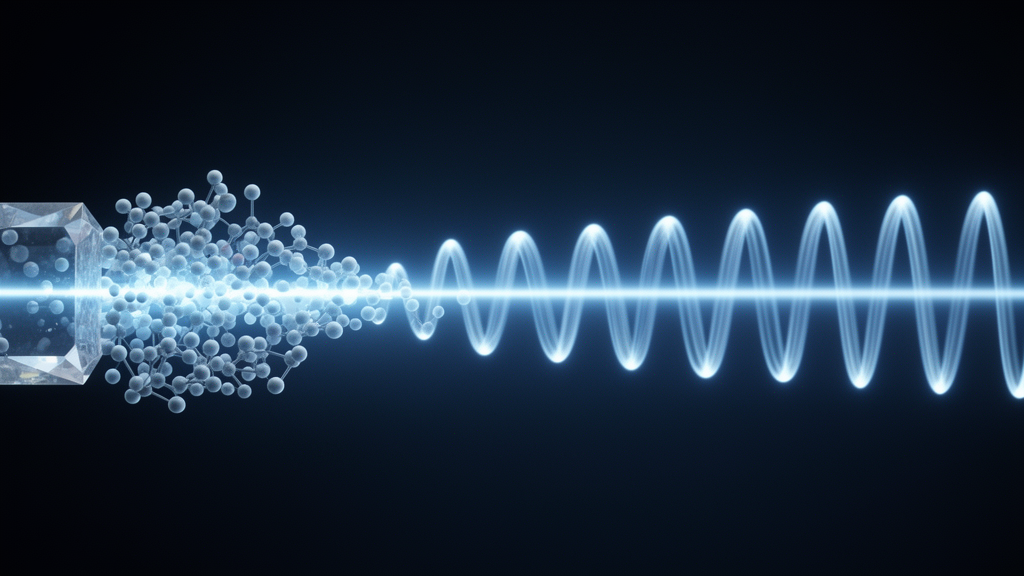
Researchers have experimentally demonstrated spatial coherence enhancement in nonlinear photonic mesh lattices through a fully conservative mechanism, thermodynamically driving incoherent light toward a pure ground state.
In isolated Hamiltonian systems, the conservation of phase-space volume rules out radiance enhancement using passive, linear optical elements, and forbids the purification of incoherent states via unitary transformations. Although apparent violations typically rely on active feedback or gain media, the authors introduced an entropic framework that bypasses these limits without non-conservative elements.
Under this conservative framework, optical nonlinearity reshapes the available phase space to relax a multimode system into a pure ground state, even when excited with strongly incoherent input states. The resulting near-zero-temperature optical state exhibits minimal statistical fluctuations without requiring active phase alignment.
This behavior was experimentally observed in nonlinear photonic mesh lattices, where spatial coherence enhancement manifests alongside the irreversible maximization of entropy. The investigation examined conservative coherence enhancement starting from an incoherent state, fluctuation statistics across different optical temperature regimes, and achievable fundamental-mode occupation versus extensive thermodynamic variables.
Because the mechanism operates broadly in conservative, weakly nonlinear multimode systems, the researchers report that the framework suggests applicability across diverse fields, ranging from high-brightness laser sources to controlled condensation in many-body quantum systems such as Bose–Einstein condensates.
In conventional Hamiltonian optics, the strict conservation of phase-space volume imposes fundamental physical barriers that prevent the purification of incoherent light. Under passive and linear operating conditions, optical elements cannot increase radiance, and isolated systems governed by unitary transformations cannot purge statistical disorder to achieve spatial order. Historically, researchers attempting to bypass these classical constraints have relied on active feedback mechanisms or external gain media. The framework demonstrated here establishes an alternative physical pathway by operating entirely within a conservative regime. Instead of injecting optical gain, the process exploits optical nonlinearity to directly reshape phase-space dynamics. This restructuring thermodynamically steers a multimode optical field toward its pure ground state, allowing an initially disordered distribution to relax into order naturally.
A central outcome of this entropic formulation is that the generation of spatial coherence occurs alongside the irreversible maximization of thermodynamic entropy. When subjected to strongly incoherent input fields, the multimode system equilibrates into a near-zero optical temperature regime. In this cooled state, statistical fluctuations across the optical field are minimized, achieving high spatial coherence without requiring external phase stabilization or active phase alignment techniques.
The physical behavior was directly observed and verified using nonlinear photonic mesh lattices. Because the governing physical principles rely fundamentally on conservative, weakly nonlinear multimode interactions rather than system-specific designs, the underlying mechanism is broadly applicable across multiple physical domains.
Subject of Research: Optical coherence enhancement via conservative thermodynamic equilibration
Article Title: Coherence enhancement through equilibration to near-zero optical temperatures
Article References: Berman Bradley, A. M., Selim, M. A., Dinani, H. M., Jeon, D.-H., Wei, Y., Ren, H., Pyrialakos, G. G., Peschel, U., Christodoulides, D. N., & Khajavikhan, M. (2026). Coherence enhancement through equilibration to near-zero optical temperatures. Nature Physics. https://doi.org/10.1038/s41567-026-03520-z
Image Credits: AI Generated
DOI: 10.1038/s41567-026-03520-z
Keywords: photonic mesh lattices, optical coherence, nonlinear optics, optical thermodynamics, Hamiltonian systems, phase space, Bose-Einstein condensates, multimode systems, Coherence, enhancement, equilibration, near-zero
Cite Scienmag News
Kelsey Dorsey. (November 7, 2026). Nonlinear Optical Equilibration Enhances Coherence Near Zero Temperature. Scienmag. https://scienmag.com/nonlinear-optical-equilibration-enhances-coherence-near-zero-temperature/
Kelsey Dorsey. "Nonlinear Optical Equilibration Enhances Coherence Near Zero Temperature." Scienmag, 7 November 2026, https://scienmag.com/nonlinear-optical-equilibration-enhances-coherence-near-zero-temperature/. Accessed 9 November 2026.
Kelsey Dorsey. "Nonlinear Optical Equilibration Enhances Coherence Near Zero Temperature." Scienmag. November 7, 2026. https://scienmag.com/nonlinear-optical-equilibration-enhances-coherence-near-zero-temperature/




