


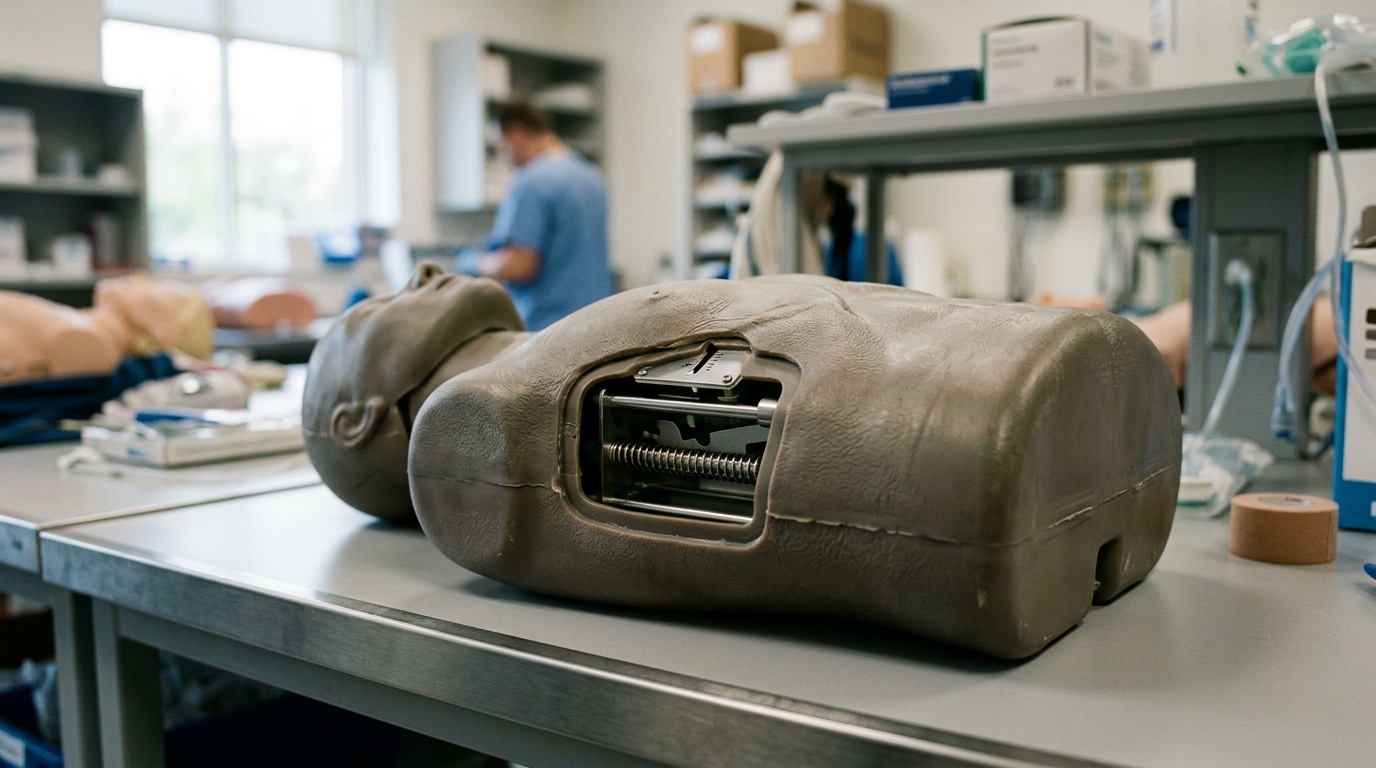
A widely adopted cardiopulmonary resuscitation training manikin mechanically prevents chest compressions from reaching the upper depth recommended by international guidelines, according to an evaluation published in Advances in Simulation. The investigation demonstrated that the Resusci Anne Simulator cannot physically achieve a compression depth beyond 5.7 centimeters, despite current resuscitation guidelines recommending an optimal chest compression target between 5 and 6 centimeters.
The issue was initially identified during an in-hospital resuscitation training project that utilized standard Laerdal manikins manufactured by Laerdal Medical in Stavanger, Norway. While conducting training courses, investigators embedded internal distance sensors into the simulators to monitor cardiopulmonary resuscitation performance and record key compression metrics. The integrated sensors consistently registered compression depths that fell below the guideline-mandated target range of at least 5 centimeters, prompting a systematic mechanical assessment of the manikins’ physical displacement properties.
In that preliminary phase, the team recorded thoracic travel using an Adafruit VL6180X high-precision Time-of-Flight distance sensor installed directly inside the manikin body. This specialized sensor captured the full displacement path during compressions.
To rigorously quantify the mechanical properties of the entire manikin, the researchers assessed all four available manikin models, which spanned different manufacturing generations. Each manikin was positioned supine on a flat, stable surface within a vertically guided metal frame. Vertical displacement of the anterior chest surface was measured directly in millimeters using a calibrated Forits 150-millimeter caliper conforming to DIN 862 industrial standards, with external compression depth formally defined as the total vertical travel distance of the anterior chest surface.
In full accordance with resuscitation guideline recommendations, the experimental compressions were applied centrally and vertically to the sternum at the external surface of the skin over the center of the thorax. The authors noted that minor cranial or caudal variations in the exact compression point did not alter the measured displacement outcomes. A standardized body weight load of 75 kilograms was applied vertically to each model, with all measurements conducted in triplicate to ensure methodological consistency and reproducible data collection across the evaluated generations.
The standardized 75-kilogram load proved sufficient to reach a clearly perceptible mechanical end point before full body weight was fully transferred onto the sternum. The investigators defined this mechanical endpoint as the specific stage where no additional increase in travel distance occurred despite further application of downward force. Across all repeated trials, the maximum achievable external compression depth never exceeded 5.7 centimeters, confirming that compressing the chest to a depth of 6.0 centimeters is physically impossible in these manikins.
The physical restriction persisted even when measurements were conducted with the skin cover and underlying chest shields fully assembled in accordance with the manufacturer’s operational instructions. When the skin cover was cranially retracted, visual inspection of the internal structural design confirmed that the mechanical assembly reached its structural hard stop at 5.7 centimeters, failing to reach the zero mark corresponding to a full 6-centimeter stroke. The researchers observed that this internal mechanical resistance could not be overcome even under supramaximal loading conditions.
The authors contextualized these findings within the history of resuscitation standards, noting that European Resuscitation Council guidelines in 2005 recommended a compression depth between 4 and 5 centimeters, whereas current guidelines from the European Resuscitation Council and American Heart Association specify a depth of at least 5 centimeters but no greater than 6 centimeters. While manufacturer documentation states that the Resusci Anne is designed for 2015 guideline depths requiring compressions of at least 5 centimeters, the physical device encounters a rigid structural boundary well before reaching the guideline ceiling of 6 centimeters.
The mechanical limitation also highlighted a notable paradox within the manikin’s electronic feedback hardware. The authors observed that the SimPad control unit display could register compressions as being too deep at a maximum compression of 60 millimeters, even though external physical displacement proved that reaching 60 millimeters was mechanically impossible. Previous literature indicated that calibration discrepancies in resuscitation feedback devices can lead to overestimations of compression depth, whereas the external caliper measurements in this study demonstrated stable and reproducible values that remained largely independent of external variables such as surface softness.
Encountering a mechanical hard stop before reaching the upper guideline boundary introduces a potentially detrimental training effect, as trainees may inadvertently learn that effective cardiopulmonary resuscitation requires forcefully pushing against a rigid mechanical obstruction. While the investigators emphasized that their evaluation was limited to a single manikin product line from a single manufacturer, they underscored that this model represents a market-leading simulator widely deployed across healthcare education. Consequently, the authors concluded that training devices require recalibration and mechanical redesign to accurately reproduce guideline parameters and safeguard resuscitation instruction.
Subject of Research: Mechanical limitation of chest compression depth in cardiopulmonary resuscitation training manikins
Article Title: Mechanical limitation of compression depth in a common CPR training manikin
Article References: Appelt, J., Jakob, L., Freschi, M., Flamm, B., Heissel, A.-K., Fiebelkorn, L., Schmutz, A., & Ganter, J. (2026). Mechanical limitation of compression depth in a common CPR training manikin. Advances in Simulation, 11(1), Article 84. https://doi.org/10.1186/s41077-026-00471-6
Image Credits: AI Generated
DOI: 10.1186/s41077-026-00471-6
Keywords: cardiopulmonary resuscitation, CPR training, Resusci Anne, compression depth, simulation manikins, medical education, resuscitation guidelines, mechanical evaluation, Mechanical, limitation, compression, depth
Cite Scienmag News
Courtney Benton. (November 7, 2026). Widely Used CPR Training Manikin Mechanically Limits Maximum Chest Compression Depth. Scienmag. https://scienmag.com/widely-used-cpr-training-manikin-mechanically-limits-maximum-chest-compression-depth/
Courtney Benton. "Widely Used CPR Training Manikin Mechanically Limits Maximum Chest Compression Depth." Scienmag, 7 November 2026, https://scienmag.com/widely-used-cpr-training-manikin-mechanically-limits-maximum-chest-compression-depth/. Accessed 22 November 2026.
Courtney Benton. "Widely Used CPR Training Manikin Mechanically Limits Maximum Chest Compression Depth." Scienmag. November 7, 2026. https://scienmag.com/widely-used-cpr-training-manikin-mechanically-limits-maximum-chest-compression-depth/




