


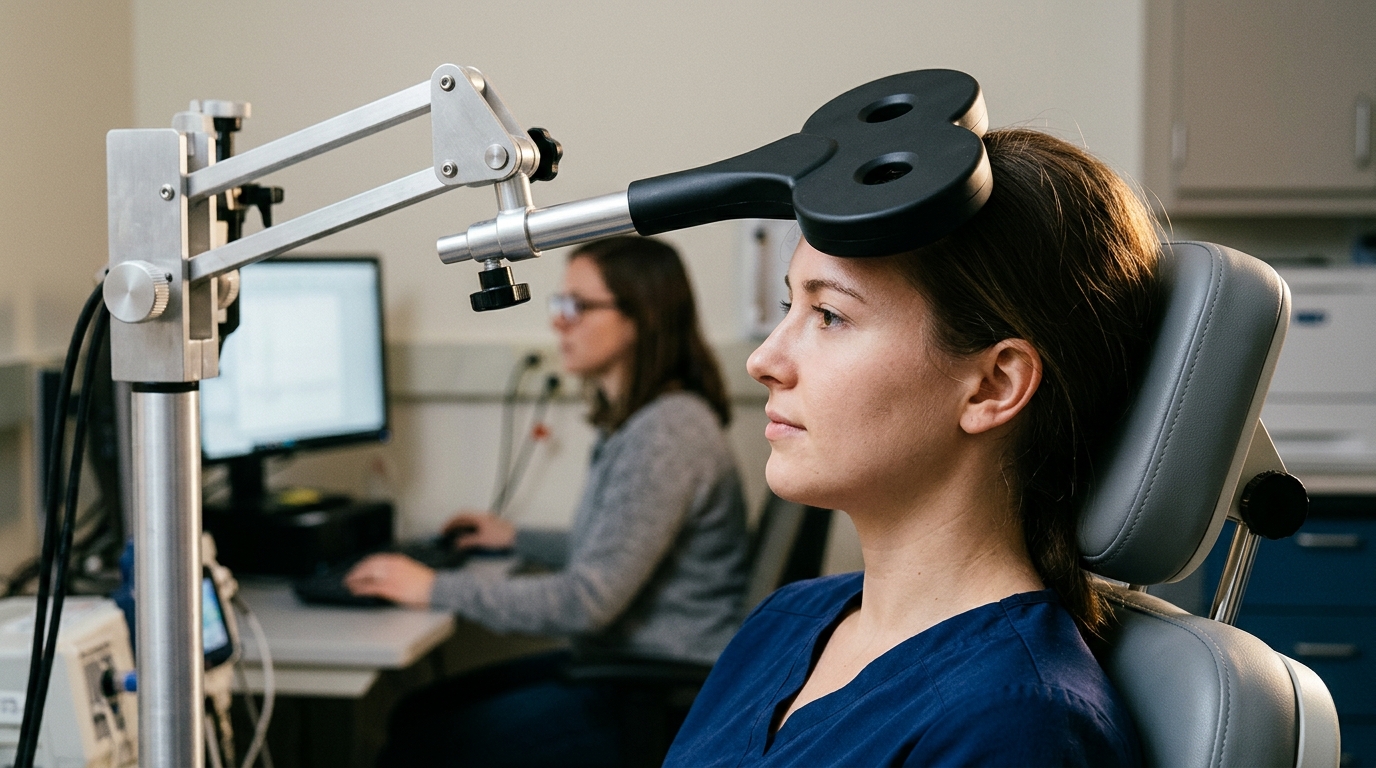
Directly disrupting a small patch of the left dorsolateral prefrontal cortex with patterned brain stimulation changes how large-scale brain networks handle conflicting information, even when performance stays the same, according to a study published in Behavioral and Brain Functions. The researchers applied continuous theta-burst stimulation over the left DLPFC of 24 healthy participants while they performed a modified color-word Stroop task and EEG was recorded. The work was published on 29 October 2026 as an open access research article.
The Stroop task is a classic probe of cognitive control. Participants must name the ink color of a word while suppressing the automatic tendency to read the word itself. When the word and the color clash, the brain must detect the competition between the goal-directed response and the automatic one and then resolve it. The dorsolateral prefrontal cortex is considered central to this implementation of control, but whether the left DLPFC causally drives the neural machinery of conflict detection and resolution has remained unclear.
At the level of event-related potentials, the fast voltage deflections time-locked to each stimulus, stimulation increased P2 amplitudes across all trial types. The P2 is an early component often linked to perceptual and attentional processing, so its amplification suggests that perturbing the left DLPFC changed early stages of stimulus evaluation rather than only later control processes.
Time-frequency analysis revealed two further changes during incongruent trials, the trials carrying the strongest conflict. Frontal theta activity, a rhythm in the roughly 4 to 8 hertz band frequently associated with cognitive control and conflict monitoring, was elevated. At the same time, parieto-occipital alpha desynchronization was attenuated. Alpha desynchronization, the suppression of the roughly 8 to 13 hertz rhythm over posterior regions, is typically read as a sign of increased attentional engagement, so its reduction indicates an altered pattern of attentional allocation under conflict.
The most striking effects appeared in functional connectivity, the statistical coupling between distant brain regions. After left DLPFC stimulation, inter- and intra-hemispheric frontoparietal and fronto-occipital networks showed strengthened connectivity in both the theta and alpha bands. In plain terms, the prefrontal control region became more strongly coupled with parietal areas involved in attention and with occipital areas involved in visual processing, both within the stimulated hemisphere and across hemispheres.
Graph-theoretical measures confirmed that this was not merely more coupling but a reorganized network architecture. The clustering coefficient, a measure of how densely neighboring nodes interconnect, was higher. Global efficiency and local efficiency, which quantify how easily information travels across the whole network and within local neighborhoods, were also higher. Characteristic path length, the average shortest route between any two nodes, was reduced. Together these indices describe a network that became more integrated and more locally cohesive after the perturbation.
To move beyond single measures, the researchers built a multivariate classifier that combined ERP, oscillatory and network features. This integrated pattern successfully discriminated congruent from incongruent trials after lDLPFC stimulation, showing that the stimulation-induced changes carried enough information to distinguish conflict from no-conflict trials.
Despite these widespread neural changes, no corresponding behavioral changes were observed. The authors interpret this dissociation carefully: the findings indicate that lDLPFC modulation alters distributed cortical network dynamics during conflict processing, and the effects suggest a causal influence of lDLPFC on the neural mechanisms underlying cognitive control, although behavior remained unchanged. This pattern is consistent with the idea that neural network reorganization can occur without immediately translating into measurable performance differences.
The study’s scope is a small sample of 24 healthy adults performing a laboratory conflict task, and the stimulation targeted one cortical site. The conclusions therefore concern causal contributions of the left DLPFC to network-level dynamics in this specific paradigm rather than general claims about cognitive control in daily life. Nevertheless, by combining stimulation, EEG, time-frequency analysis, connectivity and machine learning classification within a single experiment, the work offers a multiscale account of how a key prefrontal node shapes the distributed cortical conversation that underlies the human ability to keep automatic impulses from overriding deliberate goals.
Subject of Research: Causal role of the left dorsolateral prefrontal cortex in multiscale neural dynamics of cognitive conflict processing
Article Title: Continuous theta-burst stimulation over the left DLPFC modulates multiscale neural dynamics of conflict processing
Article References: Xu, P., Zhuo, L., Chen, Y., Yang, Y., Wei, X., Zhang, J., Jin, Z., & Li, L. (2026). Continuous theta-burst stimulation over the left DLPFC modulates multiscale neural dynamics of conflict processing. Behavioral and Brain Functions. https://doi.org/10.1186/s12993-026-00366-6
Image Credits: AI Generated
DOI: 10.1186/s12993-026-00366-6
Keywords: continuous theta-burst stimulation, left DLPFC, Stroop task, cognitive control, EEG, theta oscillations, alpha desynchronization, functional connectivity, graph theory, event-related potentials, multivariate classification, conflict processing
Cite Scienmag News
Cassandra Pierce. (November 7, 2026). Brain stimulation reshapes conflict-control networks in the Stroop task. Scienmag. https://scienmag.com/brain-stimulation-reshapes-conflict-control-networks-in-the-stroop-task/
Cassandra Pierce. "Brain stimulation reshapes conflict-control networks in the Stroop task." Scienmag, 7 November 2026, https://scienmag.com/brain-stimulation-reshapes-conflict-control-networks-in-the-stroop-task/. Accessed 22 November 2026.
Cassandra Pierce. "Brain stimulation reshapes conflict-control networks in the Stroop task." Scienmag. November 7, 2026. https://scienmag.com/brain-stimulation-reshapes-conflict-control-networks-in-the-stroop-task/




