


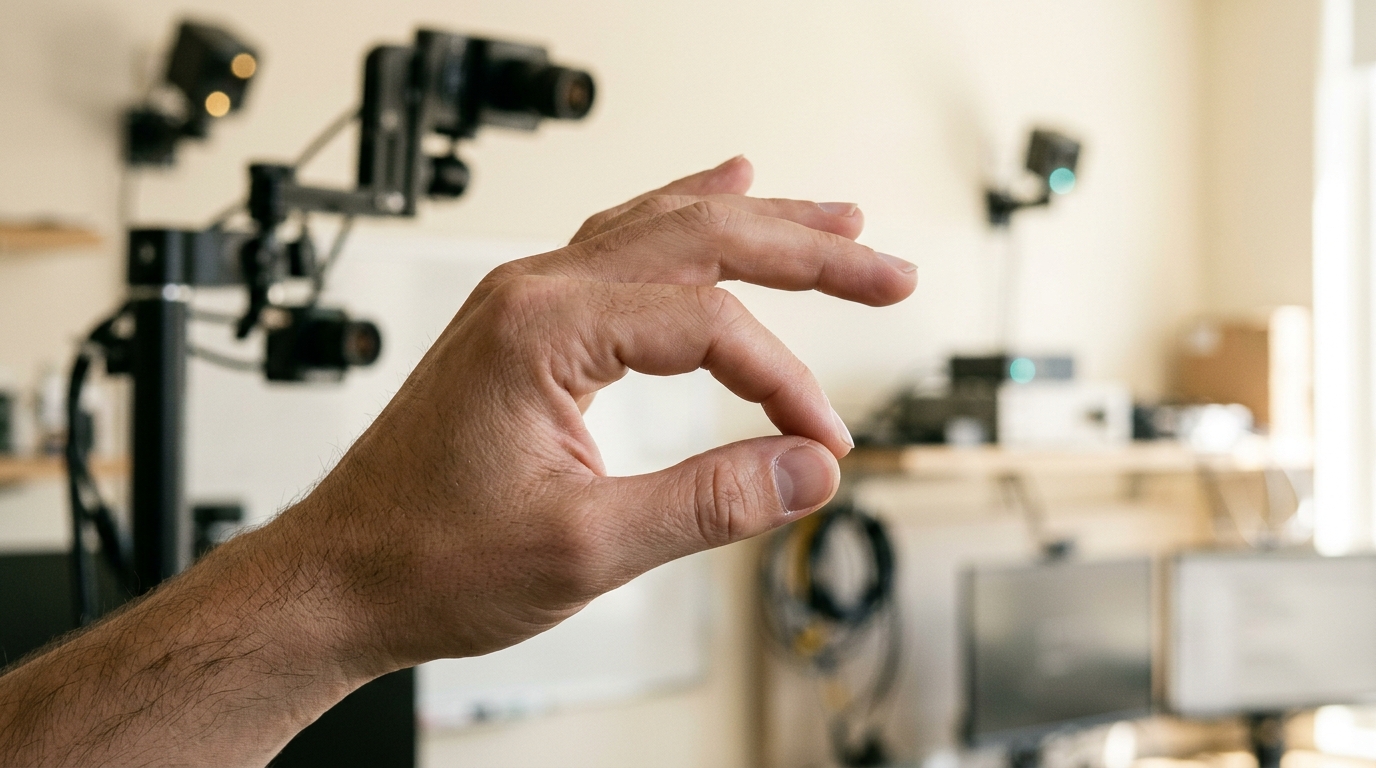
A new preprocessing framework called Speed-Invariant Phase Normalization improves the recognition accuracy of graph convolutional networks on skeleton-based hand gesture recognition benchmarks, according to findings published in Multimedia Tools and Applications by researchers Duy-Tien Le and Dinh-Tan Pham. The authors developed the technique to resolve a persistent preprocessing inconsistency that undermines the fidelity of temporal modeling in existing systems. In experimental evaluations using the DSTSA-GCN model, the proposed pipeline raised classification accuracy on the SHREC’17-14 benchmark dataset from 97.74 percent to 98.67 percent, an improvement of 0.93 percentage points over the baseline architecture. On the DHG-14 benchmark dataset, the method raised performance from 95.04 percent to 96.35 percent, achieving an absolute gain of 1.31 percentage points on the benchmark evaluation.
The authors explain that while skeleton-based hand gesture recognition using graph convolutional networks has established strong benchmark performance, conventional data pipelines contain a fundamental flaw prior to network ingestion. In standard workflows, recorded gesture sequences inherently vary in duration and temporal length. To feed these variable-length sequences into a neural network that requires a fixed temporal extent, existing systems apply uniform linear interpolation across the sequence timeline. According to the study, this uniform linear resampling fundamentally erases absolute velocity information from the movement data and renders the per-frame topology semantically inconsistent across different recorded instances of the same gesture class.
To expose this contradiction in existing methods, the authors conducted a duration-stratified accuracy analysis across state-of-the-art gesture recognition models. Their testing revealed that current models suffer a significant accuracy gap between fast-executed and slow-executed instances within the same gesture class. The degradation in accuracy was observed to be monotonically speed-dependent, showing progressively worse performance as execution speed varied.
To address this degradation, the researchers designed Speed-Invariant Phase Normalization, abbreviated as SIPN. The technique is structured as a two-stage, architecture-agnostic preprocessing pipeline that specifically replaces only the resampling step in the standard data loader. In the first stage, each input sequence is aligned to a class-specific Dynamic Time Warping Barycenter prototype. By aligning sequences to this reference prototype, the method places all gesture instances onto a shared gestural phase axis, ensuring that temporal position carries a consistent semantic meaning across different samples regardless of individual execution speed.
In the second stage of the pipeline, termed Motion-Gated Temporal Sampling, the phase-aligned sequence is resampled to the fixed temporal length required for ingestion by the neural network. Rather than relying on uniform linear spacing, this stage executes stratified sampling that is explicitly biased toward high-motion frames where critical gestural dynamics occur. The Motion-Gated Temporal Sampling mechanism is governed by a single learnable scalar parameter per modality stream, and the resulting sampling probability distribution is scaled by a temperature parameter to carefully regulate frame selection across the duration of the gesture.
To provide mechanistic evidence of how the method affects internal network representations, the researchers introduced the Intra-class Topology Variance metric, designated as ITV. This metric quantifies the consistency of temporal adjacency matrices across different instances of the same gesture class when compared at matched phase positions. In addition to reporting their experimental results, the authors have made the implementation code for Speed-Invariant Phase Normalization publicly accessible through an open online repository on GitHub.
Subject of Research: Skeleton-based hand gesture recognition with graph convolutional networks
Article Title: Graph-based deep learning with phase normalization for hand gesture recognition
Article References: Le, D.-T., & Pham, D.-T. (2026). Graph-based deep learning with phase normalization for hand gesture recognition. Multimedia Tools and Applications, 85(11), Article 839. https://doi.org/10.1007/s11042-026-22010-1
Image Credits: AI Generated
DOI: 10.1007/s11042-026-22010-1
Keywords: hand gesture recognition, graph convolutional networks, Speed-Invariant Phase Normalization, temporal modeling, computer vision, deep learning, skeleton-based recognition, phase normalization, Graph-based, deep, learning, phase
Cite Scienmag News
Blake Davidson. (November 7, 2026). Phase Normalization Enhances Graph Neural Network Accuracy in Hand Gesture Recognition. Scienmag. https://scienmag.com/phase-normalization-enhances-graph-neural-network-accuracy-in-hand-gesture-recognition/
Blake Davidson. "Phase Normalization Enhances Graph Neural Network Accuracy in Hand Gesture Recognition." Scienmag, 7 November 2026, https://scienmag.com/phase-normalization-enhances-graph-neural-network-accuracy-in-hand-gesture-recognition/. Accessed 9 November 2026.
Blake Davidson. "Phase Normalization Enhances Graph Neural Network Accuracy in Hand Gesture Recognition." Scienmag. November 7, 2026. https://scienmag.com/phase-normalization-enhances-graph-neural-network-accuracy-in-hand-gesture-recognition/




