


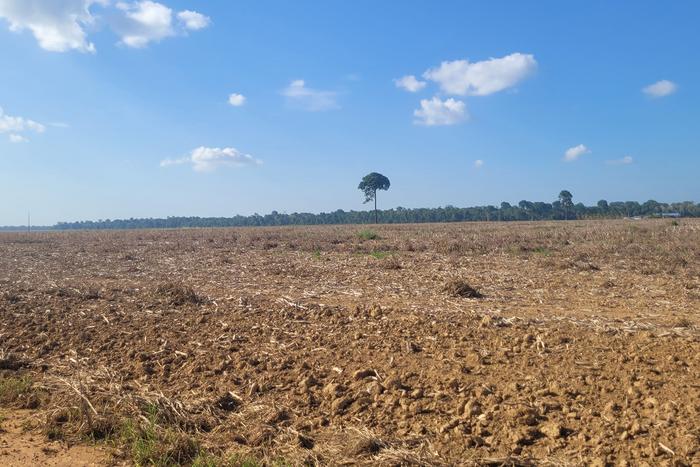
Soya, palm oil, coffee, cocoa, sugar, or hazelnuts – in only a few cases is the cultivation in the countries of origin outside Europe truly sustainable. For example, rainforests are cleared and valuable grasslands are used for palm oil and cocoa plantations and soya monocultures, and harmful pesticides are used in the cultivation of cocoa and hazelnuts. In order to prevent negative consequences for biodiversity, ecosystems, and the climate, the EU has expressed its political will to share responsibility for this. It is committed to the principle of Policy Coherence for Development (PCD) in its development policy. Accordingly, it wants to not only achieve the Sustainable Development Goals (SDGs) of the UN within EU boarders, but also support developing countries for implementing them. In the Green Deal and the Farm to Fork Strategy, the EU Commission has committed to promoting the transformation towards sustainable agricultural and food systems.

Credit: Yves Zinngrebe
Soya, palm oil, coffee, cocoa, sugar, or hazelnuts – in only a few cases is the cultivation in the countries of origin outside Europe truly sustainable. For example, rainforests are cleared and valuable grasslands are used for palm oil and cocoa plantations and soya monocultures, and harmful pesticides are used in the cultivation of cocoa and hazelnuts. In order to prevent negative consequences for biodiversity, ecosystems, and the climate, the EU has expressed its political will to share responsibility for this. It is committed to the principle of Policy Coherence for Development (PCD) in its development policy. Accordingly, it wants to not only achieve the Sustainable Development Goals (SDGs) of the UN within EU boarders, but also support developing countries for implementing them. In the Green Deal and the Farm to Fork Strategy, the EU Commission has committed to promoting the transformation towards sustainable agricultural and food systems.
In order to provide more clarity in the tangled web of complex trade relations between the EU and exporting countries in the market for agricultural products, a research team is now proposing a new approach that analyses both the relevance and leverage effect of individual imported goods for the EU and for the country of origin. The “relevance” criterion describes the proportion of an agricultural product from a country of origin in total imports into the EU. The “leverage” criterion describes how important the proportion of an agricultural product imported into the EU is for the country of origin in the overall value chain or agricultural production. “We can thus describe the importance of trade with the EU for each agricultural product and exporting country and consider measures that could make these trade relations more sustainable”, says UFZ environmental policy expert Dr Yves Zinngrebe, lead author of the publication. The team of authors analysed the relevance and leverage effect of the most important agricultural imports for three dimensions: the economic value that these imports have for the country of origin, the footprint as a measure of land consumption for the cultivation of the imported goods, and the deforestation (i.e. how many hectares had to be cleared for the production of the imported goods).
The researchers discovered that soya, palm oil, cocoa, and coffee account for more than 80% of the land deforested for the cultivation of EU products. In addition, based on the high relevance and leverage values, they found that much of the influence of the EU is focussed on a few groups of countries with specific export profiles. These include the MERCOSUR countries of Argentina, Brazil, Paraguay, and Uruguay in particular because trade with these countries (especially in soya) accounts for 22% of the trade value, 33% of the required land area, and 40% of the imported deforestation. These are joined by Malaysia, Indonesia, and Papua New Guinea, which specialise in the cultivation of palm oil as well as a number of countries in Africa, Latin America, and Vietnam, which specialise in cocoa and coffee. “The EU could achieve a great deal if it focused on soya, palm oil, coffee, and cocoa when establishing sustainable trade relations”, says Zinngrebe.
The EU also has strong leverage in certain small sugar producer countries. For countries such as Mauritius, Fiji, Barbados, and the Bahamas, the overall relevance for the EU is low. However, the leverage (i.e. the proportion of the cultivation area reserved for EU exports) is quite high (20–40%), providing a strong potential or responsibility of the EU in establishing sustainability standards. The potential leverage effect is also high for countries in Eastern Europe (e.g. Ukraine and Russia) and Central Asia (e.g. Kazakhstan), which sell large quantities of grain to the EU. Cereals such as wheat, maize, and barley as well as oilseed crops such as sunflowers, rapeseed, and linseed account for almost 70% of the imported footprint from these countries. “If the EU hopes to ensure greater sustainability in global food systems, it should use its relationships primarily with trading partners for which the leverage is particularly high”, says Prof Sebastian Lakner, agricultural economist at the University of Rostock and final author of the study. “The aim here is to develop new agricultural standards or regulations together with our trading partners, which provide benefits to both the countries of origin and the countries of consumption”. The EU supply chain law can play an important role in this. This is intended increase the transparency of the conditions under which traded goods are produced. For example, how much primeval forest has been cleared for an agricultural product or how the land was previously used.
In the case of highly relevant agricultural goods such as soya and palm oil, which together account for almost two thirds of the EU proportion of deforestation in partner countries and one third of the footprint, it is up to the EU to reduce this relevance. For example, it could regulate demand by promoting more sustainable livestock farming or a low-meat diet in the EU. However, examples from the recent past (e.g. palm oil) show how sensitively global trade should be handled. The EU had pushed ahead with regulations for more sustainable cultivation but lost large market shares as a result because other countries such as India and China took over EU proportions of the global market. “The EU thus gambled away parts of its influence because the demand for palm oil continues. It no longer has as much influence on making this trade more sustainable because the proportion of palm oil imported into the EU is no longer as high”, says Zinngrebe. This means that the EU no longer has any effective leverage. If the EU truly hopes to implement policy coherence in the interests of development, it must support these countries in developing their economies beyond agriculture to value-adding sustainable production.
Journal
One Earth
Method of Research
Data/statistical analysis
Subject of Research
Not applicable
Article Title
Prioritizing partners and products for the sustainability of the EU’s agri-food trade
Article Publication Date
4-Apr-2024
Cite Scienmag News
Sloane Callahan. (April 18, 2024). More sustainability in global agricultural trade. Scienmag. https://scienmag.com/more-sustainability-in-global-agricultural-trade/
Sloane Callahan. "More sustainability in global agricultural trade." Scienmag, 18 April 2024, https://scienmag.com/more-sustainability-in-global-agricultural-trade/. Accessed 4 September 2026.
Sloane Callahan. "More sustainability in global agricultural trade." Scienmag. April 18, 2024. https://scienmag.com/more-sustainability-in-global-agricultural-trade/

