


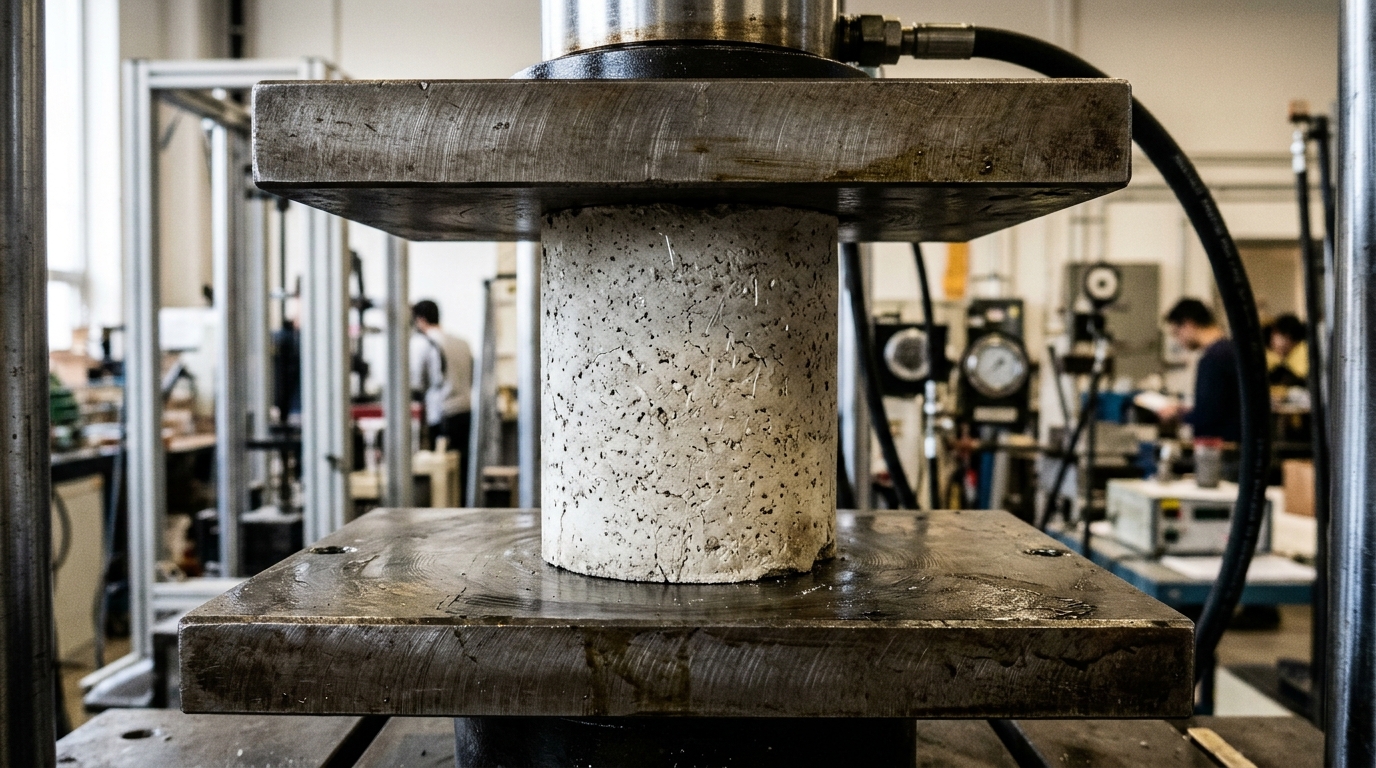
An advanced ensemble machine learning framework utilizing a hierarchical stacking architecture has demonstrated significantly enhanced accuracy in predicting the compressive strength of engineered cementitious composites, achieving a coefficient of determination of 0.896, a root mean square error of 5.734, and a mean absolute error of 4.505. Engineered cementitious composites represent an innovative class of fiber-reinforced construction materials engineered to overcome the intrinsic brittleness of conventional concrete through superior tensile ductility, crack resistance, and structural durability. While the mechanical evaluation of these composite systems has historically emphasized tensile strain and crack-bridging behavior, compressive capacity remains an indispensable determinant of structural safety, seismic performance, and infrastructure service life. The newly established model integrates three distinct base learning algorithms—Random Forest, Gradient Boosting Decision Trees, and Support Vector Regression—synthesized through an optimal meta-learner to resolve the complex, nonlinear material interactions that govern compressive performance, while establishing quantitative interpretability through game-theoretic Shapley Additive Explanations and Partial Dependence Plots.
Concrete stands as the most extensively utilized construction material globally, yet its vulnerability to brittle failure under severe mechanical stress imposes strict limitations on infrastructure safety. Despite these structural benefits, predicting the ultimate compressive strength of such composite systems has remained an intricate engineering problem due to the multifaceted interdependencies among raw constituent proportions. The final load-bearing performance is controlled not by isolated variables, but by a delicate balance encompassing water-to-cement ratios, mineral admixture dosages, curing regimens, and fiber geometry. Traditional mechanical compression testing according to standardized testing protocols like ASTM C39 provides reliable empirical measurements, but standard physical experimental routines are resource-intensive, labor-demanding, and inherently limited in their ability to map multidimensional interrelationships across broad composition spaces.
Computational modeling and machine learning approaches have increasingly emerged as capable alternatives for estimating construction material behavior, offering greater operational efficiency and analytical precision than empirical laboratory iterations alone. Previous research demonstrated that isolated algorithms, including artificial neural networks paired with meta-heuristic optimization or gene expression programming, could estimate strength in high-performance and geopolymer concretes with varying degrees of success. However, individual regression architectures frequently encounter substantial constraints, including a tendency to overfit training observations and an inability to generalize reliably when confronted with untested mixture proportions. Conventional ensemble strategies, such as bagging and sequential gradient boosting, mitigate single-model deficiencies by combining multiple weak learners to reduce variance or bias. Yet standard homogeneous ensemble methods often fall short when processing heterogeneous material variables. Stacking ensemble architectures address this limitation by structuring diverse base models into a multi-layered hierarchical system, allowing an overarching second-level meta-learner to integrate distinct predictive perspectives and effectively constrain residual prediction errors.
To establish a reliable empirical foundation for predictive modeling, the investigators compiled a comprehensive experimental dataset containing 313 physical test samples drawn from international peer-reviewed literature published between 2010 and 2024 across Asia, Europe, and North America. Rigorous inclusion criteria governed data selection: each experimental mixture required Ordinary Portland Cement as the primary binder, utilized natural aggregates with standard graded distributions, clearly documented fiber properties and chemical admixtures, and followed verified standardized testing protocols to guarantee comparability across studies. The finalized dataset encompasses 18 distinct input features arranged into four systematic categories: primary cementitious constituents, such as cement, water, and fly ash; fiber characteristics, covering volume fraction, diameter, length, and elastic modulus; chemical admixtures, including superplasticizers and viscosity modifiers; and experimental processing conditions, specifically water curing duration and temperature. Across all collected records, 11 different fiber varieties were represented, comprising polyethylene, polyvinyl alcohol, basalt, glass, and hybrid combinations such as blends of polyvinyl alcohol and steel fibers.
The predictive framework implements a structured workflow designed to safeguard model validity and prevent information leakage across training phases. The full dataset of 313 samples was partitioned into an independent training set comprising 75 percent of the data and a held-out testing set comprising the remaining 25 percent. Within the training partition, a five-fold cross-validation procedure was conducted, wherein base learners were iteratively trained on four subsets and validated on the remaining fold to generate out-of-fold predictions. These out-of-fold estimates served as the input features for training the second-tier meta-learner, thereby preventing data reuse between hierarchical levels. To determine the most effective synthesizing algorithm, ten candidate meta-learners were evaluated across linear, kernel-based, and decision-tree architectures: Decision Trees, K-Nearest Neighbors, Support Vector Regression, Bagging, Random Forest, AdaBoost, Gradient Boosting Decision Trees, Extreme Gradient Boosting, Bayesian Ridge, and Lasso Regression, with hyperparameter tuning conducted via exhaustive grid search.
Algorithmic diversity was intentionally enforced at the base layer to ensure complementary coverage of distinct data patterns. Random Forest builds an ensemble of decorrelated decision trees using bootstrap sampling and random feature selection at each split node, averaging individual tree outputs to dampen variance and resist overfitting in high-dimensional feature spaces. Gradient Boosting Decision Trees operate sequentially, fitting successive decision trees to the negative gradient of the loss function, thereby iteratively correcting residual errors and reducing predictive bias. Support Vector Regression maps continuous input data into a high-dimensional feature space using an epsilon-insensitive loss function and slack variables, establishing a balanced margin that tolerates minor noise while identifying complex nonlinear boundaries. Hyperparameter optimization through five-fold cross-validation established optimal configurations: Random Forest used 52 estimators, a maximum depth of 18, and 6 features per split; Gradient Boosting reached optimal calibration with a learning rate of 0.12, 185 estimators, and a depth of 30; and Support Vector Regression utilized a radial basis function kernel with a penalty parameter of 266, an epsilon of 1.7, and a gamma parameter of 0.06.
Cross-validation assessments across the five training folds highlighted the specific operational characteristics of each configured base learner. Random Forest maintained a stable performance profile across all folds, yielding a narrow distribution of determination coefficients centered around a median of 0.80, though reaching a minimum of 0.7805 on the fifth fold. Support Vector Regression produced higher peak scores on early folds, reaching 0.8526 and 0.8579, but displayed wider variance across validation subsets, dipping to 0.8246 on the third fold. Gradient Boosting Decision Trees outperformed both counterparts during cross-validation, achieving the highest median determination coefficient of 0.86, peaking at 0.8825, and consistently remaining above 0.83 across all folds. When evaluated on the held-out 25 percent testing set, Support Vector Regression attained an R-squared of 0.87, a root mean square error of 6.37, and a mean absolute error of 4.83, exceeding the test metrics of both tree-based models, while Random Forest achieved a test R-squared of 0.83, confirming that all base models generalized reliably without signs of data overfitting.
Alternative meta-learners, including Bayesian Ridge and Support Vector Regression, exhibited competitive test coefficients approaching 0.89, but Lasso achieved the most consistent synthesis. On the independent test set, the final stacking Lasso ensemble attained an R-squared of 0.896, accompanied by a root mean square error of 5.734 and a mean absolute error of 4.505. Scatter plots of predicted versus experimentally observed compressive strengths demonstrated strong alignment along the ideal diagonal trajectory across all strength magnitudes. By fusing the complementary inductive biases of Random Forest, Gradient Boosting, and Support Vector Regression, the stacking framework achieved a marked reduction in both average and squared prediction errors compared to any single base model, confirming the technical value of two-tier hierarchical learning for composite material modeling.
To open the machine learning framework to physical interpretation, Kernel Shapley Additive Explanations were deployed to decompose final ensemble predictions into additive feature contributions based on cooperative game theory. Global importance rankings revealed that silica fume dosage and water content exerted the strongest primary influence over predicted compressive strength. Silica fume exhibited a consistently positive correlation with Shapley values across the evaluated dataset, a finding consistent with physical pozzolanic reactions wherein silica fume consumes calcium hydroxide to form secondary calcium silicate hydrate gels, densifying the cementitious paste and reinforcing aggregate interfaces. The analysis also revealed positive Shapley contributions from fiber elastic modulus, cement proportion, and fiber volume fraction. Specifically, fibers possessing elastic moduli between 100 and 200 gigapascals provided significant structural reinforcement by improving microcrack bridging and load redistribution, whereas elastic moduli exceeding 200 gigapascals yielded diminishing returns, highlighting an upper performance threshold for matrix compatibility.
Complementary Partial Dependence Plots corroborated these findings while illustrating key multidimensional interactions and threshold behaviors governing composite performance. In contrast, increasing fiber content in mixtures containing lower-modulus fibers between 30 and 110 gigapascals led to reduced compressive strength, reflecting matrix weakening induced by fiber-related void creation and inefficient stress transfer. These data-driven observations provide engineering teams with a robust analytical basis for optimizing mixture proportions, conducting rapid quality-control assessments, and rationalizing material design choices under practical operational constraints.
Subject of Research: Machine learning strength prediction and interpretability modeling of engineered cementitious composites
Article Title: Ensemble learning-based strength prediction and model interpretability analysis of engineered cementitious composites
Article References: Wang, Y., Sun, J., Liu, X., Huang, Y., Wang, X., Zuo, L., & Wang, D. (2026). Ensemble learning-based strength prediction and model interpretability analysis of engineered cementitious composites. AI in Civil Engineering, 5(1), Article 7. https://doi.org/10.1007/s43503-026-00089-7
Image Credits: AI Generated
DOI: 10.1007/s43503-026-00089-7
Keywords: Engineered Cementitious Composites, Compressive Strength, Ensemble Learning, Stacking Architecture, Random Forest, Gradient Boosting, Support Vector Regression, SHAP Analysis, Partial Dependence Plots, Civil Engineering, Ensemble, learning-based
Cite Scienmag News
Denise Maddox. (November 6, 2026). Ensemble Machine Learning Accurately Predicts Engineered Cementitious Composite Compressive Strength. Scienmag. https://scienmag.com/ensemble-machine-learning-accurately-predicts-engineered-cementitious-composite-compressive-strength/
Denise Maddox. "Ensemble Machine Learning Accurately Predicts Engineered Cementitious Composite Compressive Strength." Scienmag, 6 November 2026, https://scienmag.com/ensemble-machine-learning-accurately-predicts-engineered-cementitious-composite-compressive-strength/. Accessed 6 November 2026.
Denise Maddox. "Ensemble Machine Learning Accurately Predicts Engineered Cementitious Composite Compressive Strength." Scienmag. November 6, 2026. https://scienmag.com/ensemble-machine-learning-accurately-predicts-engineered-cementitious-composite-compressive-strength/




