


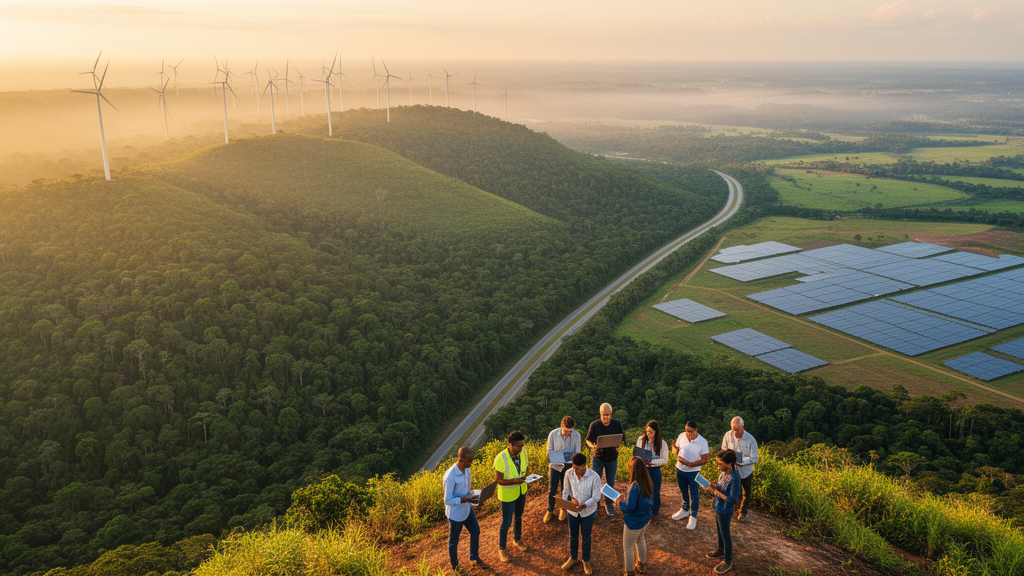
A new public, open-source digital platform developed by scientists at the State University of Campinas (UNICAMP) in Brazil and Princeton University in the United States promises to facilitate the formulation of climate policies in Brazil. Named NetZero Brazil 2050, the system cross-references georeferenced data on energy demand, land use, and macroeconomics to simulate carbon-neutrality scenarios. In practice, the tool calculates in real time the lowest-cost decarbonization pathways for the country through the middle of this century, giving policymakers a transparent way to explore how Brazil could balance its national emissions to net zero by 2050.
The platform was presented on October 28 by Professor Carla Kazue Nakao Cavaliero of the School of Mechanical Engineering (FEM-UNICAMP) during FAPESP Week Netherlands. According to the release, the tool allows public officials, academics, and civil society organizations to cross-reference data from 39 sectoral parameters to design transparent, evidence-based energy transition strategies. Developed with support from FAPESP through the São Paulo Center for Energy Transition Studies (CPTEn) and the São Paulo Center for Innovation in Public Lighting (CePIL), the initiative aims to democratize complex prospective simulation models, making advanced forecasting tools accessible to a wider audience and facilitating future planning.
Cavaliero framed the open-access approach as a deliberate contrast with commercial practice. “What some groups are doing today by selling private consulting services, we’re making fully accessible within the open science policy,” she told Agência FAPESP. “The goal is for decision-makers, civil society organizations, think tanks, and graduate students throughout Brazil to use those data to propose interdisciplinary and transparent public policies.” The statement underlines the project’s central premise: that decarbonization planning should not be confined to paid consultants, but opened to anyone with an interest in shaping Brazil’s energy future.
What sets NetZero Brazil 2050 apart, according to the researcher, is the integration of seven simulation tools that link energy supply and demand to changes in land use and macroeconomic impacts. The platform allows users to adjust 39 key parameters, divided into sectors such as transportation, industry, buildings, agriculture and livestock, energy, and waste, with two to three scenario options for each. This structure means a user can, for example, compare different assumptions about how quickly industry electrifies or how agricultural land is managed, and immediately see the consequences ripple through the whole modeled system.
The system’s engine is based on mathematical optimization models. The EnergyPathways tool estimates future energy demand with high sectoral and technological resolution. Next, a model developed in collaboration with Princeton, the Massachusetts Institute of Technology (MIT), and New York University (NYU) identifies the lowest-cost configuration to meet this demand, taking into account emissions constraints and regional potentials from various sources, such as solar and wind power, biomass, and green hydrogen. In parallel, another model developed in collaboration with the Potsdam Institute for Climate Impact Research in Germany, the University of Lisbon in Portugal, and the University of Oxford in England optimizes land use by determining the dynamics of agricultural crops and pastures.
The platform also features modules dedicated to agriculture and livestock, waste management, and an input-output model developed by UNICAMP. This tool maps how different sectors of the economy interact with one another, calculating the impact of transitions on job creation and sectoral gross domestic product. The approach reveals the interdependencies between sectors. As Cavaliero explains, if one part of the industry is unable to reduce its emissions to zero due to technological limitations, another sector must offset them so that the national net balance is zero. In other words, neutrality is treated as a system-wide accounting problem, not a collection of isolated sectoral targets.
The model’s treatment of deforestation illustrates these interdependencies starkly. “Without controlling deforestation, for example, it’ll be impossible to reach neutrality by 2050. The model clearly shows those interdependencies,” said the researcher. “By including financial data and optimizing the scenarios for the lowest cost, we were able to project the necessary investment year by year through 2050. We can say with precision that, to follow a given path, the country will need so many billions of dollars.” This capability converts abstract climate targets into concrete, year-by-year investment requirements, which is precisely the kind of information finance ministries and planning agencies need when weighing competing decarbonization strategies.
Currently, the platform presents its consolidated results on a state-wide scale for Brazil’s 27 states, using data from the National Energy Balance (BEN) and georeferenced maps. However, the research team is already working on the next phase of the project: making the data available at the municipal level. To project the data onto the map, the platform uses the SEALS model, developed by the University of Minnesota in the United States, which is being calibrated with information from MapBiomas, a collaborative initiative that maps land cover and land use in Brazil. The goal is to move from the current resolution of 300 meters to 30 meters of ground-level precision, a tenfold refinement that would make locally specific analysis far more meaningful.
The transition to the municipal scale will allow mayors and municipal secretaries to identify their cities’ specific contributions to state and national goals. The tool operates on a comparative basis, allowing users to filter and cross-reference more than 70 pre-built scenarios on the platform or generate entirely new simulations. “Municipal officials will be able to review the results and understand how their municipality fits into the national context,” Cavaliero explained. “A city government can use these projections to inform local policies promoting electric mobility, energy efficiency, or conservation – including setting more ambitious goals as part of its commitment to carbon neutrality.” The platform itself can be accessed at netzero.eco.br/index-en.html.
The creation of NetZero Brazil 2050 is part of a broader innovation ecosystem at UNICAMP, which is home to seven Science Centers for Development supported by FAPESP and focused on the energy transition. The university functions as a living lab on an urban scale, with 2.1 megawatts of solar power installed on rooftops, 100% LED street lighting, electric buses in operation, and Latin America’s first university microgrid, generating annual savings of BRL 15 million in energy costs. UNICAMP is also moving forward with the implementation of the International Hub for Sustainable Development (HIDS) on a 1.4 million-square-meter site that will include experimental modules for agrovoltaics, a combination of solar panels and agricultural production, as well as biogas and hydrogen.
This accumulated experience strengthens the international partnership showcased at FAPESP Week Netherlands. The NetZero Brazil project is part of a global network coordinated by Princeton, which has already developed similar platforms for the United States under the Net Zero America initiative, as well as for Australia, China, India, South Korea, and Poland. The team hopes to expand cooperation with Dutch institutions, including the universities of Delft, Leiden, and Groningen, by drawing on their expertise in hydrogen technology pathways and the management of living labs. “The climate transition is a global challenge. By placing data from different countries on interconnected platforms, we gain a broad perspective and avoid penalizing the competitiveness of developing economies through decarbonization,” Cavaliero concluded. For readers following Brazil’s climate trajectory, the platform’s significance lies in making the arithmetic of neutrality – which sectors must cut, which must offset, and at what cost – visible and testable for anyone, not just those who can afford a consultancy report.
Subject of Research: An open-source modeling platform that simulates lowest-cost carbon-neutrality pathways for Brazil by 2050
Article Title: Platform simulates lowest-cost pathways for Brazil to achieve carbon neutrality by 2050
Article References: Platform simulates lowest-cost pathways for Brazil to achieve carbon neutrality by 2050. Original publication (Bibliographic details unavailable.)
Image Credits: AI Generated
DOI: Not provided
Keywords: NetZero Brazil 2050, carbon neutrality, decarbonization, energy modeling, land use, UNICAMP, Princeton University, FAPESP, Brazil, open science, mathematical optimization, climate policy
Cite Scienmag News
Reid Dalton. (October 30, 2026). Open-Access Platform Maps Brazil’s Lowest-Cost Routes to Carbon Neutrality. Scienmag. https://scienmag.com/open-access-platform-maps-brazils-lowest-cost-routes-to-carbon-neutrality/
Reid Dalton. "Open-Access Platform Maps Brazil’s Lowest-Cost Routes to Carbon Neutrality." Scienmag, 30 October 2026, https://scienmag.com/open-access-platform-maps-brazils-lowest-cost-routes-to-carbon-neutrality/. Accessed 23 November 2026.
Reid Dalton. "Open-Access Platform Maps Brazil’s Lowest-Cost Routes to Carbon Neutrality." Scienmag. October 30, 2026. https://scienmag.com/open-access-platform-maps-brazils-lowest-cost-routes-to-carbon-neutrality/




