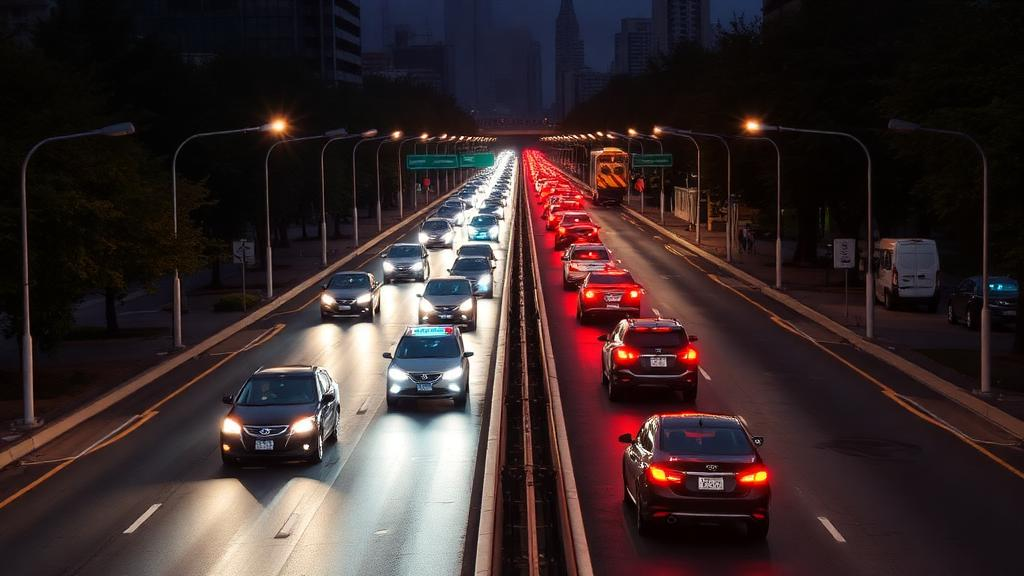
A new theoretical study by Ilaria Ciaramaglia and Paola Goatin, published in Advances in Continuous and Discrete Models, proposes a coupled partial differential equation and ordinary differential equation system designed to describe exactly this interaction between bulk traffic flow and a moving bottleneck.
In the model, the evolving traffic density is governed by a nonlocal scalar conservation law with a time delay, reflecting that drivers’ decisions depend on traffic conditions they observed slightly earlier rather than instantaneously. The bottleneck’s trajectory, meanwhile, is described by an ordinary differential equation whose velocity field is nonlocal and depends on downstream traffic conditions. Because the car’s motion responds to the density it is itself shaping, the two equations are strongly and fully coupled, creating what the authors call a full micro-macro coupling between the individual vehicle and the collective flow.
The central contribution is a rigorous well-posedness result for this system. The authors prove it by constructing a fractional step finite volume approximation, a numerical scheme that alternates between advancing the traffic density and updating the bottleneck position. Within this framework they establish uniform BV estimates and L-infinity bounds for the approximate solutions. These bounds provide compactness of the scheme, which in turn guarantees that the sequence of approximating solutions converges to an entropy solution of the coupled system, establishing existence of solutions.
Uniqueness is obtained separately through an L1 stability result, meaning that two solutions starting from close initial data remain close over time. Together, the existence and uniqueness results show that the model’s predictions are mathematically well-defined rather than ambiguous, an essential property for any model intended for simulation or control applications.
The work is a mathematical analysis paper: it establishes theoretical guarantees for the equations themselves and does not report field measurements, simulations of specific road networks, or validated traffic predictions. Nevertheless, by proving that a fully coupled nonlocal PDE-ODE system with time delay admits a well-defined entropy solution, the study provides a foundation on which future work on moving bottlenecks, such as slow controlled vehicles interacting with surrounding traffic, can be built with confidence that the underlying model behaves consistently.
Subject of Research: Well-posedness of a fully coupled nonlocal PDE-ODE model with time delay describing traffic flow around a moving bottleneck
Article Title: Moving bottlenecks in traffic flows: a well-posed fully coupled nonlocal PDE-ODE model with time delay
Article References: Ciaramaglia, I., & Goatin, P. (2026). Moving bottlenecks in traffic flows: a well-posed fully coupled nonlocal PDE-ODE model with time delay. Advances in Continuous and Discrete Models. https://doi.org/10.1186/s13662-026-04131-x
Image Credits: AI Generated
DOI: 10.1186/s13662-026-04131-x
Keywords: traffic flow, moving bottleneck, PDE-ODE coupling, nonlocal conservation law, time delay, well-posedness, finite volume scheme, BV estimates, entropy solution, mathematical modeling, Moving, bottlenecks
Cite Scienmag News
Reid Dalton. (October 29, 2026). Mathematicians Prove a Traffic Model With Moving Bottlenecks Is Well-Posed. Scienmag. https://scienmag.com/mathematicians-prove-a-traffic-model-with-moving-bottlenecks-is-well-posed/
Reid Dalton. "Mathematicians Prove a Traffic Model With Moving Bottlenecks Is Well-Posed." Scienmag, 29 October 2026, https://scienmag.com/mathematicians-prove-a-traffic-model-with-moving-bottlenecks-is-well-posed/. Accessed 30 October 2026.
Reid Dalton. "Mathematicians Prove a Traffic Model With Moving Bottlenecks Is Well-Posed." Scienmag. October 29, 2026. https://scienmag.com/mathematicians-prove-a-traffic-model-with-moving-bottlenecks-is-well-posed/