


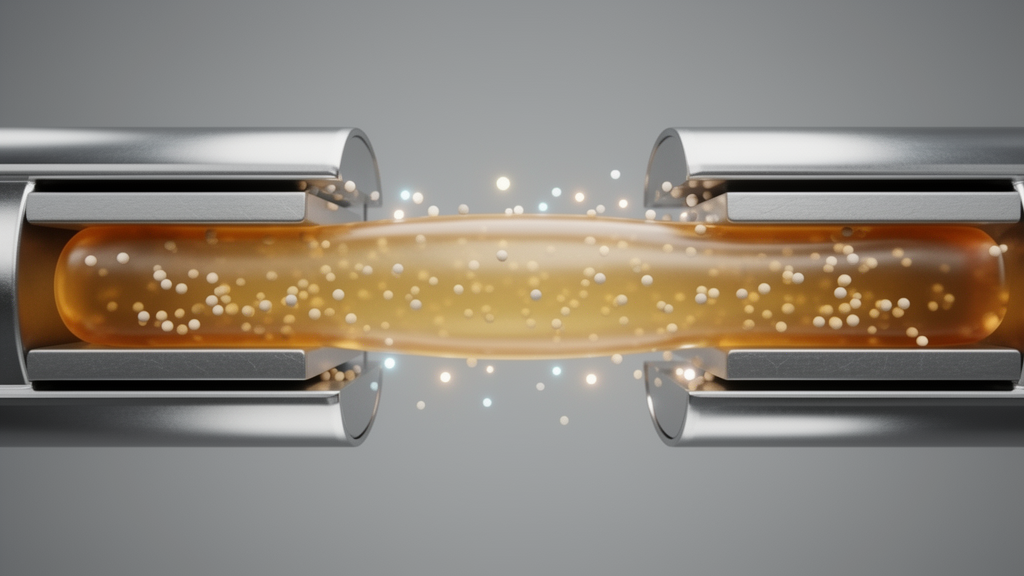
A composite solid electrolyte that pairs a prelithiated polyurethane polymer with ceramic LAGP fillers has delivered some of the more striking laboratory numbers reported for liquid-free all-solid-state lithium batteries. The material, named PLAP by its developers at Nanjing Tech University and partner institutions, achieved a room-temperature ionic conductivity of 3.8 × 10⁻⁴ S/cm, sustained lithium plating and stripping in symmetric cells for 750 hours at a demanding current density of 10 mA/cm², and powered lithium iron phosphate full cells that retained most of their capacity after 2,000 cycles. The work, published in Frontiers in Chemistry, targets two long-standing bottlenecks in solid-state battery design: the trade-off between ionic conductivity and mechanical strength, and a phenomenon the authors call interfacial ion trapping.
All-solid-state lithium batteries replace the flammable organic liquid electrolytes of conventional lithium-ion cells with solid conductors, a change that could improve safety and potentially raise energy density. Yet the two main families of solid electrolytes each carry weaknesses. Inorganic ceramic conductors such as Li₁.₅Al₀.₅Ge₀.₅P₃O₁₂, or LAGP, a NASICON-type material, offer high ionic conductivity around 10⁻⁴ S/cm at 25 °C, a wide electrochemical stability window exceeding 6 V, and good air stability, but they are brittle, suffer from grain-boundary resistance, and form sluggish solid-solid contacts with electrodes. Solid polymer electrolytes such as polyethylene oxide and polyurethane are flexible and processable but conduct ions poorly at room temperature, typically below 10⁻⁵ S/cm, with low lithium-ion transference numbers.
Blending ceramics into polymers is the standard remedy, but the new study identifies a subtler problem that limits many such composites. In conventional polyurethane-LAGP systems, the electronegative terminal hydroxyl groups on the polymer chains bind migrating lithium ions strongly at the polymer-ceramic interface through Coulombic Li-O interactions. This trapping raises interfacial charge-transfer resistance and reduces the effective lithium-ion transference number even when bulk conductivity looks reasonable. The usual fixes, adding more ceramic filler or extra lithium salt, backfire: excessive filler disrupts the continuous polymer network and weakens the membrane mechanically, while surplus lithium salt can trigger side reactions.
The team’s answer was chemical rather than compositional. Before polymerization, they treated the sucrose-based polyether soft segment of the polyurethane with lithium hydroxide, converting the terminal hydroxyl groups into lithium alkoxide groups, a step they term terminal prelithiation. They then added lithium salt, nano-alumina, LAGP powder with particles from 1 to 500 nm, and diphenylmethane diisocyanate to initiate polymerization, casting the mixture into coin-cell molds and curing at 120 °C for 48 hours.
X-ray photoelectron spectroscopy and infrared spectroscopy of the finished composite confirmed that the polyurethane backbone and the LAGP crystal chemistry both survive fabrication, with lithium, aluminium, germanium and phosphorus retaining their expected valence states. The authors note, however, that dedicated XPS measurements of standalone pristine polyurethane and pristine LAGP were not performed; peak assignments relied on reference fingerprints from published homologous materials, and powder X-ray diffraction, which would directly confirm LAGP crystalline phase integrity, was not measured.
Mechanically, the optimized membrane, containing 40 wt% LAGP, showed a tensile strength of about 5.47 MPa and an elongation at break of 192.4 percent, figures the authors attribute to the soft-hard segmented architecture of the polyurethane, in which rigid MDI-based hard segments bear mechanical load while flexible PPG soft segments solvate lithium ions. A composition screen across 10 to 80 wt% LAGP illustrated the classic trade-off: conductivity climbed with filler content, reaching 8.5 × 10⁻⁴ S/cm at 80 wt%, but tensile strength fell monotonically from 8.0 MPa to 3.8 MPa as surplus rigid particles agglomerated and broke the continuity of the polymer chains. The 40 wt% formulation balanced a conductivity of 3.8 × 10⁻⁴ S/cm against a strength near 5.5 MPa, which the authors describe as a threshold for suppressing lithium dendrite propagation.
Thermal and transport measurements filled out the picture. Differential scanning calorimetry gave a glass transition temperature of about −43 °C, indicating high segmental mobility at room temperature, and thermogravimetric analysis showed no significant weight loss before 200 °C, with decomposition onset near 260 °C by a 5 percent weight-loss criterion. Impedance spectroscopy from 25 °C to 80 °C showed conductivity rising to 1.01 × 10⁻³ S/cm, and the Arrhenius plot deviated from linearity, fitting Vogel-Tammann-Fulcher behavior in which ion transport is coupled to polymer segment relaxation, with an apparent activation energy of about 15.9 kJ/mol.
Symmetric lithium cells with 50 µm membranes and 200 µm lithium foils cycled at 0.5, 5 and 10 mA/cm² for 1,250, 1,000 and 750 hours respectively, with one-hour plating and stripping half-cycles and no rest intervals. Polarization stayed within roughly ±40 mV even at the highest current, scaling linearly with current in a way consistent with the measured conductivity, and replicate cells gave conductivities between 3.4 and 4.1 × 10⁻⁴ S/cm. Importantly, the benchmark for the unmodified, hydroxyl-terminated analogue comes not from new control experiments but from the team’s earlier published work with matching composition and protocols; that baseline achieved only about 10⁻⁶ S/cm and showed severe polarization within 100 hours. The authors also disclose that some supplementary impedance spectra were simulated from measured bulk resistance rather than newly acquired raw data, and that cross-section SEM imaging confirming membrane thickness and filler distribution was not carried out.
Full cells pairing lithium iron phosphate cathodes with lithium metal anodes fared well in cycling tests. Rate tests delivered specific capacities of roughly 168, 160, 153, 147, 141 and 135 mAh/g at 0.2, 1, 2, 3, 4 and 5 C, with the 0.2 C value close to the theoretical 170 mAh/g of LFP, and capacity recovered 99 percent when the rate returned to 0.2 C. Over extended cycling, retention reached 95.7 percent after 2,000 cycles at 0.2 C, 91 percent at 2 C and 87.8 percent at 5 C. The authors attribute the residual high-rate fading mainly to cathode-side structural evolution and interphase thickening rather than electrolyte degradation, an interpretation they support with the stable symmetric-cell voltage profiles, though they acknowledge that raw pre-cycling full-cell impedance datasets were not preserved and that simulated spectra stand in for direct interface measurements.
The study stops well short of a commercial claim, and its authors are candid about the gaps: no direct morphological imaging of the composite, no XRD phase confirmation, no separately measured pristine controls, and computational results that support but cannot prove the de-trapping mechanism. Even so, the combination of room-temperature ionic conductivity of 3.8 × 10⁻⁴ S/cm, mechanical strength above 5 MPa, and multi-thousand-cycle full-cell durability in fully liquid-free coin cells represents a coherent demonstration that modifying polymer terminal chemistry, rather than simply loading more ceramic into the mix, can address interfacial ion trapping. If the prelithiation strategy survives independent replication with proper control samples, it could offer a relatively simple molecular-design lever for the polymer-ceramic composite electrolytes that many see as a practical route toward safer, fast-charging lithium-metal batteries.
Subject of Research: A prelithiated polyurethane-LAGP composite solid electrolyte for all-solid-state lithium batteries
Article Title: Synergistic dual-phase network in rigid-flexible PU/LAGP composite electrolytes for fast-ion-conducting solid-state lithium batteries
Article References: Tang, X., Wang, S., Gou, Y., Ma, L., Wu, H., & Cui, P. (2026). Synergistic dual-phase network in rigid-flexible PU/LAGP composite electrolytes for fast-ion-conducting solid-state lithium batteries. Frontiers in Chemistry, 14, Article 1908013. https://doi.org/10.3389/fchem.2026.1908013
Image Credits: AI Generated
DOI: 10.3389/fchem.2026.1908013
Keywords: solid-state batteries, composite electrolyte, polyurethane, LAGP, ionic conductivity, prelithiation, lithium metal, LiFePO4, DFT calculations, ion transport, polymer electrolyte, Synergistic
Cite Scienmag News
Neil Sanderson. (October 29, 2026). Prelithiated Polymer-Ceramic Electrolyte Pushes Solid-State Batteries Toward Fast Charging. Scienmag. https://scienmag.com/prelithiated-polymer-ceramic-electrolyte-pushes-solid-state-batteries-toward-fast-charging/
Neil Sanderson. "Prelithiated Polymer-Ceramic Electrolyte Pushes Solid-State Batteries Toward Fast Charging." Scienmag, 29 October 2026, https://scienmag.com/prelithiated-polymer-ceramic-electrolyte-pushes-solid-state-batteries-toward-fast-charging/. Accessed 21 November 2026.
Neil Sanderson. "Prelithiated Polymer-Ceramic Electrolyte Pushes Solid-State Batteries Toward Fast Charging." Scienmag. October 29, 2026. https://scienmag.com/prelithiated-polymer-ceramic-electrolyte-pushes-solid-state-batteries-toward-fast-charging/




