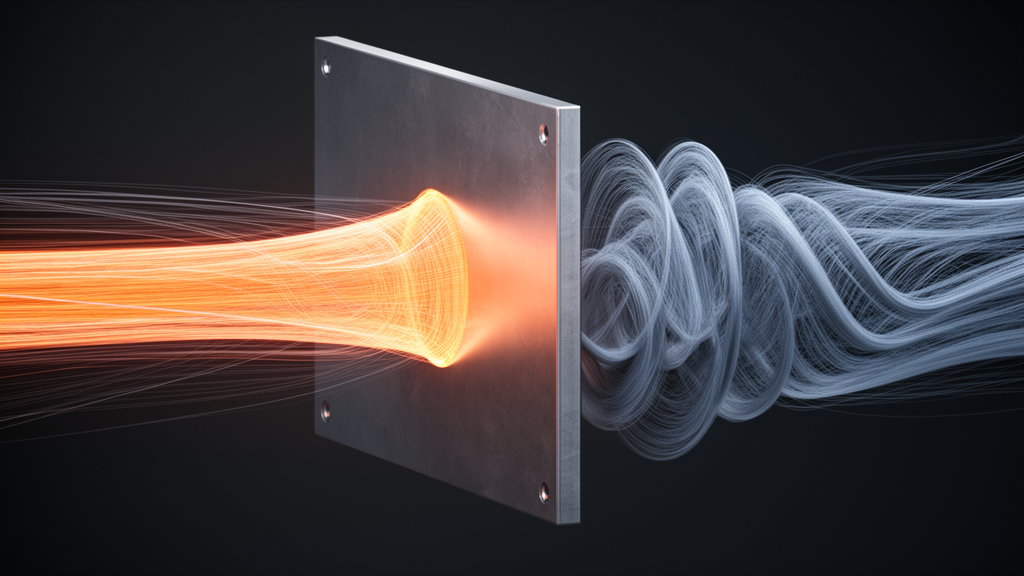
When a supersonic vehicle pushes through the atmosphere, shock waves slamming into the thin layer of air clinging to its skin can peel that layer away from the surface entirely. This phenomenon, known as shock wave-boundary layer interaction, is one of the central headaches in designing supersonic and hypersonic craft, because the resulting flow separation sharply increases drag, drives surface heat flux to dangerous peaks, and undermines the reliability of thermal protection systems. A new direct numerical simulation study, published in Advances in Aerodynamics, dissects exactly how shock strength and wall temperature govern this separation, and uses the findings to rebuild a decades-old prediction formula so that it works across a far wider flight envelope.
The research team, Hui Zhang, Deyu Gai and Wei Cao, focused on a canonical configuration: an incident shock wave striking a flat laminar boundary layer. Their computational model features a 360-millimetre flat plate with the shock impingement point placed 200 millimetres from the leading edge, generated by an upper wedge whose deflection angle controls the shock intensity. Using a self-developed direct numerical simulation solver built on the finite volume method, with an implicit Lower–Upper Symmetric Gauss–Seidel scheme for time integration, a third-order MUSCL scheme for inviscid fluxes and second-order central differencing for viscous terms, they computed steady flow fields at a freestream Mach number of 3.4 and a freestream Reynolds number of 1.5 million.
Shock intensity was swept systematically. Wedge angles of 2.5, 3.2, 4, 5, 6 and 7 degrees produced post-shock to freestream pressure ratios of 1.518 up to 2.974. At each intensity, the authors varied the wall temperature from 106 to 530 kelvin, corresponding to wall temperature ratios between 0.2 and 1 relative to the freestream total temperature, with the baseline case sitting at 320 kelvin, or 0.6 times the adiabatic wall temperature. Before trusting any of these results, the team validated their solver against the classic experiment of Hakkinen and colleagues and against numerical results from Katzer, Yao and Wasistho, finding that the computed wall pressure distribution matched the reference data closely, while the skin friction agreement with experiment showed a discrepancy the authors attribute to transition onset in the experimental reattachment region.
Grid independence was established through a convergence study at the strongest shock and hottest wall, with five grids tested and wall-normal clustering via hyperbolic tangent distributions. The first grid spacing at the wall was fixed at 0.5 thousandths of a millimetre, and comparisons of the wall skin friction coefficient showed that 1501 nodes in the streamwise direction were sufficient, with the chosen grid reproducing the friction distribution of finer grids almost exactly. Because the skin friction coefficient directly defines where flow separates and reattaches, this sensitivity check matters: the separation bubble dimension in this study is measured as the distance between the two points where wall friction crosses zero.
The central discovery concerns secondary separation. As shock intensity rises, the primary separation bubble grows, with the separation point moving upstream and the reattachment point moving downstream. But above a certain intensity, a second, smaller recirculation zone appears within the primary one. At the baseline wall temperature, this threshold lies between pressure ratios of 2.233 and 2.583. When the shock reaches 2.583, a secondary separation zone emerges upstream of the impingement point, and at 2.974 it stretches further in the streamwise direction while the primary separation zone fragments into multiple vortices. The authors link this onset to the normal pressure gradient: at weaker shocks, pressure through the boundary layer at the main vortex core stays constant, but once secondary separation begins, a normal pressure gradient appears and strengthens with shock intensity, destabilising the near-wall fluid and seeding the secondary zone.
The mechanism traces back to vorticity. A negative vorticity sheet at the shear layer feeds momentum from the external inviscid flow into the primary separation zone; the more momentum it delivers, the stronger the vortex rotation, the larger the low-pressure region at the vortex core, and the bigger the adverse pressure gradient imposed on the wall. Reverse flow velocity also increases with shock strength, and once secondary separation occurs, a distinct inflection point appears in the reverse-flow velocity profile. Notably, the team found that a pressure drop downstream of the separation plateau, previously attributed by other researchers to secondary separation, is actually caused by this low-pressure region within the primary vortex core.
Wall temperature turns out to be the wild card. Raising the wall temperature pushes the primary separation point upstream and the reattachment point downstream, enlarging the primary bubble, while the plateau pressure rises and the reattachment pressure climb becomes more gradual. The secondary separation behaves non-monotonically: as wall temperature increases, the size of the secondary zone first grows, then shrinks, and finally vanishes entirely. At a pressure ratio of 2.583, a single-zone type A secondary separation at the coldest walls transforms into a multi-zone type B structure as temperature rises, before disappearing altogether at a wall temperature ratio of 1. The authors explain this through two competing effects: hotter walls reduce the maximum shear stress in the shear layer, weakening momentum transfer and the adverse pressure gradient, but they also reduce the boundary layer’s own resistance to that gradient. Their interplay produces the rise-then-fall pattern, and additional simulations at wall temperature ratios up to 1.8 for the strongest shock confirmed the eventual disappearance.
These insights were aimed at a practical target: predicting how long the separation bubble is. The benchmark is Katzer’s formula, a dimensionless correlation valid for Mach numbers between 1.6 and 3.4 under adiabatic wall conditions. The simulations showed that Katzer’s formula progressively deviates from the DNS data as the pressure-rise parameter grows, and that once this parameter exceeds 1, wall temperature effects and secondary separation seriously degrade its accuracy. The team also found that Katzer’s method for computing the initial separation pressure ratio loses validity above Mach 6. Their fix introduces a wall temperature correction factor and a power-law exponent on the pressure-rise term, with coefficients fitted by regression across Mach numbers and wall temperature ratios, plus a revised initial separation criterion built on the hypersonic similarity parameter and viscous interference parameter, whose fitted relationship changes slope near a viscous interference parameter of 1.
The resulting formula predicts the primary separation bubble dimension for Mach numbers from 1.6 to 15 and wall temperature ratios from 0.2 to 1, covering both adiabatic and isothermal walls. Validation against Katzer’s adiabatic data and against numerical and experimental isothermal-wall results from the literature, most of which lie outside the conditions simulated here, showed that the data scatter evenly around the theoretical predictions. Against numerical benchmarks the new formula’s relative error mostly stays within 15 percent, and against experimental data from Holden it stays within 20 percent, whereas Katzer’s formula reaches errors as high as 70 percent under the same conditions. Crucially, the formula remains accurate even when secondary separation is present, because the study showed that secondary separation does not alter the qualitative dependence of the primary bubble dimension on shock intensity and wall temperature.
For engineers designing hypersonic vehicles that fly long durations through wide speed ranges, where real surface temperatures sit well below adiabatic equilibrium values, the message is concrete: separation predictions built on adiabatic assumptions can be badly wrong, and the corrected correlation offers a route to locating peak heat flux and sizing flow control strategies with far better confidence. The work also leaves a clear physical picture for future study, pinning the onset and evolution of secondary separation to the normal pressure gradient within the primary separation zone and to the temperature-dependent balance between shear-layer momentum transfer and boundary layer resilience.
Subject of Research: Flow separation in shock wave-boundary layer interactions over a flat plate, studied with direct numerical simulation across varying shock intensities and wall temperatures
Article Title: Research on the flow separation characteristics of shock wave-boundary layer interaction
Article References: Zhang, H., Gai, D., & Cao, W. (2026). Research on the flow separation characteristics of shock wave-boundary layer interaction. Advances in Aerodynamics, 8(1), Article 23. https://doi.org/10.1186/s42774-025-00221-8
Image Credits: AI Generated
DOI: 10.1186/s42774-025-00221-8
Keywords: shock wave-boundary layer interaction, flow separation, direct numerical simulation, secondary separation, supersonic flow, hypersonic vehicles, wall temperature effects, separation bubble, Katzer formula, aerodynamics, laminar boundary layer, heat flux
Cite Scienmag News
Denise Maddox. (October 29, 2026). Simulations Reveal How Wall Temperature Reshapes Shock-Induced Flow Separation. Scienmag. https://scienmag.com/simulations-reveal-how-wall-temperature-reshapes-shock-induced-flow-separation/
Denise Maddox. "Simulations Reveal How Wall Temperature Reshapes Shock-Induced Flow Separation." Scienmag, 29 October 2026, https://scienmag.com/simulations-reveal-how-wall-temperature-reshapes-shock-induced-flow-separation/. Accessed 29 October 2026.
Denise Maddox. "Simulations Reveal How Wall Temperature Reshapes Shock-Induced Flow Separation." Scienmag. October 29, 2026. https://scienmag.com/simulations-reveal-how-wall-temperature-reshapes-shock-induced-flow-separation/