Bacteria pushed through repeated rounds of surface migration can change in striking ways, and a new study from Brown University shows just how far those changes can go within a handful of laboratory passages. Researchers took a single clonal isolate of Enterobacter sp. SM3, a strain originally recovered from the murine intestinal lumen, and subjected it to a cyclic swarming assay in which cells were repeatedly harvested from the advancing edge of a colony growing across soft agar. After five to six such transfers, the resulting populations looked and behaved markedly differently from their ancestor: their cells were more than three times longer on average, they swam with longer runs and smaller reorientation angles, and their genomes carried a distinctive set of population-level mutations. The team named the five independent lineages they generated SM3 Swarmium, designated SM3SA through SM3SE.
The experimental design, described in the journal Frontiers in Microbiology, began with a colony purified from a frozen stock of SM3 obtained from the laboratory of Dr. Sridhar Mani at the Albert Einstein College of Medicine. This clonal parent, designated SM3A, was grown in lysogeny broth at 32 degrees Celsius, diluted, and spread on hard agar plates so that well-separated colonies could form. A single colony was picked at random to serve as the defined ancestral background. From that starting point, the researchers inoculated the center of plates containing 0.5 percent agar and LB medium, incubated them for roughly six hours until the swarm front had expanded across about two-thirds of the plate, and then transferred a small patch of cells from the front onto a fresh plate. Repeating this cycle five to six times constituted the selection regime, and five independent variants were produced in separate chronological trials.
A crucial feature of the protocol is what the authors did not do. After the final passage, they did not purify single colonies from the selected material. Each Swarmium population therefore remains a genetically heterogeneous mixture that may contain multiple genotypes that arose during the passage process. The variants are independently selected populations rather than defined clonal mutant strains, and this distinction shapes how the genomic findings should be interpreted. The study was designed to characterize the phenotypic and genomic changes arising in populations subjected to repeated swarming selection, not to isolate the individual genotypes responsible for those changes, and the authors are explicit that the genetic variants they report are associative rather than causal.
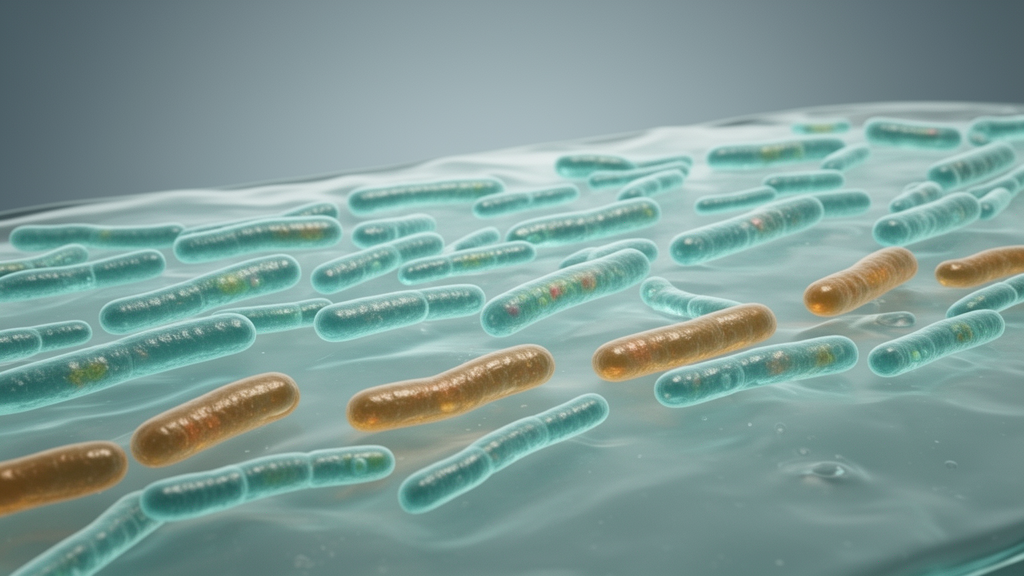
The most visible phenotype was morphological. Under phase-contrast microscopy, cells taken directly from the swarm front after the final passage showed pronounced filamentation, a form long associated with swarming behavior in many bacterial species. Quantitative measurements of 150 to 200 cells per condition revealed a mean cell length of 7.56 micrometers across the Swarmium variants, compared with 2.41 micrometers for the parental SM3A strain, an increase of more than threefold. One-way analysis of variance with post hoc testing indicated that every one of the five variants differed significantly from the parent in average length, although the extent and variability of elongation differed among the lineages. The abstract describes the Swarmium cells as two to three times longer than the parental strain, while the reported means correspond to a greater-than-threefold difference, a discrepancy the authors present alongside their per-variant distributions.
Motility was analyzed with a custom Python tracking algorithm applied to movies captured at 25 frames per second. The algorithm identifies a tumble event only when two criteria are met simultaneously: a decrease in the cell’s linear speed and an increase in angular speed of the cell body exceeding 20 percent of the baseline established in preceding frames. This dual-threshold approach minimizes false positives, though the authors note it may miss tumbles briefer than the 0.04-second interval between frames. From the tracked trajectories, the researchers extracted instantaneous linear speed, angular speed, run duration, tumble duration, and tumble angle. The results showed that swimming velocity and tumble duration were not significantly different between the Swarmium populations and the parent. What changed instead was directional persistence: Swarmium cells displayed longer runs and smaller tumble angles than SM3A, producing more persistent trajectories without any change in how fast the cells swim.
To connect these phenotypes to genetics, the team sequenced the genomes of SM3A and all five variants using Illumina paired-end short reads on a NovaSeq 6000 platform, generating between 18 and 27 million read pairs per genome. Coverage was exceptionally deep, ranging from 571-fold for SM3SC to 845-fold for SM3SD, with a mean of 634-fold across the six genomes, well above the threshold the authors consider sufficient for high-confidence base calling and variant detection. The assemblies were constructed de novo and curated through the Bacterial and Viral Bioinformatics Resource Center. All assemblies were comparable in length and GC content, at roughly 4.8 megabases and 56 percent, though variants B and E showed slightly lower N50 values and reduced counts of tRNA and rRNA genes, suggesting somewhat less contiguous assemblies for those two populations.
Polymorphism discovery was carried out by aligning each Swarmium assembly against the SM3A reference using the nucmer utility from MUMmer, filtering for one-to-one matches, and extracting single-nucleotide polymorphisms and small insertions and deletions. The numbers varied considerably among lineages: SM3SB carried 51 SNPs and 8 indels affecting 7 genes, SM3SA had 44 SNPs and 8 indels affecting 9 genes, SM3SE showed 35 SNPs and the most indels at 12, affecting 11 genes, SM3SD had 27 SNPs and 4 indels affecting 7 genes, and SM3SC was the least diverged with 17 SNPs, 2 indels, and 6 affected genes. SNPs appeared in both coding and intergenic regions, but the authors emphasize that coding variants were not systematically classified as synonymous or non-synonymous, and their predicted structural or functional consequences were not determined.
Despite that limitation, the affected loci form a suggestive pattern. Variants mapped to genes annotated for flagellar and motility regulation, including rcsB, which carried variants in SM3SA, SM3SC, and SM3SD; among those populations, SM3SA and SM3SD exhibited significantly longer run times relative to the parent, and SM3SD also showed the greatest mean cell length of the five. A variant in ftsL, a gene involved in cell division, was unique to SM3SE, the lineage whose filamentation would plausibly connect to a division defect. Changes also appeared in translation machinery, specifically ribosomal RNA operons and the translation elongation factor EF-Tu, and in loci associated with Type VI secretion systems, including PAAR-adjacent regions and proteins containing the DUF6531 domain of unknown function, whose genomic context adjacent to Type VI secretion modules hints at a possible but unconfirmed role in cooperative or competitive interactions at dense swarm fronts.
The authors are careful about what these associations do and do not establish. Because the mutations were identified in heterogeneous populations and never functionally validated, it remains unclear whether they are drivers of the observed phenotypes, compensatory adaptations, or secondary consequences of the selection regime. They also note that passage number differences between strains may introduce variability in background mutations, that bulk swarming dynamics were not quantitatively assessed even though the selection protocol used swarming conditions, and that more rigorous analyses such as mean square displacement or angle autocorrelation would strengthen conclusions about directional persistence. Their findings are therefore best read as describing motility changes in populations derived under swarming selection rather than definitive alterations in swarming behavior itself.
What the study does deliver is a framework and a set of leads. Repeated selection at expanding swarm fronts reliably produced elongated, directionally persistent populations from a single clonal ancestor, and deep sequencing catalogued the genomic variation that accompanied that transition, from regulatory and division genes to translation and interbacterial competition modules. The genomic data have been deposited in the NCBI under BioProject accession PRJNA1530472, with the microscopy and motility data available from the corresponding author on request. The next step, the authors argue, is to isolate individual clones from the selected populations, determine whether the phenotypes and candidate variants are retained in defined clonal backgrounds, and then use targeted mutagenesis and complementation to establish what each variant actually contributes.
Subject of Research: Experimental evolution of hyper-swarming Enterobacter sp. SM3 variants and their associated genomic and motility changes
Article Title: A cyclic swarming assay produces genetically and phenotypically distinctive variants of Enterobacter sp. SM3
Article References: Kim, D. D. H., Pagano, F. S., Costa, S. K., Germann, D. A., Belenky, P., & Tang, J. X. (2026). A cyclic swarming assay produces genetically and phenotypically distinctive variants of Enterobacter sp. SM3. Frontiers in Microbiology, 17, Article 1968333. https://doi.org/10.3389/fmicb.2026.1968333
Image Credits: AI Generated
DOI: 10.3389/fmicb.2026.1968333
Keywords: Enterobacter sp. SM3, swarming motility, experimental evolution, serial passage, cell elongation, whole-genome sequencing, run-and-tumble motility, rcsB, ftsL, Type VI secretion, population-level variants, directional persistence
Cite Scienmag News
Gavin Prescott. (October 28, 2026). Serial Swarming Selection Yields Elongated, Genetically Distinct Enterobacter Variants. Scienmag. https://scienmag.com/serial-swarming-selection-yields-elongated-genetically-distinct-enterobacter-variants/
Gavin Prescott. "Serial Swarming Selection Yields Elongated, Genetically Distinct Enterobacter Variants." Scienmag, 28 October 2026, https://scienmag.com/serial-swarming-selection-yields-elongated-genetically-distinct-enterobacter-variants/. Accessed 29 October 2026.
Gavin Prescott. "Serial Swarming Selection Yields Elongated, Genetically Distinct Enterobacter Variants." Scienmag. October 28, 2026. https://scienmag.com/serial-swarming-selection-yields-elongated-genetically-distinct-enterobacter-variants/