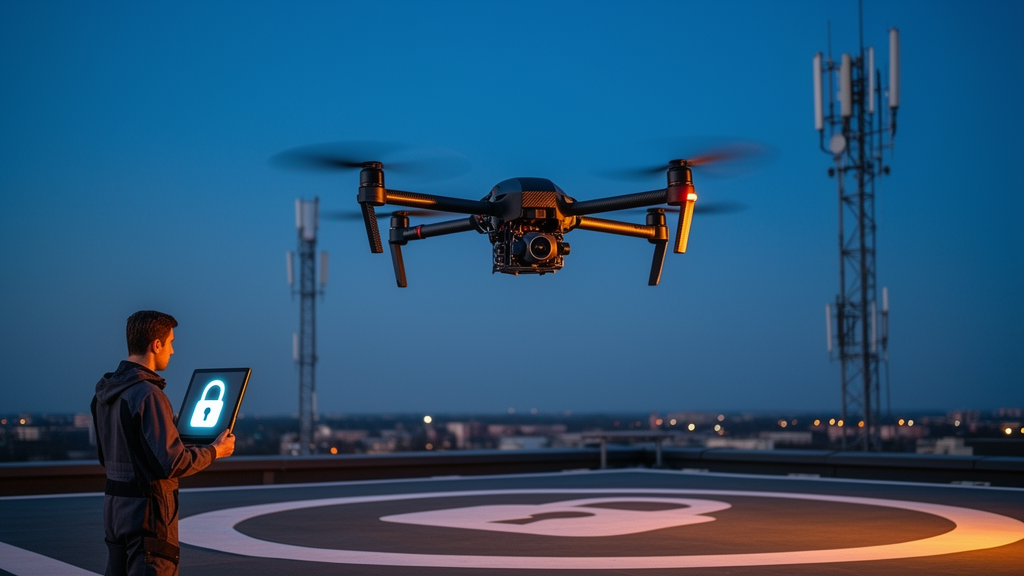
Cross-domain drone operations often span multiple administrative domains, and a new protocol published in Scientific Reports proposes a blockchain-assisted authentication scheme designed to make such access both privacy-preserving and revocable. The work, by Sen Xu, Yilin Guan, Shengnan Li, Junjie Li and Yang Zhao, targets what the authors describe as persistent weaknesses in existing systems: centralized authorization, exposure of mission attributes, inconsistent revocation, and limited auditability.
The core innovation is a shift from identity- or location-centric verification to revocation-aware lifecycle verification of mission capabilities. In the proposed framework, a committee of Domain Authorities jointly issues blinded capability credentials using distributed key generation and threshold BLS signatures, so no single party can fabricate a credential alone. Unmanned aerial vehicles then prove compliance with a mission policy through Groth16 zero-knowledge proofs, demonstrating that they hold the required capabilities without revealing the sensitive attributes themselves.
Revocation is handled on-chain. A blockchain maintains each credential’s active state, revocation versions, and audit-root evidence, giving domains a consistent, accountable record of which capabilities remain valid. Because revocation status is checked as part of authentication, a credential that has been withdrawn cannot simply be reused in another domain.
To reduce the cost of repeated access, the protocol includes a ticket-based AuthResume mechanism. Instead of running full authentication every time a UAV crosses a domain boundary or reconnects, the drone presents a ticket that resumes an earlier verified session. The design explicitly guards against outdated tickets bypassing revocation, so a drone whose credentials have been revoked cannot use a stale ticket to regain access.
The authors evaluated the scheme through formal security analysis, BAN logic, and Scyther automated verification, reporting that it supports credential unforgeability, revocation enforcement, auditability, mutual authentication, freshness, and session synchronization. On the implementation side, Solidity smart contracts were deployed on the Sepolia testnet, an Ethereum test network. Experimental results there showed acceptable overhead for full authentication and lightweight repeated access via AuthResume, though the article is an early-access version subject to further edits before the final Version of Record appears.
Subject of Research: A blockchain-assisted authentication protocol for cross-domain UAV edge networks using revocable capability credentials and zero-knowledge proofs.
Article Title: Blockchain-assisted revocable capability credential authentication for cross-domain UAVs
Article References: Xu, S., Guan, Y., Li, S., Li, J., & Zhao, Y. (2026). Blockchain-assisted revocable capability credential authentication for cross-domain UAVs. Scientific Reports. https://doi.org/10.1038/s41598-026-66290-x
Image Credits: AI Generated
DOI: 10.1038/s41598-026-66290-x
Keywords: UAV authentication, blockchain, capability credentials, zero-knowledge proofs, threshold BLS signatures, revocation, cross-domain security, Groth16, smart contracts, edge networks, Blockchain-assisted, revocable
Cite Scienmag News
Scienmag. (October 28, 2026). Blockchain Protocol Adds Revocable Capability Credentials for Cross-Domain UAV Authentication. https://scienmag.com/blockchain-protocol-adds-revocable-capability-credentials-for-cross-domain-uav-authentication/
Scienmag. "Blockchain Protocol Adds Revocable Capability Credentials for Cross-Domain UAV Authentication." Scienmag, 28 October 2026, https://scienmag.com/blockchain-protocol-adds-revocable-capability-credentials-for-cross-domain-uav-authentication/. Accessed 29 October 2026.
Scienmag. "Blockchain Protocol Adds Revocable Capability Credentials for Cross-Domain UAV Authentication." Scienmag. October 28, 2026. https://scienmag.com/blockchain-protocol-adds-revocable-capability-credentials-for-cross-domain-uav-authentication/