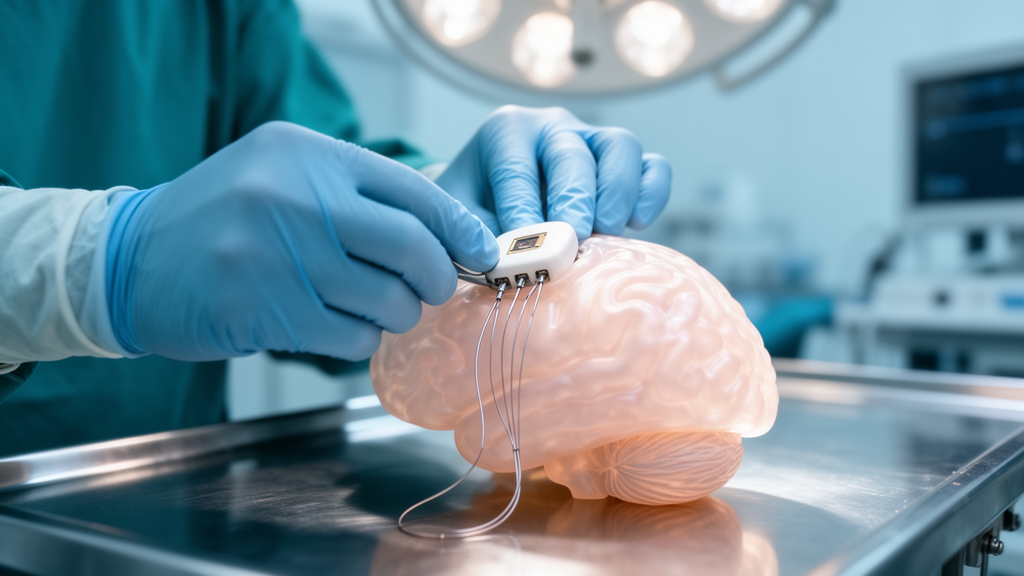
Implanted brain-computer interfaces are no longer laboratory curiosities. In a handful of trials, people with severe paralysis have used electrodes in or on their brains to type, speak through a decoder, move a robotic arm and control devices at home, in some cases for years at a time. Yet according to a review published on 28 October 2026 in Frontiers in Neuroscience, the evidence used to judge whether these devices are safe over the long term remains fragmented, small in scale and difficult to compare across the different ways an interface can be built. The review, led by Baozhou Xing, Li Zhang and Wen-Jun Tu of Shandong Second Medical University and Peking University Aerospace School of Clinical Medicine, argues that no implanted BCI architecture can currently be described as generally safe, and it proposes a structured lifecycle framework for collecting safety evidence that its authors hope can be tested across centres.
The review examines three main families of implanted systems: penetrating intracortical electrodes that sit inside neural tissue, cortical-surface systems including epidural, subdural and subpial placements, and cerebral-venous systems that place the recording interface inside a vein. Electrical stimulation, such as the intracortical microstimulation used to deliver sensory feedback, is treated as an additional exposure that cuts across all three designs. The authors stress that the anatomical compartment determines which complications are plausible, which tissues contact the device and what can actually be observed during follow-up, so safety priorities differ fundamentally between architectures.
The clearest prospective human data come from the BrainGate programme, which enrolled 14 implanted participants between 2004 and 2021 and accumulated 12,203 participant-days of safety follow-up, with a mean implant duration of 872 days. Investigators recorded 342 adverse events in total, of which 274, or 80.1 percent, were judged unrelated to the investigational device. The remaining 68 were device-related, and six of those were serious. Irritation of the incision or pedestal site and related skin changes accounted for 35 of the 68 device-related events. Across 17,927 array-implant-days, no intracranial or deep-tissue device-related infection required hospitalisation, intravenous antibiotics or explantation. The review is careful to note that these figures describe event counts from a single percutaneous platform, not the proportion of participants who experienced each event.
Not every risk in that record belongs to the device itself. Two BrainGate participants with previous traumatic brain injury had seizures on postoperative day 4, when antiseizure prophylaxis was absent or interrupted, and neither had further seizures nor lost the ability to continue in the trial. A participant with a history of pulmonary embolism developed recurrent embolism on postoperative day 3 while therapeutic anticoagulation was still withheld, and recovered after it was restarted. These cases, the review argues, show how event patterns connect to baseline risk, perioperative medication decisions and subsequent outcomes, which is why the proposed framework would require medication interruptions and restarts to remain in the record.
Cortical-surface systems trade penetrating electrode tracks for a different chronic risk profile. One fully implanted subdural system remained usable at home for five years in a participant with spinal cord injury, with electrode impedance stabilising within six months and the battery remaining at an operable voltage. A separate Utrecht system was followed for 7.5 years. In that case, the participant used the fully implanted system independently at home for almost seven years, and for more than three years it was her only way to initiate communication. Use declined after about year six and ended 7.5 years after implantation when control became unreliable, although no technical malfunction was identified. The review highlights this as a reminder that end-of-use, fallback arrangements and functional dependence remain clinically relevant even when no conventional device failure ever occurs.
Cerebral-venous systems raise a distinct set of questions about vessel patency, wall response and antithrombotic treatment. The SWITCH study enrolled five people and implanted four. At three and twelve months, CT venography showed no target-vessel occlusion or thrombosis, and the mean absolute change in distal-electrode position was 0.45 millimetres. The protocol used dual antiplatelet therapy for three months and aspirin through month twelve, and during follow-up eight mild adverse device effects were recorded, comprising four incision-site bruising events, two anaemia events, one jugular access-site haematoma and one episode of postoperative fatigue, all of which resolved without intervention. The review cautions that a four-person, twelve-month record cannot determine late vessel-wall response, chronic removability or the safety of different antithrombotic regimens, and sheep studies from the same platform found neointimal coverage and non-uniform vascular remodelling despite stable impedance, findings that cannot be inferred from a patent human vessel alone.
Stimulation adds its own exposure dimension. A recent long-term report followed five participants receiving intracortical microstimulation for two to ten years, totalling 27 implant-years, 623 stimulation-hours and more than 170 million pulses. Fifty-three brief sensations that continued after the stimulation train ended were recorded as stimulation-related adverse events, ranging from three to 25 per participant, with a mean of roughly 23,000 stimulation trials per event. Most lasted less than ten seconds, the longest about 9.5 minutes, none was painful and none required medical intervention. Detection thresholds increased by an average of 3.67 microamps per year, with substantial variation across electrodes and participants, and stimulation still evoked tactile sensations in the participant followed for ten years. The review notes that these sessions were intermittent, closely monitored and governed by predefined limits and stopping rules, so the data do not define a safe exposure for continuous real-world stimulation or for other cortical targets.
One of the review’s central arguments is that different evidence streams capture different parts of the safety picture and cannot be substituted for one another. Clinical examination detects manifested consequences but not microscopic tissue change. Imaging is constrained by resolution, artefact and device configuration, and a normal scan does not exclude abnormalities below its sensitivity. Device metrics such as impedance and channel yield are sensitive to trends but non-specific, and signal instability or recalibration can arise from several technical states without evidence that tissue injury is the cause. An explant study examined 980 microelectrodes from ten arrays removed from three people after 956 to 2,130 days, alongside one unimplanted control array, and found material damage whose relation to electrical performance differed by electrode type. Retrieval and post-mortem studies reveal material or local tissue findings only at selected endpoints, and animal experiments illuminate mechanisms without supplying a human incidence rate. The review also warns that counting publications rather than participants overstates independent human exposure, since one implanted person may generate several papers, and that inconsistent exposure denominators, such as participant-days, active-use hours and pulse counts, cannot be reduced to a single incidence measure.
Against this backdrop, the authors propose a lifecycle framework spanning the preimplant baseline, implantation, recovery, chronic use, new findings and end-of-use. It combines a small common dataset covering participant and baseline state, procedure and configuration, time and exposure, repeated safety observations, an event pathway and final implant status, with architecture-specific modules for skin-route, surface, venous, packaging and stimulation considerations. Alongside scheduled follow-up, an event-triggered route would govern how a new symptom, imaging finding or technical change moves through confirmation, attribution, escalation and outcome recording: isolated technical changes would first be retested under matched conditions, and persistent or unexplained changes would prompt clinical review because technical checks cannot exclude tissue injury. Hardware exchanges, firmware updates and decoder revisions would be versioned with start and stop dates, so that an event after an update is not assigned to the wrong configuration.
The authors are explicit that this framework is a proposal, not a validated standard. It does not prescribe visit intervals, imaging schedules, stimulation-dose limits or explantation thresholds, and it should become formal guidance only if prospective multicentre studies show that it improves care, with independent adjudication, input from participants and caregivers, registry follow-up and periodic revision. The review also finds that the available evidence does not support ranking implant architectures by safety, because cohorts are small and sometimes overlapping, event definitions and follow-up durations vary, and much of the biological interface remains beyond direct observation during life. What the existing evidence can support, the authors conclude, is a practical starting point: shared definitions, a longitudinal core record, architecture-specific additions, event-triggered review and a documented end-of-use status for every implant, so that clinical, biological, technical and functional findings can finally be aligned over time.
Subject of Research: Clinical safety evidence and standardisation of implanted brain-computer interfaces
Article Title: Clinical safety assessment of implanted brain-computer interfaces: current evidence and a pathway to standardization
Article References: Xing, B., Zhang, L., & Tu, W.-J. (2026). Clinical safety assessment of implanted brain-computer interfaces: current evidence and a pathway to standardization. Frontiers in Neuroscience, 20, Article 1994636. https://doi.org/10.3389/fnins.2026.1994636
Image Credits: AI Generated
DOI: 10.3389/fnins.2026.1994636
Keywords: brain-computer interface, clinical safety, intracortical electrodes, cortical surface, cerebral-venous interface, adverse events, device explantation, intracortical microstimulation, long-term follow-up, standardisation, neuroprosthetics, Frontiers in Neuroscience
Cite Scienmag News
Cassandra Pierce. (October 28, 2026). Implanted brain-computer interfaces lack a shared safety rulebook, review warns. Scienmag. https://scienmag.com/implanted-brain-computer-interfaces-lack-a-shared-safety-rulebook-review-warns/
Cassandra Pierce. "Implanted brain-computer interfaces lack a shared safety rulebook, review warns." Scienmag, 28 October 2026, https://scienmag.com/implanted-brain-computer-interfaces-lack-a-shared-safety-rulebook-review-warns/. Accessed 29 October 2026.
Cassandra Pierce. "Implanted brain-computer interfaces lack a shared safety rulebook, review warns." Scienmag. October 28, 2026. https://scienmag.com/implanted-brain-computer-interfaces-lack-a-shared-safety-rulebook-review-warns/