Friday, October 30, 2026
Science
No Result
View All Result
  • Login
  • HOME
  • SCIENCE NEWS
  • CONTACT US
  • HOME
  • SCIENCE NEWS
  • CONTACT US
No Result
View All Result
Scienmag
No Result
View All Result
Home Science News Psychology & Psychiatry

Over Half of Neurology Patients in Eastern Congo Screen Positive for Trauma Distress

October 28, 2026
in Psychology & Psychiatry
Glenn Wilkins
By Glenn Wilkins Scienmag Editorial Profile - Clinical Psychology
Reading Time: 3 mins read
0
Over Half of Neurology Patients in Eastern Congo Screen Positive for Trauma Distress

Over Half of Neurology Patients in Eastern Congo Screen Positive for Trauma Distress

65
SHARES
587
VIEWS
Share on FacebookShare on Twitter
ADVERTISEMENT

More than half of adults receiving neurological care at a hospital in Goma, in the conflict-affected east of the Democratic Republic of the Congo, screened positive for trauma-related psychological distress, according to a hospital-based cross-sectional study published in Discover Psychology. Among 569 participants, 324, or 56.9 percent, scored above the threshold on the 10-item Trauma Screening Questionnaire, a result the authors emphasize reflects a positive screening, not a psychiatric diagnosis.

The survey was conducted at CIMAK in Goma between December 2024 and March 2025. Adults with a current, clinician-confirmed neurological disorder were systematically sampled. The Trauma Screening Questionnaire was scored from 0 to 10, with scores of 6 or higher defining a positive screening result. The researchers used explanatory multivariable logistic regression to examine sociodemographic, clinical, and contextual factors associated with positive screening, modeling age in categories because it showed a nonlinear relationship with the log-odds of a positive result.

The strongest association was with conflict-related trauma exposure: participants reporting such exposure had 12.60 times the adjusted odds of screening positive compared with those who did not, a 95 percent confidence interval of 7.96 to 19.94 and a p-value below 0.001. Substance use was also associated with higher odds, with an adjusted odds ratio of 2.28 (95 percent CI 1.42 to 3.66; p < 0.001).

Age showed a more complex pattern. Compared with participants aged 18 to 29 years, those aged 30 to 44 years had 2.81 times the adjusted odds of positive screening (95 percent CI 1.54 to 5.14), and those aged 45 to 59 years had 3.67 times the odds (95 percent CI 1.81 to 7.41). The group aged 60 and older did not differ significantly from the youngest group. Male sex and urban residence were associated with lower odds of a positive screening result, while a history of traumatic brain injury did not remain statistically significant after adjustment.

The study population was 301 female participants, or 52.9 percent, with 440 participants, or 77.3 percent, living in urban areas, and a mean age of 40.5 plus or minus 19.8 years. The authors note that prolonged armed conflict in eastern DRC creates substantial psychological stress, yet evidence among patients receiving neurological care had remained limited, motivating this survey of screening prevalence and its associated factors.

The authors conclude that positive screening on the Trauma Screening Questionnaire was common among adults receiving neurological care in this conflict-affected setting, and that the findings support trauma-informed psychological screening and referral within neurological services. They stress, however, that cross-sectional screening results are neither causal estimates nor psychiatric diagnoses, and the study’s hospital-based design means the figures describe this sampled patient population rather than the general population of the region.

Subject of Research: Prevalence of positive trauma screening and associated factors among neurological care patients in eastern Democratic Republic of the Congo

Article Title: Prevalence of trauma-related psychological distress and associated factors among patients receiving neurological care in eastern Democratic Republic of the Congo: a cross-sectional study

Article References: Kamabu, L. K., Bakesiga, A., Sikakulya, F. K., Bisimwa, M. A., Lekuya, H. M., Kangitsi, C. K., & Maheshe, F. P. (2026). Prevalence of trauma-related psychological distress and associated factors among patients receiving neurological care in eastern Democratic Republic of the Congo: a cross-sectional study. Discover Psychology. https://doi.org/10.1007/s44202-026-00946-7

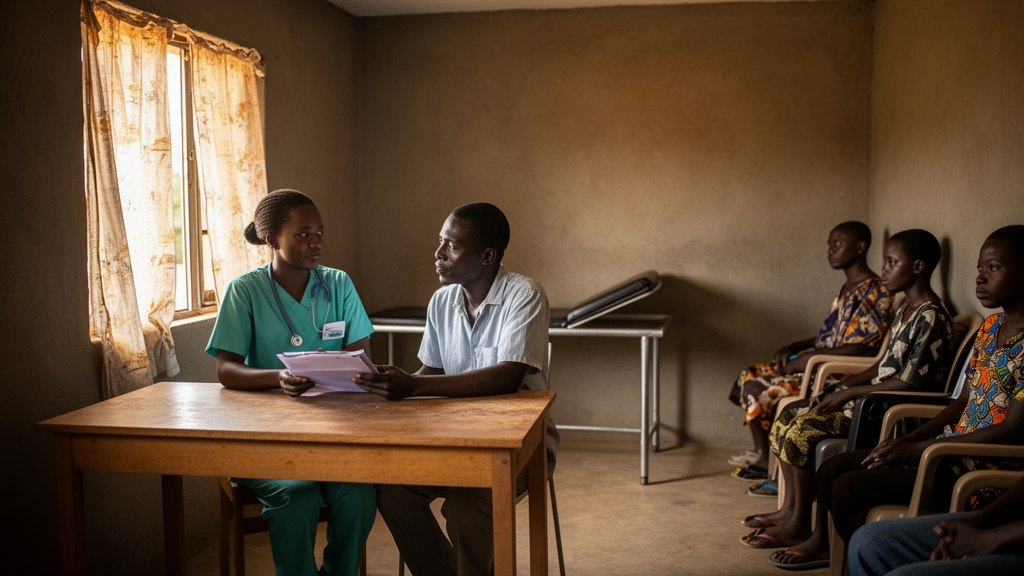
Image Credits: AI Generated

DOI: 10.1007/s44202-026-00946-7

Keywords: trauma, psychological distress, Democratic Republic of the Congo, neurological care, cross-sectional study, Trauma Screening Questionnaire, armed conflict, Goma, substance use, mental health screening, Prevalence, trauma-related

Cite Scienmag News

Glenn Wilkins. (October 28, 2026). Over Half of Neurology Patients in Eastern Congo Screen Positive for Trauma Distress. Scienmag. https://scienmag.com/over-half-of-neurology-patients-in-eastern-congo-screen-positive-for-trauma-distress/


Glenn Wilkins. "Over Half of Neurology Patients in Eastern Congo Screen Positive for Trauma Distress." Scienmag, 28 October 2026, https://scienmag.com/over-half-of-neurology-patients-in-eastern-congo-screen-positive-for-trauma-distress/. Accessed 30 October 2026.

Glenn Wilkins. "Over Half of Neurology Patients in Eastern Congo Screen Positive for Trauma Distress." Scienmag. October 28, 2026. https://scienmag.com/over-half-of-neurology-patients-in-eastern-congo-screen-positive-for-trauma-distress/

Tags: armed conflictconflict exposure and mental health outcomescross-sectional studycross-sectional study on trauma prevalenceDemocratic Republic of the CongoGomaimpact of conflict-related traumamental health in conflict zonesMental health screeningmental health screening tools in resource-limited settingsneurological careneurological disorders and psychological distressneurological patient mental health assessmentprevalencepsychological distresssociodemographic factors and trauma risksubstance usetraumatrauma and substance use correlationtrauma impact on neurological patientsTrauma screening in Eastern CongoTrauma Screening Questionnairetrauma-relatedtrauma-related psychological distress in Goma
Share26Tweet16
Previous Post

New Orthodontic Framework Pairs Vertical Control With Class II Correction

Next Post

Stigma Concerns Linked to Depressive Symptoms in COVID-19 Survivors in Hong Kong

Related Posts

Time Online, Not Gender or Income, Best Tracks Problematic Internet Use in Turkish Youth
Psychology & Psychiatry

Time Online, Not Gender or Income, Best Tracks Problematic Internet Use in Turkish Youth

October 30, 2026
Integrated job support program keeps people with schizophrenia employed longer, three-year trial finds
Psychology & Psychiatry

Integrated job support program keeps people with schizophrenia employed longer, three-year trial finds

October 30, 2026
Psychosis risk calculator predicts remission and antidepressant use, not just conversion
Psychology & Psychiatry

Psychosis risk calculator predicts remission and antidepressant use, not just conversion

October 30, 2026
Discrimination and school belonging tied to teen suicidal thoughts, but no combined effect
Psychology & Psychiatry

Discrimination and school belonging tied to teen suicidal thoughts, but no combined effect

October 30, 2026
Sensitive employees may shape their own jobs through friendships and enjoyment at work
Psychology & Psychiatry

Sensitive employees may shape their own jobs through friendships and enjoyment at work

October 30, 2026
Vigorous workouts linked to quieter rumination in college students
Psychology & Psychiatry

Vigorous workouts linked to quieter rumination in college students

October 30, 2026
Next Post
Stigma Concerns Linked to Depressive Symptoms in COVID-19 Survivors in Hong Kong

Stigma Concerns Linked to Depressive Symptoms in COVID-19 Survivors in Hong Kong

  • Mothers who receive childcare support from maternal grandparents show more optimized

    Mothers who receive childcare support from maternal grandparents show more parental warmth, finds NTU Singapore study

    27656 shares
    Share 11059 Tweet 6912
  • University of Seville Breaks 120-Year-Old Mystery, Revises a Key Einstein Concept

    1061 shares
    Share 424 Tweet 265
  • Bee body mass, pathogens and local climate influence heat tolerance

    682 shares
    Share 273 Tweet 171
  • Researchers record first-ever images and data of a shark experiencing a boat strike

    546 shares
    Share 218 Tweet 137
  • Groundbreaking Clinical Trial Reveals Lubiprostone Enhances Kidney Function

    531 shares
    Share 212 Tweet 133
Science

Embark on a thrilling journey of discovery with Scienmag.com—your ultimate source for cutting-edge breakthroughs. Immerse yourself in a world where curiosity knows no limits and tomorrow’s possibilities become today’s reality!

RECENT NEWS

  • Freeze-Dried Chips Made from Discarded Prawns Win the Taste Test
  • Pilot trial of body and mind program for osteoarthritis with cognitive concerns proves acceptable but not feasible
  • Word embeddings trace a 1945 turning point in Japan’s gendered language
  • West Africa’s shifting seasons: systematic review finds climate change disrupting crop, vegetation and animal timing

Categories

  • Agriculture
  • Anthropology
  • Archaeology
  • Athmospheric
  • Biology
  • Biotechnology
  • Blog
  • Bussines
  • Cancer
  • Chemistry
  • Climate
  • Earth Science
  • Editorial Policy
  • Marine
  • Mathematics
  • Medicine
  • Pediatry
  • Policy
  • Psychology & Psychiatry
  • Science Education
  • Science News
  • Social Science
  • Space
  • Technology and Engineering

Subscribe to Blog via Email

Enter your email address to subscribe to this blog and receive notifications of new posts by email.

Join 5,151 other subscribers

© 2025 Scienmag - Science Magazine

Welcome Back!

Login to your account below

Forgotten Password?

Retrieve your password

Please enter your username or email address to reset your password.

Log In
No Result
View All Result
  • HOME
  • SCIENCE NEWS
  • CONTACT US

© 2025 Scienmag - Science Magazine

Discover more from Science

Subscribe now to keep reading and get access to the full archive.

Continue reading