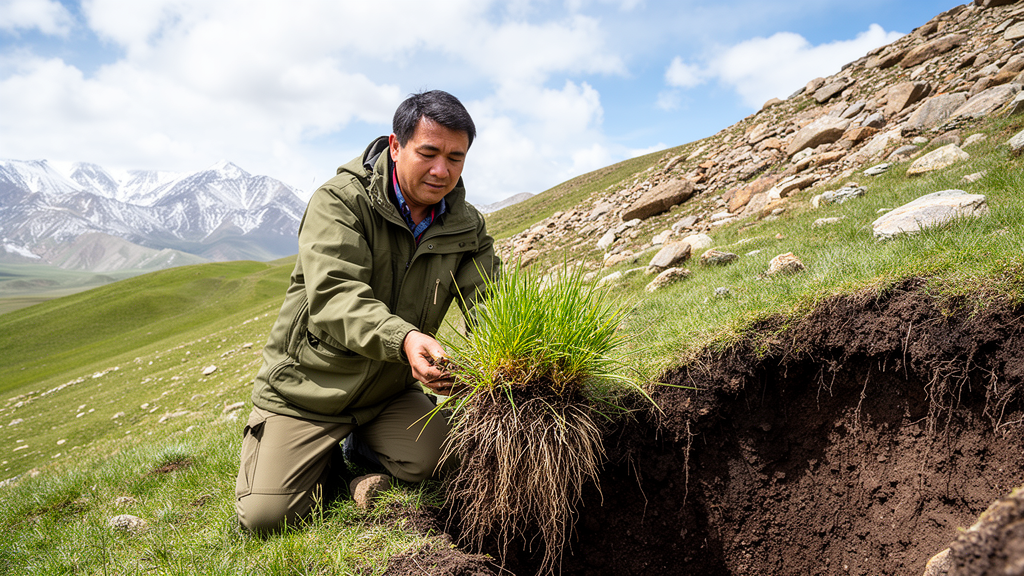
On the loess slopes of the Xining Basin, where the northeastern Qinghai–Tibet Plateau meets the western Loess Plateau, shallow landslides, collapses, and debris flows threaten railways, highways, and densely inhabited communities. A new open access study published in Geoenvironmental Disasters on 7 September 2026 examined whether three dominant herbaceous grasses could strengthen this fragile ground, and measured exactly how much their roots change the mechanical behaviour of loess soil.
Researchers from institutions associated with the study, led by Jimei Zhao with co-authors including Xiasong Hu, Changyi Liu, Yanxiu Wang, Lin Lu, and Shi Liu, worked at the Changlinggous National-Level Science and Technology Demonstration Park for Soil and Water Conservation in Qinghai Province. The park covers 1725 acres at elevations between 2294.2 and 2600.6 metres, with a temperate semi-arid continental climate: an average annual temperature of 6 °C, roughly 368 mm of annual precipitation, and about 1762.8 mm of annual evaporation. The region’s Late Pleistocene Malan loess and Holocene loess, 3 to 50 metres thick along the Huangshui River and its tributaries, are loose, silty, porous, and collapsible, softening and losing strength under rainfall infiltration or disturbance.
The team established an in situ planting test site at 2352 metres altitude, covering 48 square metres on four slopes, each 8 metres long and 1.5 metres wide with a 25-degree gradient. Three perennial Elymus species were chosen against explicit criteria including cold and drought tolerance, well-developed root systems, high tensile and shear strength, and short aboveground height: Elymus nutans, Elymus trachycaulus, and Elymus sibiricus. The plants were sown in mid-April 2022 by drilling at 2–3 cm depth and 10 cm row spacing, covered with non-woven fabric to retain moisture, irrigated for 15 days after sowing, and grown for a four-year growth period, with an unplanted bare slope kept as the control.
The investigation then moved through three scales of measurement. Single-root tensile tests used an HY 0580 microcomputer-regulated electronic universal testing machine with a 20 mm gauge length and a tensile speed of 20 mm/min; for each species, three replicate groups of 60 roots were tested, and only specimens fracturing at the midpoint between the grips counted as valid. Multiroot tensile tests used bundles of 5, 10, 15, 20, and 25 roots, a range set by preliminary trials showing that bundles of three or fewer roots failed sequentially without notable synergy, while bundles of 30 or more caused grip slippage that reduced the test success rate. Direct shear tests on root–soil composites, prepared from undisturbed loess taken at 3 to 10 cm depth in cutting rings, applied normal stresses of 50, 100, 200, and 300 kPa at a constant shear rate of 2.4 mm/min, with failure defined at 4 mm of shear displacement.
At the single-root scale, the results followed a familiar but consequential pattern. Tensile resistance rose with root diameter, described by an exponential relationship with statistical significance (R² > 0.5, P < 0.01), while tensile strength fell with diameter, following a power function. E. trachycaulus achieved the highest single-root tensile resistance at 17.10 N, 1.82 times that of E. nutans (9.42 N) and 7.01 times that of E. sibiricus (2.44 N). Yet the ranking reversed for strength per unit area: E. nutans exhibited the highest tensile strength at 97.53 MPa, ahead of E. trachycaulus (60.84 MPa) and E. sibiricus (23.66 MPa). Ultimate elongation rate showed no clear relationship with diameter at all, with goodness-of-fit values of 0.0173, 0.0001, and 0.0098 approaching zero, but E. trachycaulus again led with a mean elongation of 42.28%, 3.15 times that of E. nutans (13.41%) and 5.13 times that of E. sibiricus (8.24%).
Root cross-sectional scanning helped explain why the rankings diverged. The three species’ stele proportions decreased in the order 46%, 41%, and 37%, and xylem proportions in the order 28%, 22%, and 20%, matching the descending order of tensile resistance and elongation rate. E. trachycaulus roots, with dried sample diameters of roughly 0.69 to 0.75 mm, had an epidermis about 15–30 μm thick, a cortex of 8–10 layers of closely arranged parenchyma cells about 80–140 μm thick, and a stele about 490–510 μm in diameter with xylem vessels 15–30 μm across. E. nutans and E. sibiricus roots were finer, with stele diameters near 171–182 μm and 160–173 μm respectively, and smaller vessel diameters of 4–8 μm and 8–13 μm. The authors interpret the pattern as microstructural regulation: higher stele and xylem proportions favour tensile resistance and elongation, while larger vessel diameters may attenuate tensile strength per unit area, which is why E. nutans, with the smallest vessels, led on strength.
The multiroot tests revealed the study’s most striking finding. Tensile resistance increased with root number in a significant positive linear correlation, but tensile strength decreased. In E. trachycaulus, resistance climbed from 63.26 N at five roots to 261.67 N at twenty-five, while strength fell from 45.82 to 36.43 MPa over the same range. At n = 25, E. trachycaulus reached the highest multiroot tensile resistance and strength (243.35 N and 36.43 MPa), while E. sibiricus yielded the lowest (46.14 N and 17.17 MPa). Crucially, measured values fell systematically below predictions built from single-root properties, with negative deviations of 14.86–48.13% that widened as root number grew. In E. nutans, the measured resistance went from 18.46% below the theoretical value at five roots to 44.84% below at twenty-five, and the strength deviation grew from 16.43% to 47.30%. Force–displacement curves for E. sibiricus showed why: a single root produced one peak of 3.31 N, but a five-root bundle produced successive peaks as the weakest roots fractured first, redistributing load to survivors, with the maximum reaching 14.09 N. As root number rose from 1 to 25, peak force increased 12.94-fold and corresponding displacement rose 38%, from 9.95 to 13.72 mm. The bundles behave as nonlinear, interacting systems rather than simple linear sums of individual roots.
The direct shear tests translated these mechanics into slope-relevant numbers. All three species significantly enhanced soil shear strength relative to the bare slope. Cohesion of the root–soil composites ranked E. trachycaulus (29.54 kPa) above E. nutans (23.48 kPa) and E. sibiricus (20.42 kPa), with increases over the bare slope of 157.99%, 104.54%, and 78.34% respectively as reported in the abstract. The internal friction angle followed the same ordering, 36.93° for E. trachycaulus, 35.53° for E. nutans, and 34.0° for E. sibiricus, though the authors note the friction angle showed no significant variation among species while cohesion did. Under the highest normal load of 300 kPa, shear stress reached 255.18 kPa for E. trachycaulus, 242.93 kPa for E. nutans, and 220.22 kPa for E. sibiricus, increases of 29.49%, 23.27%, and 11.75% over the bare slope. Vegetation also raised soil water content, from 12.97% on the bare slope to 17.82%, 16.57%, and 15.37% under the three species, with E. trachycaulus retaining 37.4% more water than bare ground.
The study’s morphology data reinforced why E. trachycaulus performed best. Its maximum effective root length of 33 cm exceeded E. nutans (23 cm) by 1.43 times and E. sibiricus (27 cm) by 1.22 times, and its average root diameter of 0.60 mm was 1.74 and 1.62 times that of the other two species. Its average plant height of 127.5 mm and ground diameter of 1.73 mm also led the group. Checking against the classical Wu–Waldron model, which estimates root-induced cohesion gain as 1.2 times average root tensile strength times the root area ratio, the experimental cohesion ranking matched the multiroot tensile strength ranking, and a larger root area ratio corresponded to higher composite shear strength.
The authors frame the work as a theoretical and practical basis for selecting vegetation in ecological slope protection projects across loess regions of the plateau, where hazards have included a 2016 landslide along the Lanzhou–Xinjiang High-Speed Railway that forced suspension of service and abandonment of the Zhangjiazhuang Tunnel, a September 2022 loess landslide in Huzhu County that killed five people, and a mudflow triggered by the December 2023 Jishishan earthquake. They also state the key limitation plainly: the direct shear tests were performed under laboratory conditions that do not fully replicate field environments with rainfall infiltration and cyclic wetting–drying, and future work will incorporate in situ testing and dynamic hydrological conditions to evaluate how the laboratory results hold up in the field.
Subject of Research: Multiscale tensile and shear testing of three herbaceous species to quantify root reinforcement of loess slope soil in the Xining Basin
Article Title: Multiscale mechanical characteristics and slope protection effects of herbaceous roots in the loess region of the Qinghai–Tibet Plateau
Article References: Zhao, J., Hu, X., Liu, C., Wang, Y., Lu, L., & Liu, S. (2026). Multiscale mechanical characteristics and slope protection effects of herbaceous roots in the loess region of the Qinghai–Tibet Plateau. Geoenvironmental Disasters, 13(1), Article 61. https://doi.org/10.1186/s40677-026-00411-6
Image Credits: AI Generated
DOI: 10.1186/s40677-026-00411-6
Keywords: loess, Qinghai–Tibet Plateau, root reinforcement, soil shear strength, Elymus, landslides, slope stability, direct shear test, root tensile strength, vegetation, Xining Basin, geohazards
Cite Scienmag News
Violet Maxwell. (October 28, 2026). Herbaceous Roots Tested for Slope Protection on the Qinghai–Tibet Plateau. Scienmag. https://scienmag.com/herbaceous-roots-tested-for-slope-protection-on-the-qinghai-tibet-plateau/
Violet Maxwell. "Herbaceous Roots Tested for Slope Protection on the Qinghai–Tibet Plateau." Scienmag, 28 October 2026, https://scienmag.com/herbaceous-roots-tested-for-slope-protection-on-the-qinghai-tibet-plateau/. Accessed 29 October 2026.
Violet Maxwell. "Herbaceous Roots Tested for Slope Protection on the Qinghai–Tibet Plateau." Scienmag. October 28, 2026. https://scienmag.com/herbaceous-roots-tested-for-slope-protection-on-the-qinghai-tibet-plateau/