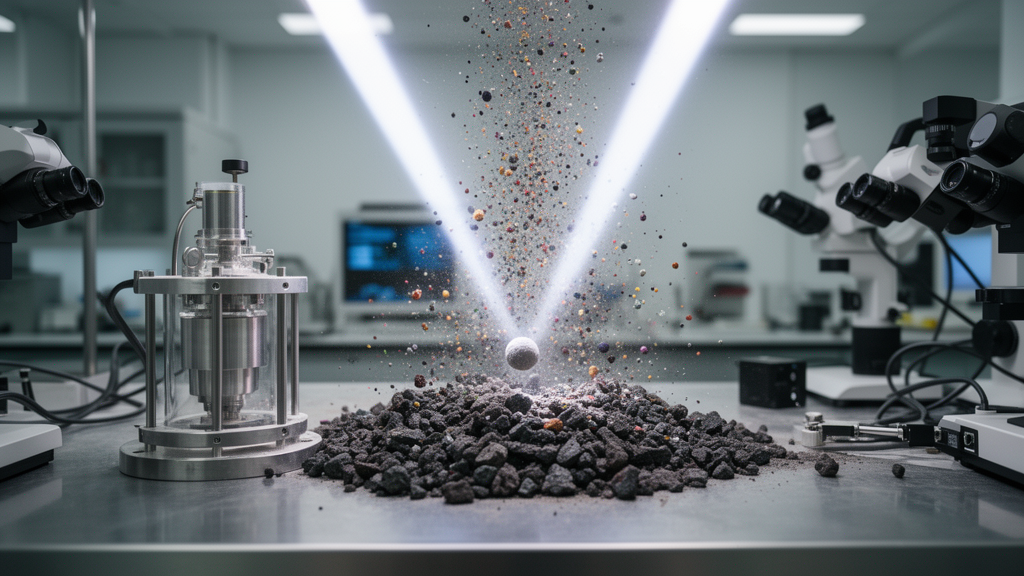
When a spacecraft deliberately slams into an asteroid or comet, the resulting plume of excavated dust offers a rare glimpse of material that has been shielded from solar radiation for billions of years. A new numerical study published in Earth, Planets and Space examines how the light scattered by such an ejecta curtain changes depending on the size and composition of the dust grains it contains, with the aim of helping scientists interpret images from past and future impact experiments.
The research, led by U. Keerthana and P. Shalima with Koji Wada, Johannes Markkanen and Hiroshi Kimura, sets up a model ejecta curtain based on the Hayabusa2 mission’s impact experiment on asteroid Ryugu. In that 2019 event, a small carry-on impactor struck the asteroid’s surface and the deployable camera DCAM3 captured the evolution of the resulting ejecta curtain over time. The team’s model predicts scattered intensities in the visible range at 6000 angstroms, matching the DCAM3 specifications, so that the calculations can be checked against the actual images of the impact event.
The geometry of the model is deliberately simple. The ejecta curtain is treated as an inverted hollow cone, ten meters in both height and radius, built from small cubes of side 0.1 meters. Sunlight strikes the curtain as parallel rays at a 45-degree incident angle, producing phase angles of 40 to 50 degrees in the multiple scattering calculations, which is approximately equal to the phase angle range of 50 to 53 degrees reported for the Hayabusa2 observations. The detector is placed 1000 meters from the curtain, observing perpendicular to the cone axis, and the authors note that the scattered intensity can be scaled to arbitrary observational distances.
At the heart of the study is a dust grain model spanning a wide range of possibilities. Grain radii are varied from 0.1 micrometers to 1000 micrometers, a range informed by prior estimates from comet Halley, Deep Impact observations of comet 9P/Tempel 1, Rosetta observations of comet 67P, and the DART impact on Dimorphos. The compositions tested include amorphous carbon, graphite, iron, astronomical silicates, cometary dust, lunar glass, magnesium-rich olivine, organic refractories and Titan tholin, each characterized by a complex refractive index at 6000 angstroms. The materials are grouped by their absorptive power: weakly absorbing substances such as lunar glass and Mg-rich olivine have an imaginary refractive index near zero, moderately absorbing materials such as astronomical silicates, organic refractories and tholin range from about 0.02 to 0.1, and strongly absorbing materials such as amorphous carbon, graphite, iron and cometary dust span roughly 0.5 to 3.
Because the grains are assumed to be spherical for computational simplicity, the team uses Mie theory, implemented through the Python package miepython, to calculate cross-sections and scattering matrix elements. These feed into a Monte Carlo radiative transfer method that tracks photon trajectories from first scattering until the photons leave the medium or their intensity drops significantly. The calculation uses ten million weighted photons, the point at which the model intensity converges within the available computational limits, and generating a single intensity map for a fixed set of dust parameters takes about two and a half hours of computation.
A key finding concerns the phase function, the mathematical description of how light is scattered at different angles. The authors compare their calculated phase functions with the widely used Henyey-Greenstein phase function and find that the Henyey-Greenstein form overestimates the values compared with the scattering phase function, regardless of the size and composition of the dust grains. For small grains the Henyey-Greenstein curve shows only weak dependence on scattering angle, resembling isotropic grains, and as grain size increases the interference features visible in the theoretical phase curves are absent from the smooth Henyey-Greenstein curve. The authors argue that this demonstrates the importance of using phase functions that reproduce actual grain materials rather than the often-used Henyey-Greenstein approximation in impact plume modeling.
The phase function results themselves reveal strong compositional signatures. At sub-micron sizes the phase functions are nearly constant, implying mostly isotropic scattering, while larger grains show increasingly complex profiles with a series of maxima and minima across the Mie resonance range and strong forward scattering at small angles. Weakly absorbing materials such as lunar glass and Mg-rich olivine display ripple structures and interference patterns in their phase functions, features that are absent in strongly absorbing materials like iron and graphite, because low absorptive power allows light to penetrate the material and interfere. The magnitude and the interference pattern both diminish as absorptive power increases.
Turning to the scattered intensity maps, the model shows that the median scattered intensity of the ejecta curtain depends strongly on both size and composition. For weakly absorbing materials such as Mg-rich olivine and lunar glass, the median intensity is maximum at 0.1 micrometers and then decreases gradually, with the curtain brightest at sub-micron sizes and significantly dimmer once grains reach the millimeter range; Mg-rich olivine shows the brightest median intensity at each individual size. For moderately absorbing materials such as astronomical silicate, organic refractory and tholin, the intensity rises to a maximum around 0.1 to 0.5 micrometers and then falls substantially, while for strongly absorbing materials the peak occurs around 0.5 micrometers before a slight decline. Cometary dust shows the least intensity among all the compositions tested, and the intensity profile across the map also changes shape, with a U-shaped profile for sub-micron grains that flattens as size increases.
Optical depth emerges as another major control on the results. Testing three regimes with optical depth below 1, equal to 1 and above 1, the study finds a general decrease in the magnitude of the median scattered intensity as optical depth increases, which the authors attribute to the increasing extinction that photons experience after each scattering before reaching the detector. When the dust grain size is varied at fixed composition, the median scattered intensity remains low for optical depths above 1, and no significant deviation appears in the intensity profile with grain size and optical depth. The discussion section adds that the sharp decline in intensity at larger grain sizes is mostly due to the increase in extinction cross-section, which raises the optical depth, combined with a sharp drop in the phase function at scattering angles of roughly 130 to 140 degrees for larger grains.
Finally, the study extends the model beyond monodisperse grains to a power-law size distribution with indices of minus 2, minus 3 and minus 4, spanning 0.1 to 1000 micrometers, and also tests a number density that decreases from the base to the top of the cone with a power-law index of minus 1.82. The model median scattered intensity increases as the power index of the grain-size distribution decreases, and the influence of the power index is strong in weakly absorbing materials and weak in strongly absorbing ones. Varying the number density reduces the overall median intensities, but the overall variation in the profile between different compositions remains the same as in the monodisperse case with uniform density. The authors acknowledge that their calculations are restricted to spherical grains and a single geometry based on the DCAM3 specifications, whereas real grains are mostly aggregates, and they envisage the study as a useful reference for investigating subsurface grain properties of planetary bodies via impact plume observations, for improving available ejecta scattering models, and for selecting prospective targets for future impact missions.
Subject of Research: Numerical modeling of light scattering by dust grains of varying size and composition in an impact-induced ejecta curtain
Article Title: Numerical study of multiple scattering intensities obtained from dust grains of different sizes and compositions in an impact-induced ejecta curtain
Article References: Keerthana, U., Shalima, P., Wada, K., Markkanen, J., & Kimura, H. (2026). Numerical study of multiple scattering intensities obtained from dust grains of different sizes and compositions in an impact-induced ejecta curtain. Earth, Planets and Space, 78(1), Article 229. https://doi.org/10.1186/s40623-026-02548-y
Image Credits: AI Generated
DOI: 10.1186/s40623-026-02548-y
Keywords: ejecta curtain, impact cratering, light scattering, dust grains, Hayabusa2, Ryugu, Monte Carlo radiative transfer, Mie theory, phase function, optical depth, grain-size distribution, planetary science
Cite Scienmag News
Grant Pearson. (October 28, 2026). Modeling How Dust Grain Size and Composition Shape Impact Ejecta Light Scattering. Scienmag. https://scienmag.com/modeling-how-dust-grain-size-and-composition-shape-impact-ejecta-light-scattering/
Grant Pearson. "Modeling How Dust Grain Size and Composition Shape Impact Ejecta Light Scattering." Scienmag, 28 October 2026, https://scienmag.com/modeling-how-dust-grain-size-and-composition-shape-impact-ejecta-light-scattering/. Accessed 30 October 2026.
Grant Pearson. "Modeling How Dust Grain Size and Composition Shape Impact Ejecta Light Scattering." Scienmag. October 28, 2026. https://scienmag.com/modeling-how-dust-grain-size-and-composition-shape-impact-ejecta-light-scattering/