Stretchable strain sensors promise to bend, stretch and conform to the human body, to robots and to aircraft structures, but most laboratory studies evaluate them only under benign room conditions. A new study published in Discover Sensors on 29 August 2026 examines what happens when a screen-printed stretchable strain sensing array is pushed through a controlled range of ambient temperatures and humidity levels while being mechanically deformed. The work, led by Hansraj Gupta and colleagues including Sumit Verma and Shrutidhara Sarma, systematically varied relative humidity between 60 and 80 percent and temperature between roughly 31 and 48 degrees Celsius, and compared the custom array against a commercial strain gauge under identical external loading.
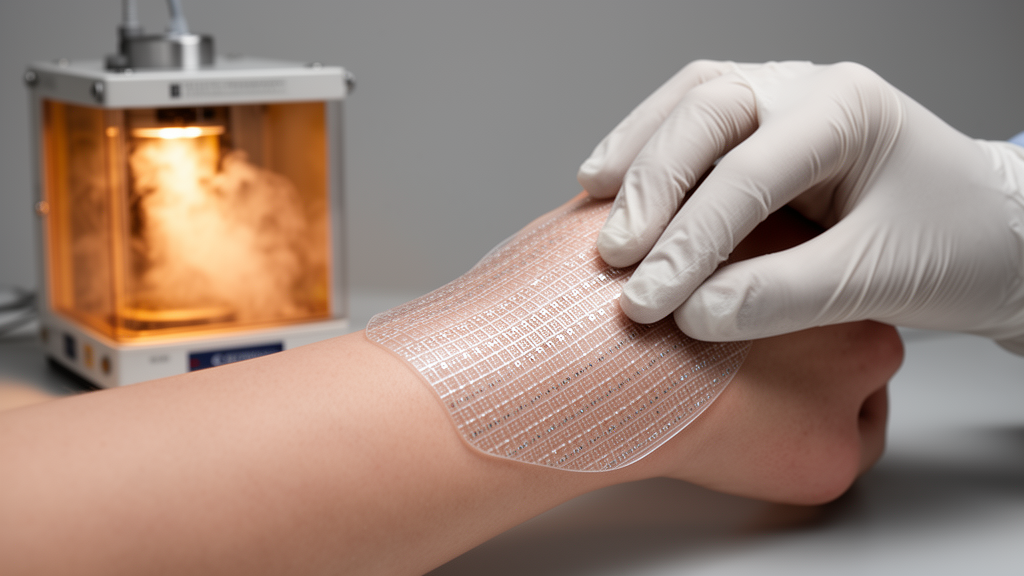
The device under test, named SS-Flower15, is a stretchable strain sensing array designed and fabricated in-house. It consists of 15 carbon-based resistive sensing elements arranged in a flower-like pattern on a polydimethylsiloxane (PDMS) substrate, with a second layer of silver ink providing the electrical connections. The sensing layer was printed using Dupont Intexar PE671 stretchable carbon ink, while the interconnects used Dupont Intexar PE874 stretchable silver ink. The masks for both layers were designed in KiCad 7.0 and printed through a 150 threads-per-inch polyester mesh. The carbon layer was printed first, followed by the silver layer, with a 250 micrometre gap between adjacent electrodes, and the printed layers were cured at 150 degrees Celsius for 45 minutes. A thin encapsulating layer of PDMS mixed with curing agent in a 10:1 ratio was applied over the sensor.
The flower-like geometry was chosen deliberately. Because the 15 elements fan out in different directions, the array can pick up strain from multiple orientations, conform to curved surfaces, and reduce regions where strain might otherwise go undetected. All sensing elements are routed to a 16-pin connector, allowing the array to interface with external measurement electronics through an FCC cable and a PSoC-6 microcontroller module, which handled signal conditioning, data acquisition and preliminary processing. During mechanical loading, signals from all 15 elements were acquired sequentially through analog multiplexers and digitized at a sampling rate of 8 hertz, with multiple readings averaged for each element to reduce noise and transient fluctuations.
To create the environmental conditions, the team built a low-cost custom chamber from plastic, enclosed on three sides with an aluminium sheet as the fourth side. The aluminium panel acted as a heat spreader, distributing the temperature from a hot plate underneath evenly and preventing localized overheating that could deform the plastic enclosure. Relative humidity was regulated separately by a 24-volt DC humidifier in a separate enclosure, which delivered water vapor through a connecting pipe, with a 12-volt DC fan and relay controlling the vapor flow. AHT25 temperature and humidity sensors placed at different positions monitored conditions across the chamber. The chamber held temperature within approximately plus or minus 0.17 degrees Celsius of the set value and humidity within approximately plus or minus 0.3 percent of the target, with temperature stabilizing in about an hour and humidity in about three hours.
Mechanical loading was applied by a linear actuator driven by a DM556 stepper motor driver controlled by an Arduino Uno, applying up to 1 millimetre of linear deflection in 0.2 millimetre increments, with a positioning resolution of 10 micrometres. The SS-Flower15 and a commercial 350-ohm strain gauge were mounted on opposite sides of a foam layer so that both experienced the same external deformation simultaneously. The authors are careful to note that this comparison is qualitative: because the sensors sit on opposite sides of the foam, differences in local strain transfer across the foam thickness cannot be excluded, and the goal was to compare overall response trends rather than establish point-by-point quantitative equivalence.
The results showed a clear pattern. Under varying humidity at a constant 30 degrees Celsius, the SS-Flower15 exhibited a substantially larger change in resistance than the commercial strain gauge under the same external loading. The maximum resistance change for the array was 6.86 kilo-ohms at 60 percent relative humidity, which fell to 0.69 kilo-ohms at 70 percent and rose slightly to 1.76 kilo-ohms at 80 percent, with a similar trend for the strain gauge. The slope of the normalized resistance versus strain relationship was highest at 60 percent humidity and progressively decreased toward 80 percent, which the authors attribute to moisture absorption that may have altered the microstructure of the carbon ink and reduced its piezoresistive response. Notably, the sensor maintained a linear strain-response relationship across all humidity levels.
Temperature produced an inverse effect on sensitivity. Tested at 31, 41 and 48 degrees Celsius at a constant 60 percent relative humidity, the slope of the SS-Flower15’s normalized resistance versus strain curve dropped from 13.920 at 31 degrees to 6.659 at 41 degrees and 6.024 at 48 degrees, a decline the authors link to thermal expansion of the polymer matrix increasing the spacing between conductive particles. The resistance change fell from 4.80 kilo-ohms at 31 degrees to 2.98 and 1.77 kilo-ohms at 41 and 48 degrees respectively. The commercial strain gauge, by contrast, showed only small changes in resistance across temperatures, with slopes decreasing from 0.008 to 0.004, reflecting the lower temperature sensitivity of metallic gauges. Baseline resistance for most of the array’s sensing elements increased with temperature, consistent with a positive temperature coefficient effect in the polymer matrix. The authors note that although tests were planned at 30, 40 and 50 degrees, actual conditions settled at 31, 41 and 48 degrees due to chamber stabilization limits.
Hysteresis, the difference between loading and unloading responses at the same strain, behaved differently under the two environmental variables. For the SS-Flower15, hysteresis increased with humidity, rising from 27.92 percent at 60 percent relative humidity to 37.8 percent at 80 percent, which the authors attribute to moisture-induced behaviour of the PDMS substrate reducing elastic recovery. But hysteresis decreased with temperature, falling from 19.71 percent at 31 degrees to 18.83 percent at 41 degrees and 10.40 percent at 48 degrees, an overall reduction of 47 percent. The explanation offered is that PDMS molecular chains move more freely as the polymer warms and softens, allowing faster relaxation and recovery after deformation. The commercial strain gauge showed consistently high hysteresis of roughly 113.68 percent at 60 percent humidity and about 113.54 percent across temperature conditions, which the authors link to moisture absorption by the adhesive layer and mechanical lag in the less compliant metallic gauge.
The authors also examined baseline resistance drift across individual sensing elements. Five elements aligned with the loading axis and showing stable, repeatable responses were selected for analysis, and the authors stress that these results represent only those selected elements, not all 15. Baseline resistance for most of these elements decreased as humidity rose from 60 to 80 percent, attributed to moisture-induced softening of the PDMS substrate and improved conductivity in the carbon ink, while baseline drift in the normalized plots decreased from 0.058 at 60 percent humidity to 0.006 at 80 percent, indicating improved stability at higher humidity. With temperature, baseline resistance generally increased, with drift for example from 15.43 to 18.07 ohms as temperature rose, whereas the metallic strain gauge remained nearly constant at around 352 ohms but offered minimal responsiveness.
The study’s authors frame these findings as a caution and an opportunity. The environmental dependence of both sensitivity and baseline resistance underscores the need for careful calibration and compensation strategies in real deployments, such as wearable devices, field-deployed robotics and aerospace technologies, where temperature and humidity cannot be tightly controlled. They suggest encapsulation layers that limit moisture while preserving flexibility, and temperature-compensation approaches including reference sensing elements, Wheatstone bridge configurations and calibration algorithms. The authors acknowledge limitations: strain experienced by the two sensors may not have been identical because of substrate compliance and possible variation in foam deformation, and partial chamber insulation and basic sensor encapsulation may have introduced minor inconsistencies. Future work, they write, will investigate combined temperature and humidity effects using a factorial design, validate strain transfer with additional gauges or optical measurement, and develop compensation methodologies. The tested conditions, 60 to 80 percent humidity and 31 to 48 degrees Celsius, represent a specific warm, humid range rather than the full span such sensors might encounter in the field.
Subject of Research: Environmental effects on a screen-printed stretchable strain sensing array
Article Title: Influence of ambient temperature and humidity on the performance of a screen-printed stretchable strain sensing array
Article References: Gupta, H., Verma, S., & Sarma, S. (2026). Influence of ambient temperature and humidity on the performance of a screen-printed stretchable strain sensing array. Discover Sensors, 2(1), Article 50. https://doi.org/10.1007/s44397-026-00083-9
Image Credits: AI Generated
DOI: 10.1007/s44397-026-00083-9
Keywords: stretchable sensors, strain sensing array, screen printing, humidity, temperature, wearable electronics, soft robotics, hysteresis, piezoresistive, PDMS, environmental chamber, calibration
Cite Scienmag News
Denise Maddox. (October 28, 2026). Stretchable strain sensor array keeps its linear response under heat and humidity. Scienmag. https://scienmag.com/stretchable-strain-sensor-array-keeps-its-linear-response-under-heat-and-humidity/
Denise Maddox. "Stretchable strain sensor array keeps its linear response under heat and humidity." Scienmag, 28 October 2026, https://scienmag.com/stretchable-strain-sensor-array-keeps-its-linear-response-under-heat-and-humidity/. Accessed 29 October 2026.
Denise Maddox. "Stretchable strain sensor array keeps its linear response under heat and humidity." Scienmag. October 28, 2026. https://scienmag.com/stretchable-strain-sensor-array-keeps-its-linear-response-under-heat-and-humidity/