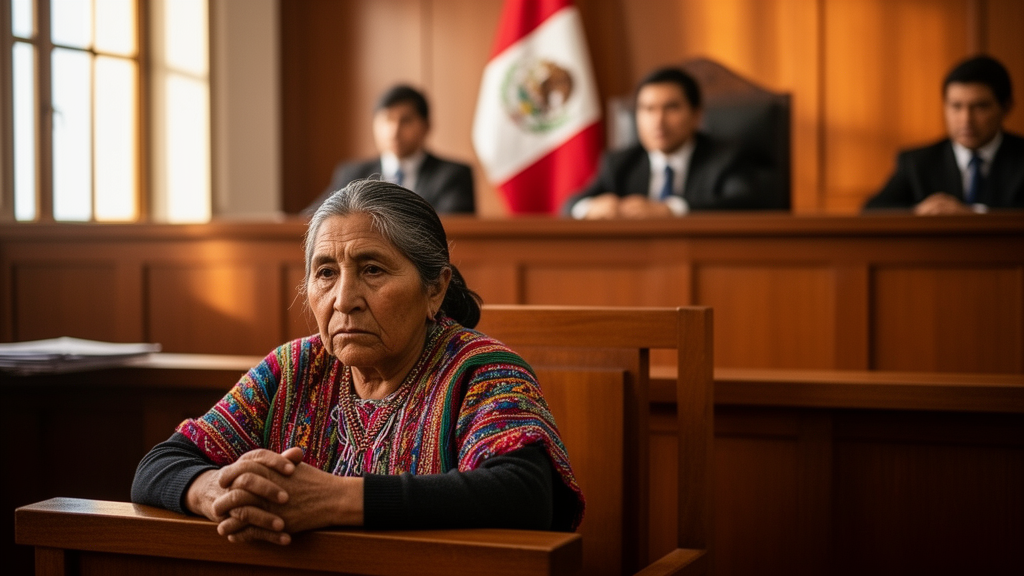
Between 1996 and 2000, a Peruvian family planning program sterilized hundreds of thousands of people, most of them poor, rural and Indigenous women, many of whom never gave free consent. The program did not operate in a legal vacuum. It ran under the cover of a law, a ministerial resolution, numerical sterilization targets and signed consent forms, so that at every step the state’s intervention was documented as lawful, technical and, when framed as voluntary, consented to. A new theoretical article in Frontiers in Sociology argues that this documentary scaffolding did more than enable the policy: it shaped how the same facts would later be judged, and ultimately helped ensure that no official was ever criminally convicted.
The authors, Andherson J. Aguirre-Lanegra and Jonathan Rafael García Enríquez of the Technological University of Peru, propose a concept they call the juridical laundering of biopower. Biopower, in their usage, means the state’s power over a population’s life and reproduction. The concept has two phases. In the first, legal documents present state intervention in reproduction as legitimate and technical. In the second, prosecutors, courts and other institutions place the very same facts into different legal categories, and whichever category prevails determines whether anyone can be held responsible. The category assigned to the facts, in other words, is not a neutral description but the decisive variable in accountability.
The Peruvian record shows how dramatically those categories could diverge. Since 1997, Peruvian prosecutors and courts, Congress and international human rights bodies have classified the same events in contradictory ways: as an accident, as ordinary crimes barred by time limits, as a lawful health program, and as serious human rights violations. Each classification carried different consequences. Calling the program a lawful health initiative foreclosed responsibility altogether; calling the acts ordinary crimes allowed statutes of limitations to extinguish prosecution; calling them serious human rights violations opened a path toward accountability, but only under specific conditions.
To test these ideas systematically, the authors examined the program’s own documents alongside 34 decisions and other official acts issued between 1997 and 2026. They tested four propositions. The evidence supported three: the program’s own documents later served as grounds for not prosecuting its architects; the facts were classified in contradictory ways over nearly three decades; and none of the program’s architects was convicted. The fourth proposition, concerning the conditions under which accountability becomes possible, was consistent with the evidence, though the authors state only that the evidence is consistent with it rather than fully supporting it.
Classifying the facts as human rights violations led to accountability only when three conditions coincided: when domestic and international institutions agreed on that classification, when a binding court decision enforced it, and when time limits did not bar prosecution. Agreement among institutions, an enforceable ruling and an open procedural window had to align. Where any one was missing, the human rights framing remained a moral judgment without legal teeth.
The article frames this as a question for the sociology of law: how do legal documents make state control over reproduction look legitimate, and how do they shape later disputes over it? The authors note that existing research has explained either how such policies were legitimized or how they were contested, but not the link between the two. The two-phase concept is their attempt to connect legitimization and contestation in a single analytical frame, showing that the documents produced to authorize a policy can return decades later as shields for the officials who designed it.
The Peruvian case thus ends in what the authors call deferred impunity: a policy that the state presented as lawful ends in a finding that the state itself violated human rights, while no official is held criminally responsible. The finding of violation is real and formally recorded, but it arrives without a conviction. The authors present this as a theoretical contribution to sociology rather than a policy prescription, and the analysis is limited to the Peruvian case and the 34 official acts they examined, so the framework’s applicability elsewhere remains to be tested.
Signed consent forms, numerical targets and ministerial resolutions documented the program’s reach in real time; years later, those same documents anchored decisions not to prosecute. The article is classified as a hypothesis and theory contribution in the sociology of law, and it was received in July 2026 and accepted in October 2026. Its central claim is deliberately narrow: legal categories do not merely describe state violence after the fact, they help determine whether that violence will ever be answered in court.
Subject of Research: How legal documents legitimized Peru's forced sterilization program and later shaped contradictory legal classifications that ended in no criminal convictions.
Article Title: How law legitimized and later recharacterized forced sterilization in Peru: the juridical laundering of biopower
Article References: Aguirre-Lanegra, A. J., & García Enríquez, J. R. (2026). How law legitimized and later recharacterized forced sterilization in Peru: the juridical laundering of biopower. Frontiers in Sociology, 11, Article 1944164. https://doi.org/10.3389/fsoc.2026.1944164
Image Credits: AI Generated
DOI: 10.3389/fsoc.2026.1944164
Keywords: Peru, forced sterilization, biopower, sociology of law, human rights, accountability, legal characterization, reproductive governance, impunity, Frontiers in Sociology, legitimized, later
Cite Scienmag News
Courtney Benton. (October 28, 2026). Law legitimized Peru’s forced sterilizations, then shielded officials from conviction. Scienmag. https://scienmag.com/law-legitimized-perus-forced-sterilizations-then-shielded-officials-from-conviction/
Courtney Benton. "Law legitimized Peru’s forced sterilizations, then shielded officials from conviction." Scienmag, 28 October 2026, https://scienmag.com/law-legitimized-perus-forced-sterilizations-then-shielded-officials-from-conviction/. Accessed 29 October 2026.
Courtney Benton. "Law legitimized Peru’s forced sterilizations, then shielded officials from conviction." Scienmag. October 28, 2026. https://scienmag.com/law-legitimized-perus-forced-sterilizations-then-shielded-officials-from-conviction/