Thursday, October 29, 2026
Science
No Result
View All Result
  • Login
  • HOME
  • SCIENCE NEWS
  • CONTACT US
  • HOME
  • SCIENCE NEWS
  • CONTACT US
No Result
View All Result
Scienmag
No Result
View All Result
Home Science News Medicine

Heart MRI Without Contrast Dye Predicts Risk After Heart Attack

October 28, 2026
in Medicine
Ophelia Keating
By Ophelia Keating Scienmag Editorial Profile - Health Services Research
Reading Time: 2 mins read
0
Heart MRI Without Contrast Dye Predicts Risk After Heart Attack

Heart MRI Without Contrast Dye Predicts Risk After Heart Attack

65
SHARES
587
VIEWS
Share on FacebookShare on Twitter
ADVERTISEMENT

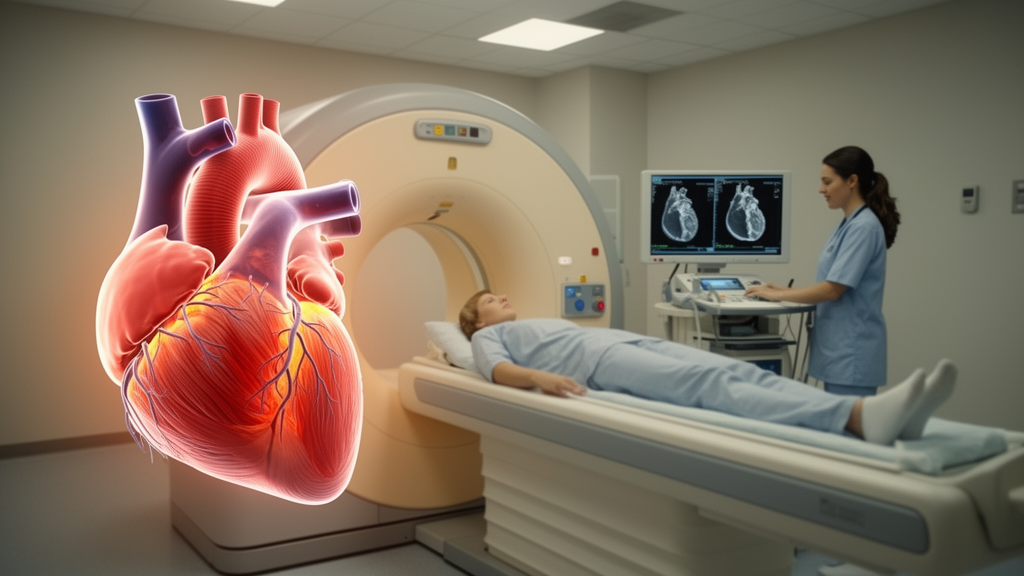
Patients recovering from a heart attack may not need contrast dye for the MRI scans that guide their follow-up care, according to a new retrospective study published in BMC Medical Imaging. Combining two contrast-free imaging measurements — left ventricular global longitudinal strain (LV GLS) and native T1 mapping — predicted major adverse cardiac events after acute myocardial infarction at least as well as, and in some comparisons better than, conventional contrast-enhanced markers.

In the retrospective study, 1253 patients from four centers who underwent percutaneous coronary intervention and cardiac MRI between February 2017 and September 2024 were enrolled. The cohort was split into a development group of 1002 patients and an external validation group of 251. Over a median follow-up of 43 months, 137 patients in the development cohort and 36 in the validation cohort experienced a major adverse cardiac event, defined as all-cause death, life-threatening arrhythmias, cardiac death, reinfarction or heart failure hospitalization.

The key comparison centered on two risk models. Model 2 relied on conventional contrast-enhanced CMR markers: late gadolinium enhancement, microvascular obstruction and intramyocardial hemorrhage. Model 3 instead combined clinical variables, left ventricular ejection fraction, native T1 z score and LV GLS, all obtainable without contrast. In the development cohort, the non-contrast model improved discrimination over the contrast-enhanced model, with a C-index of 0.780 versus 0.736 (P = 0.033). The pattern held in the external validation cohort.

The study found that these two measures together offered complementary prognostic information, improving risk stratification and reclassification beyond established risk factors.

The non-contrast approach also outperformed two established clinical tools. Native T1 and LV GLS showed better prognostic performance than both the GRACE score and the Glasgow CMR Risk Score, suggesting that the imaging-based combination captures prognostic information these scores miss.

The authors conclude that combined native T1 mapping and LV GLS supported the potential of a contrast-free CMR strategy that outperformed a conventional contrast-enhanced model. Because the study was retrospective and focused on AMI patients who had already undergone PCI and CMR, the findings describe prognostic associations in this population rather than the effect of changing clinical practice.

Subject of Research: Prognostic value of non-contrast cardiac MRI markers after acute myocardial infarction

Article Title: Prognosis and risk stratification with LV global longitudinal strain and Native T1 mapping in acute myocardial infarction

Article References: Zhang, S., Zhu, G., Gu, X., Wu, J., & Wu, L. (2026). Prognosis and risk stratification with LV global longitudinal strain and Native T1 mapping in acute myocardial infarction. BMC Medical Imaging. https://doi.org/10.1186/s12880-026-02992-y

Image Credits: AI Generated

DOI: 10.1186/s12880-026-02992-y

Keywords: cardiac MRI, acute myocardial infarction, native T1 mapping, global longitudinal strain, risk stratification, major adverse cardiac events, prognosis, contrast-free imaging, late gadolinium enhancement, C-index, risk, stratification

Cite Scienmag News

Ophelia Keating. (October 28, 2026). Heart MRI Without Contrast Dye Predicts Risk After Heart Attack. Scienmag. https://scienmag.com/heart-mri-without-contrast-dye-predicts-risk-after-heart-attack/

Ophelia Keating. "Heart MRI Without Contrast Dye Predicts Risk After Heart Attack." Scienmag, 28 October 2026, https://scienmag.com/heart-mri-without-contrast-dye-predicts-risk-after-heart-attack/. Accessed 29 October 2026.

Ophelia Keating. "Heart MRI Without Contrast Dye Predicts Risk After Heart Attack." Scienmag. October 28, 2026. https://scienmag.com/heart-mri-without-contrast-dye-predicts-risk-after-heart-attack/


Tags: acute myocardial infarctionC-indexcardiac MRIcontrast-free imagingglobal longitudinal strainlate gadolinium enhancementmajor adverse cardiac eventsnative T1 mappingprognosisRiskrisk stratificationstratification
Share26Tweet16
Previous Post

Nurse-led programme modestly improves dementia risk profiles in Australian primary care trial

Next Post

AI-Generated Fake Weather Videos Teach Surveillance Models to See Better

Related Posts

Breathing by the numbers: bedside lung mechanics reshape ARDS ventilation
Medicine

Breathing by the numbers: bedside lung mechanics reshape ARDS ventilation

October 29, 2026
Trial to Test Whether Interactive Exercise Eases Autism Symptoms in Children
Psychology & Psychiatry

Trial to Test Whether Interactive Exercise Eases Autism Symptoms in Children

October 29, 2026
Stiffer Arteries Track With Poorer Fitness in Cardiac Rehabilitation Patients
Medicine

Stiffer Arteries Track With Poorer Fitness in Cardiac Rehabilitation Patients

October 29, 2026
Sexual Dysfunction Common and Tied to Poor Quality of Life in Men with Type 2 Diabetes
Medicine

Sexual Dysfunction Common and Tied to Poor Quality of Life in Men with Type 2 Diabetes

October 29, 2026
Active Self-Harm Linked to Higher Negative Affectivity and Psychoticism in Psychiatric Patients
Psychology & Psychiatry

Active Self-Harm Linked to Higher Negative Affectivity and Psychoticism in Psychiatric Patients

October 29, 2026
Machine Learning Predicts Opaque Bubble Layer Risk During Keyhole Laser Vision Surgery
Medicine

Machine Learning Predicts Opaque Bubble Layer Risk During Keyhole Laser Vision Surgery

October 29, 2026
Next Post
AI-Generated Fake Weather Videos Teach Surveillance Models to See Better

AI-Generated Fake Weather Videos Teach Surveillance Models to See Better

  • Mothers who receive childcare support from maternal grandparents show more optimized

    Mothers who receive childcare support from maternal grandparents show more parental warmth, finds NTU Singapore study

    27656 shares
    Share 11059 Tweet 6912
  • University of Seville Breaks 120-Year-Old Mystery, Revises a Key Einstein Concept

    1061 shares
    Share 424 Tweet 265
  • Bee body mass, pathogens and local climate influence heat tolerance

    682 shares
    Share 273 Tweet 171
  • Researchers record first-ever images and data of a shark experiencing a boat strike

    546 shares
    Share 218 Tweet 137
  • Groundbreaking Clinical Trial Reveals Lubiprostone Enhances Kidney Function

    531 shares
    Share 212 Tweet 133
Science

Embark on a thrilling journey of discovery with Scienmag.com—your ultimate source for cutting-edge breakthroughs. Immerse yourself in a world where curiosity knows no limits and tomorrow’s possibilities become today’s reality!

RECENT NEWS

  • Research report: The effects of socioscientific issue-based education on science teachers’ cognitive structures, affective tendencies and scientific thinking habits
  • Humans kill most cougars in five-year Alberta tracking study of 80 big cats
  • Organic molecular qubit joins photonic chip in push toward scalable quantum computing
  • Science Advances Issues Editorial Expression of Concern Over CNS Injury Paper’s Figures

Categories

  • Agriculture
  • Anthropology
  • Archaeology
  • Athmospheric
  • Biology
  • Biotechnology
  • Blog
  • Bussines
  • Cancer
  • Chemistry
  • Climate
  • Earth Science
  • Editorial Policy
  • Marine
  • Mathematics
  • Medicine
  • Pediatry
  • Policy
  • Psychology & Psychiatry
  • Science Education
  • Science News
  • Social Science
  • Space
  • Technology and Engineering

Subscribe to Blog via Email

Enter your email address to subscribe to this blog and receive notifications of new posts by email.

Join 5,151 other subscribers

© 2025 Scienmag - Science Magazine

Welcome Back!

Login to your account below

Forgotten Password?

Retrieve your password

Please enter your username or email address to reset your password.

Log In
No Result
View All Result
  • HOME
  • SCIENCE NEWS
  • CONTACT US

© 2025 Scienmag - Science Magazine

Discover more from Science

Subscribe now to keep reading and get access to the full archive.

Continue reading