Researchers have designed a solar cell that contains no lead and no tin, pairing two light-absorbing materials with complementary bandgaps in a single bilayer stack, and their computer simulations predict a power conversion efficiency of 28.5%. The study, published in Discover Electronics, is entirely computational: no physical device was built or measured.
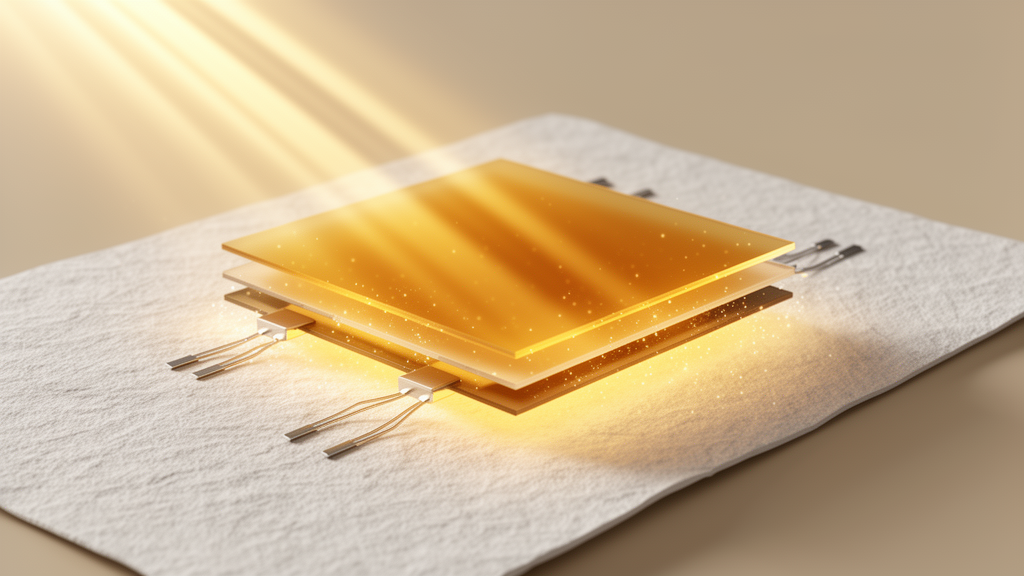
The proposed device stacks fluorine-doped tin oxide glass, a tungsten disulfide (WS₂) electron transport layer, a primary absorber of Cs₂TiI₆, a secondary absorber of La₂NiMnO₆, a PEDOT:PSS hole transport layer, and a gold back contact. Cs₂TiI₆ is a vacancy-ordered perovskite that avoids both lead and the Sn²⁺ ions that plague many lead-free alternatives, which oxidize readily and degrade devices. The authors selected it for its 1.8-electronvolt direct bandgap, high absorption coefficient, and resistance to oxidation. La₂NiMnO₆, a double perovskite with a narrower 1.4-electronvolt bandgap, adds strong light absorption, thermal stability, and low toxicity, and it captures the longer-wavelength photons that pass through the top layer.
The DFT work, performed within the CASTEP framework using the HSE06 hybrid functional, confirmed a direct bandgap of 1.8 electronvolts for Cs₂TiI₆ and a density of states plot showing a clean gap with negligible mid-gap states, which the authors interpret as intrinsic defect tolerance. The calculated absorption coefficient peaks at 2.7 × 10⁵ per centimetre at 15 electronvolts, indicating robust ultraviolet absorption with a moderate visible response. Reflectivity stays low, peaking at 0.38 at 14.9 electronvolts, the real part of the dielectric function reaches 8.2 at 0.7 electronvolts, and the refractive index peaks at 2.9, supporting light trapping. Notably, the electronic and optical parameters of La₂NiMnO₆ were not computed by the team; they were adopted from established literature because standard semi-local DFT functionals inadequately describe lanthanum-containing compounds.
On the device side, the researchers screened eight hole transport layers with WS₂ fixed as the electron transport layer, and PEDOT:PSS emerged as the most efficient choice, delivering a simulated 22.3% efficiency for the single-absorber cell. Doping optimization followed: for the Cs₂TiI₆ primary layer, performance was best at an acceptor density of 1.0 × 10¹⁹ per cubic centimetre and a relatively low donor density of 10¹⁶ per cubic centimetre. Varying the primary absorber thickness from 200 to 1400 nanometres raised the simulated efficiency from 16.7% to 24.3%, with the short-circuit current density climbing from 15.1 to 19.5 milliamperes per square centimetre while the open-circuit voltage held steady at 1.45 volts.
The decisive step was adding the La₂NiMnO₆ secondary absorber. With its acceptor density raised toward 10¹⁹ per cubic centimetre, the bilayer efficiency climbed to a peak of 28.5% and the fill factor improved to 90% in that sweep, while the short-circuit current density held near 25.4 milliamperes per square centimetre. Donor doping in the secondary layer worked in the opposite direction: efficiency peaked at 28.4% at the lowest donor density tested and degraded as doping increased, so the optimum sits below 10¹⁸ per cubic centimetre. Secondary-layer thickness mattered strongly, with efficiency rising from 17% at 200 nanometres to 28.5% at 1400 nanometres, and 1000 nanometres chosen as the operating optimum. Transport layer thicknesses were also tuned, with 50 nanometres of WS₂ and 250 nanometres of PEDOT:PSS selected.
The final optimized bilayer design delivers a simulated efficiency of 28.5%, a fill factor of 75.5%, a short-circuit current density of 29.98 milliamperes per square centimetre, and an open-circuit voltage of 1.26 volts under standard AM 1.5G illumination at 300 kelvin. The current density represents a 53.7% gain over the single-layer cell, driven by near-unity quantum efficiency across the 375 to 680 nanometre range. The authors verified internal consistency by numerically integrating the simulated external quantum efficiency spectrum against the AM1.5G photon flux, recovering 29.98 milliamperes per square centimetre to within 0.01% of the SCAPS-reported value.
Not every metric improved. The fill factor fell from 85.7% to 75.5% and the open-circuit voltage dropped from 1.45 to 1.26 volts relative to the single-junction cell. Band-offset analysis using Anderson’s rule identified the culprit: the internal Cs₂TiI₆/La₂NiMnO₆ junction carries a substantially larger offset than the other heterointerfaces, with a conduction-band offset of 0.70 electronvolts and a valence-band offset of 1.10 electronvolts. Thermionic emission modelling indicates this valence-band spike acts as a dominant barrier to hole transport, raising series resistance and lowering the fill factor, while the narrower bandgap of La₂NiMnO₆ and its higher dark saturation current constrain the voltage. The current gain outweighs these penalties in the power equation, but the barrier remains the device’s central weakness.
Temperature and spectrum sweeps added nuance. Simulating operation from 300 to 360 kelvin, the short-circuit current stayed invariant at 29.98 milliamperes per square centimetre, while the fill factor rose from 75.5% to 81.5% and efficiency rose marginally, because thermal energy helps carriers surmount the 1.10-electronvolt interfacial barrier. Under a representative visible indoor spectrum spanning 400 to 800 nanometres at an incident power of 1000 watts per square metre, the model produced an efficiency of 44.42%, but the authors caution that this intensity far exceeds real indoor lighting levels, and actual indoor operation would yield proportionally lower photocurrents and efficiencies due to low-intensity trap-assisted recombination.
The team also proposed a theoretical fabrication route: WS₂ deposited by chemical vapor deposition or liquid-phase exfoliation, Cs₂TiI₆ grown by co-evaporation of CsI and TiI₄ under high vacuum, La₂NiMnO₆ formed from a sol-gel and annealed at 600 to 800 degrees Celsius in oxygen with rapid thermal processing to protect the underlying layer, followed by spin-coated PEDOT:PSS and evaporated gold contacts. An alternative reverse deposition order would spare the temperature-sensitive Cs₂TiI₆ from the high-temperature anneal. Series and shunt resistance sweeps rounded out the optimization, with series resistance needing to stay below 2 ohm-square centimetres and shunt resistance of 1000 ohm-square centimetres chosen as adequate.
The authors are candid about the study’s limits. Beyond the absence of any fabricated device, they note that interfacial defect densities at the critical junction were held constant in the baseline model even though real devices would contain significant recombination centres, and that the optimization followed a one-factor-at-a-time approach that misses coupled parameter interactions. Potential applications in indoor energy harvesting for internet-of-things sensors and drone-mounted photovoltaics are described as purely prospective, requiring quantitative assessment and experimental validation. The study stands as a computationally optimized blueprint for lead-free, tin-free bilayer photovoltaics, with experimental fabrication, stability testing, and scalable synthesis identified as the necessary next steps before any real-world claim can be made.
Subject of Research: Computational modelling of a lead-free bilayer perovskite solar cell using Cs₂TiI₆ and La₂NiMnO₆ absorbers
Article Title: Modelling and optimization of a lead and tin free Cs₂TiI₆ and La₂NiMnO₆ bilayer photovoltaic cell
Article References: Mangla, H., Singh, S., Pant, D., Agrawal, R., Monga, K., Gupta, D., & Sharma, U. (2026). Modelling and optimization of a lead and tin free Cs₂TiI₆ and La₂NiMnO₆ bilayer photovoltaic cell. Discover Electronics, 3(1), Article 150. https://doi.org/10.1007/s44291-026-00302-y
Image Credits: AI Generated
DOI: 10.1007/s44291-026-00302-y
Keywords: perovskite solar cells, lead-free photovoltaics, Cs₂TiI₆, La₂NiMnO₆, SCAPS-1D simulation, density functional theory, bilayer absorber, power conversion efficiency, band alignment, electron transport layer, indoor energy harvesting, solar cell modelling
Cite Scienmag News
Denise Maddox. (October 28, 2026). Simulated lead-free bilayer solar cell reaches 28.5% efficiency on paper. Scienmag. https://scienmag.com/simulated-lead-free-bilayer-solar-cell-reaches-28-5-efficiency-on-paper/
Denise Maddox. "Simulated lead-free bilayer solar cell reaches 28.5% efficiency on paper." Scienmag, 28 October 2026, https://scienmag.com/simulated-lead-free-bilayer-solar-cell-reaches-28-5-efficiency-on-paper/. Accessed 28 October 2026.
Denise Maddox. "Simulated lead-free bilayer solar cell reaches 28.5% efficiency on paper." Scienmag. October 28, 2026. https://scienmag.com/simulated-lead-free-bilayer-solar-cell-reaches-28-5-efficiency-on-paper/