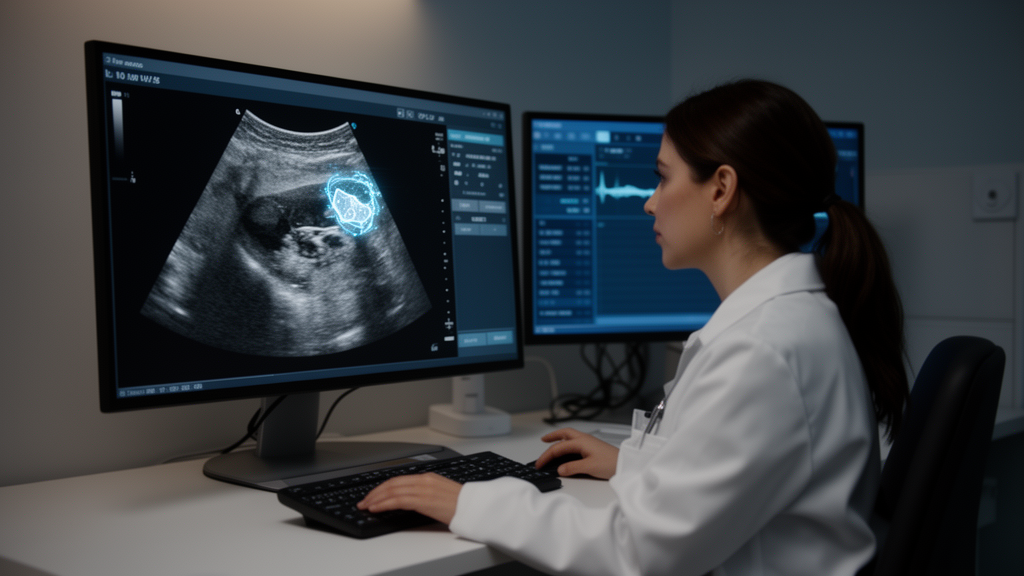
An FDA-cleared artificial intelligence tool used alongside breast ultrasound could have spared a substantial share of benign breast biopsies, according to a retrospective study conducted at two academic medical centers and published in Breast Cancer Research and Treatment. The finding addresses one of the most persistent trade-offs in breast imaging: the price of catching every possible cancer is a high rate of biopsies that ultimately find nothing malignant.
Between March and May 2025, fourteen breast imaging radiologists documented cases they assessed as BI-RADS 4, the category meaning suspicious and warranting tissue sampling, along with the output of the AI decision support tool (Koios DS). The researchers then compared the AI classifications against the actual biopsy pathology results to see how the algorithm would have sorted the same lesions.
The cohort included 271 lesions in 253 women, whose ages ranged from 24 to 92 years with a mean of 54. All of the lesions had been categorized as BI-RADS 4 by the radiologists and were biopsied, aspirated, or surgically excised. Pathology showed that 23.2 percent of the lesions, 63 of 271, were malignant, while 76.8 percent, 208 of 271, were benign. In other words, roughly three out of four biopsies in this suspicious category did not find cancer.
The AI tool’s performance on the malignant lesions was the critical safety benchmark. It classified 90.5 percent of the malignant lesions, 57 of 63, as BI-RADS 4, agreeing with the radiologists that tissue sampling was needed. The remaining 9.5 percent, 6 of 63 malignant lesions, were assigned to the lower-risk BI-RADS 2 or 3 categories, a misclassification that underscores why the study’s authors stress that any clinical use of such a tool must preserve timely cancer diagnosis.
On the benign side, the algorithm diverged much more sharply from the radiologists. It labeled 41.8 percent of benign lesions, 87 of 208, as BI-RADS 2, which denotes a benign finding, and another 18.8 percent, 39 of 208, as BI-RADS 3, meaning probably benign and typically eligible for short-interval follow-up rather than immediate biopsy. Taken together, 60.6 percent of the benign lesions, 126 of 208, fell into BI-RADS 2 or 3 according to the AI output.
When the researchers retrospectively applied the AI output to the biopsy triage decisions, the result suggested a potential reduction in benign biopsy recommendations. Had the AI’s lower-risk classifications been weighed in the original decisions, a majority of the lesions that turned out to be benign might have been directed toward surveillance instead of tissue sampling, while most cancers would still have been flagged for biopsy.
The study’s design matters for interpreting these numbers. This was not a prospective trial in which AI recommendations changed patient care; the tool’s output was recorded after radiologists had already made their BI-RADS 4 assessments, and the analysis modeled what might have happened if that output had informed triage. The cohort was also limited to lesions already judged suspicious by experienced breast imaging radiologists at two academic centers, so the findings speak to a specific, high-stakes decision point rather than to general screening.
That caveat leads directly to the study’s central conclusion: AI may help reduce benign biopsy recommendations among lesions radiologists assess as BI-RADS 4, but careful integration with radiologist judgment and clinical history is essential to ensure that cancers are not delayed. The six malignant lesions the tool downgraded to BI-RADS 2 or 3 illustrate the risk side of that equation. The authors frame the technology as decision support rather than decision replacement, a tool that could prompt a second look at a suspicious finding without overriding the radiologist’s final call.
For patients, the practical significance lies in the benign biopsy rate itself. If AI decision support can reliably identify a subset of suspicious-appearing lesions that are probably benign, radiologists gain an additional data point when weighing biopsy against follow-up imaging, provided the tool’s misses are understood and managed within clinical workflow.
The work represents an early, real-world look at how a commercially deployed ultrasound AI behaves on the exact cases where the stakes are highest. Future evaluation in broader settings and prospective designs will be needed to establish whether the retrospective benefit seen here translates into safer, more efficient biopsy triage in routine practice.
Subject of Research: Evaluation of an FDA-cleared AI decision support tool for breast ultrasound in reducing benign biopsies among BI-RADS 4 lesions
Article Title: Artificial intelligence decision support for breast ultrasound: potential to reduce benign biopsies
Article References: Fishman, M. D. C., Lamb, L. R., Haver, H. L., Giess, C. S., DiPiro, P. J., Chesebro, A. L., Chung, S. H., Gombos, E. C., Karimova, E. J., Portnow, L. H., Saksena, M. A., Salah, F. A., Wang, G. X., & Bahl, M. (2026). Artificial intelligence decision support for breast ultrasound: potential to reduce benign biopsies. Breast Cancer Research and Treatment, 220(1), Article 8. https://doi.org/10.1007/s10549-026-08094-1
Image Credits: AI Generated
DOI: 10.1007/s10549-026-08094-1
Keywords: breast ultrasound, artificial intelligence, BI-RADS, benign biopsy, breast imaging, decision support, BI-RADS 4, cancer diagnosis, radiology, retrospective study, Artificial, intelligence
Cite Scienmag News
Nathaniel Bowman. (October 28, 2026). AI Decision Support for Breast Ultrasound May Reduce Benign Biopsies. Scienmag. https://scienmag.com/ai-decision-support-for-breast-ultrasound-may-reduce-benign-biopsies/
Nathaniel Bowman. "AI Decision Support for Breast Ultrasound May Reduce Benign Biopsies." Scienmag, 28 October 2026, https://scienmag.com/ai-decision-support-for-breast-ultrasound-may-reduce-benign-biopsies/. Accessed 30 October 2026.
Nathaniel Bowman. "AI Decision Support for Breast Ultrasound May Reduce Benign Biopsies." Scienmag. October 28, 2026. https://scienmag.com/ai-decision-support-for-breast-ultrasound-may-reduce-benign-biopsies/