


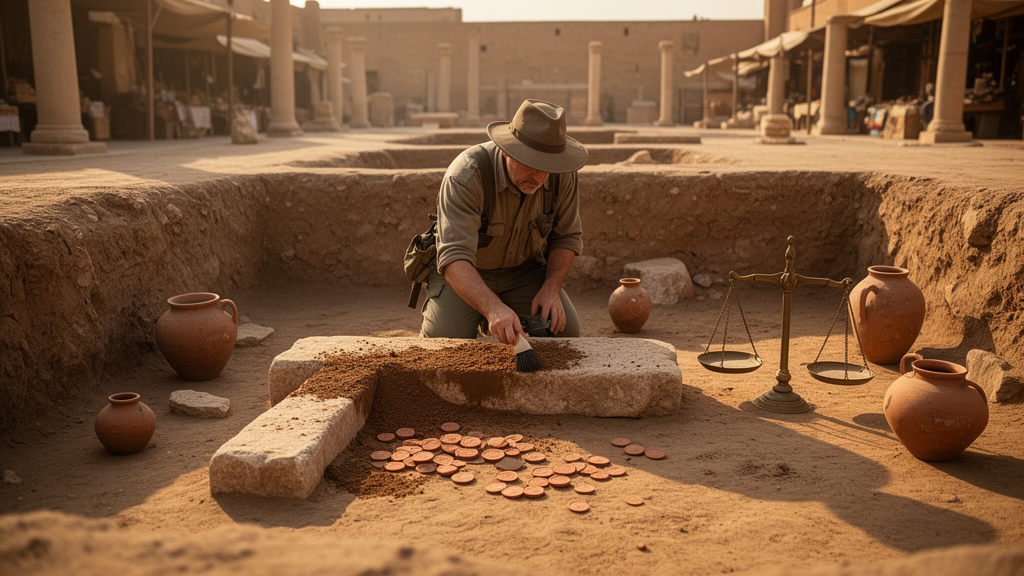
Markets and marketplace exchange have played a far larger role in human history, and in far more corners of the world, than either economists or anthropologists have traditionally allowed, according to a new collection of studies published in Frontiers in Human Dynamics. The thematic issue, introduced by an editorial from archaeologists Gary M. Feinman of the Field Museum of Natural History and Richard E. Blanton of Purdue University, assembles archaeological, historical, and anthropological evidence to document what the editors describe as a long and diverse global history of marketplace exchange. Their aim is not simply to add new case studies but to replace the entrenched theoretical divides that have shaped how scholars think about markets with a new conceptual framework.
For decades, the study of economic exchange has been split between two opposing camps. Many economists have treated markets as natural, spontaneous, self-regulating, and ever-present features of human life, while many anthropologists and archaeologists, particularly those in the substantivist tradition, have viewed markets as absent, rare, or strictly controlled by states in most premodern societies. The editorial argues that this standoff has left the comparative history and diversity of marketplace exchange systems under-problematized in the social sciences. The new collection rejects both the market-versus-non-market dichotomous thinking that has long structured the field and the linear framing that treats markets as a purely recent stage of economic transfer, or as strictly limited to the recent West.
At the heart of the editors’ framework is a redefinition of what a marketplace actually is. They argue that venues of market exchange are necessarily cooperative institutions, whose emergence and functioning generally require both top-down and bottom-up coordination to establish the customs and ground rules that allow strangers and diverse arrays of people to buy, sell, and trade in defined spatial and temporal contexts. Markets, on this view, work most effectively when they are open and guided by egalitarian sensibilities that foster participation by heterogeneous publics. Because marketplaces may be open to strangers, including peoples from afar, they are often liminal or hybrid spaces, sometimes situated at the edge or periphery of communities and settlements, and generally bounded or defined spaces where a specific set of rules and practices may transcend or even contradict everyday cultural behaviors.
This institutional view of markets also captures a distinctive paradox of human social life. The editors note that humans are both the best cooperators with non-kin on the planet and, at the same time, capable of agentic and selfish behavior. Selfishness, in their framework, undergirds what they call the “capitalist impulse”: practices that distort fair market competition through monopolization, hoarding, or other strategic actions that retain or magnify profits despite the continual downward pressure on profits characteristic of a competitive economy. By distinguishing between open and competitive marketplaces, on the one hand, and the capitalist impulse, on the other, the framework is intended to add depth and breadth to the analysis of price-making markets and their divergent social and economic outcomes across time and space.
Most of the essays in the collection document the importance of marketplace exchange in contexts where it has rarely been considered or recognized. Lynn Gamble, focusing on the Chumash of indigenous Southern California, and Lane Fargher-Navarro, taking a broader perspective on precolonial North America, illustrate the economic significance of markets and commodity currencies in contexts dominated by foraging and horticulture. Arlen, Diane, and Adrian Chase synthesize a rich corpus of information to illustrate the importance of markets for the prehispanic Maya. Together with other recent archaeological and historical examples, these studies are extending marketplace exchange well beyond the traditional time-space constraints that have long confined discussions of markets to certain regions and eras.
The geographic and temporal reach of the collection extends well beyond the Americas. Katerina Ragkou and Christian Mader compare the market systems of the Byzantine Empire with networks of exchange in the prehispanic Central Andes, illustrating the breadth of conditions in which market transfers occurred, as well as the contrasting roles of formal state-based currencies, which existed in Byzantium but were absent in the Central Andes. In a diachronic study of Bronze and Iron Age Europe, Nicola Ialongo challenges the presumption that the introduction of formal state-issued coinage would have necessarily prompted a revolutionary shift in the modes and networks of commerce. Drawing mainly from textual records, Elizabeth Paris examines prehispanic Mesoamerican long-distance traders, while Thurston’s contribution covers late medieval and early modern Sweden, exploring the variable linkages between market systems and other social, political, and economic institutions in two diachronic cases.
Across all of these papers, a set of common themes emerges concerning the relationships between markets and political and religious institutions, and the role and nature of currencies and the equivalencies employed. The editors emphasize that the web of institutional articulations associated with markets is dynamic yet highly diverse in its sequences of change and relations to institutions of governance. In case after case, states are neither the uniform instigators of markets nor necessarily antagonistic to the workings of market systems. Indeed, the editorial notes that collectively governed states and empires often have incentives to oppose capitalistic impulses, both to maintain tax revenues generated from market participation and transactions, and to ensure that citizens of nucleated and urban polities are assured access to affordable food supplies.
That last point connects the new collection to earlier comparative work by Blanton and Fargher, whose historical analysis of 30 premodern states found that higher degrees of commercialization and market exchange were associated with more collective forms of governance. This association, the editors suggest, accords with the pattern visible across the new case studies, in which the character of market institutions and the character of governance are intertwined rather than opposed. The framework also moves beyond the remnants of the old formalist-substantivist debate in anthropology, while simultaneously challenging perspectives from economics that view spontaneous modes or institutions of barter and trade as simply reflecting or extending inherent human tendencies.
The editors argue that understanding the variable workings of marketplace exchange systems is not only crucial for grappling with contemporary economic diversity, but can also provide insights into how markets function, the ways that they dovetail with other institutions, and the factors that contribute to the relative sustainability of market systems. Finally, they suggest that the emergence and endurance of markets offer an analytical portal into the role of institutions in human networks of cooperation, especially how they facilitate interdependence amongst heterogeneous, diverse, and often large populations characterized principally by weak interpersonal ties. In this way, examinations of the rules and customs of market exchange yield a critical vantage into the ways that humans can equitably cooperate at scale.
The collection is published in Volume 8 of Frontiers in Human Dynamics, in the journal’s section on Institutions and Collective Action, and was edited and reviewed by Jane Freedman of Université Paris 8. The editorial was received on 20 September 2026, accepted on 23 September 2026, and published on 27 October 2026. As an editorial introducing the thematic issue, the piece itself does not present new empirical data; rather, its claims rest on the assembled papers in the collection and on prior archaeological and historical scholarship. Its central message, however, is clear: marketplace exchange has been a persistent, varied, and institutionally embedded feature of human societies across history, and studying it comparatively offers a window into how large, diverse populations of strangers have managed to cooperate through defined rules, shared ground rules, and institutions that keep competition fair.
Subject of Research: The historical and global diversity of marketplace exchange as a cooperative institution, examined through archaeological, historical, and anthropological case studies.
Article Title: Editorial: Marketplace exchange across history: transcending theoretical divides
Article References: Feinman, G. M., & Blanton, R. E. (2026). Editorial: Marketplace exchange across history: transcending theoretical divides. Frontiers in Human Dynamics, 8, Article 2004981. https://doi.org/10.3389/fhumd.2026.2004981
Image Credits: AI Generated
DOI: 10.3389/fhumd.2026.2004981
Keywords: marketplace exchange, economic anthropology, archaeology, cooperation, collective action, economic history, markets, premodern states, currencies, institutions, governance, exchange networks
Cite Scienmag News
Courtney Benton. (October 27, 2026). Markets are far older and more diverse than economists and anthropologists long assumed. Scienmag. https://scienmag.com/markets-are-far-older-and-more-diverse-than-economists-and-anthropologists-long-assumed/
Courtney Benton. "Markets are far older and more diverse than economists and anthropologists long assumed." Scienmag, 27 October 2026, https://scienmag.com/markets-are-far-older-and-more-diverse-than-economists-and-anthropologists-long-assumed/. Accessed 27 October 2026.
Courtney Benton. "Markets are far older and more diverse than economists and anthropologists long assumed." Scienmag. October 27, 2026. https://scienmag.com/markets-are-far-older-and-more-diverse-than-economists-and-anthropologists-long-assumed/


