

Tuesday, October 27, 2026
Science
No Result
View All Result
  • Login
  • HOME
  • SCIENCE NEWS
  • CONTACT US
  • HOME
  • SCIENCE NEWS
  • CONTACT US
No Result
View All Result
Scienmag
No Result
View All Result
Home Science News Space

Hidden hot companion revealed around young star in Cepheus star-forming region

October 27, 2026
in Space
Grant Pearson
By Grant Pearson Scienmag Editorial Profile - Observational Astronomy
Reading Time: 3 mins read
0
Hidden hot companion revealed around young star in Cepheus star-forming region

Hidden hot companion revealed around young star in Cepheus star-forming region

65
SHARES
587
VIEWS
Share on FacebookShare on Twitter
ADVERTISEMENT

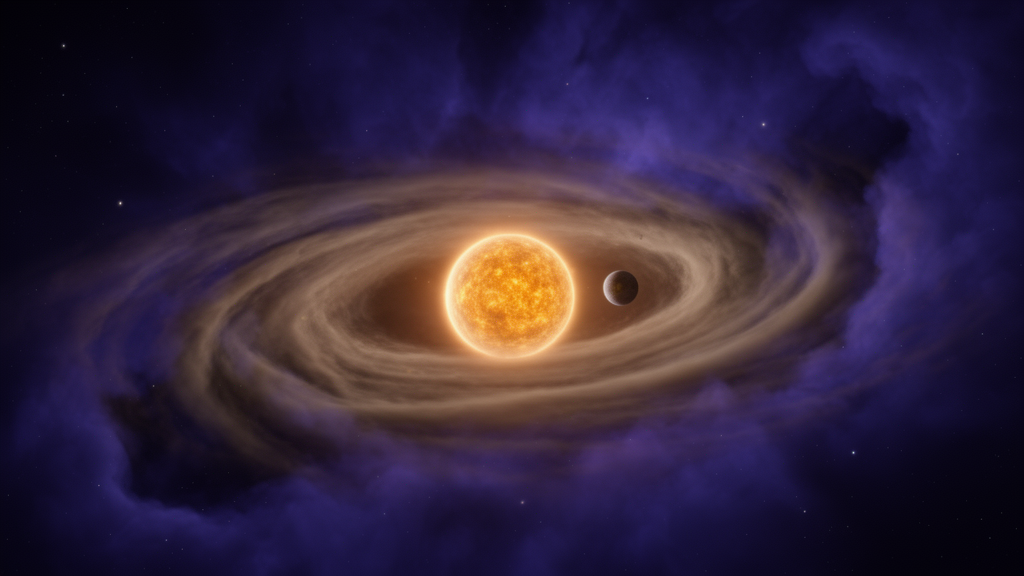
Astronomers have identified an unusual binary system hiding in the Cepheus star-forming regions, where a young star appears to share its surroundings with an unseen, extremely hot companion. The object, catalogued as Gaia DR3 2205212960562531328, stood out during a photometric survey of the region because it sat in the wrong place on a color-magnitude diagram built from Gaia’s optical measurements, shifted away from where its expected parameters would place it.

That mismatch prompted a multi-pronged investigation combining astrometric accuracy, photometric modeling and spectroscopic studies. The team, led by T. B. Cysil with colleagues including Blesson Mathew, published the study in Astrophysics and Space Science in October 2026.

Emission lines in a stellar spectrum and an excess of infrared light in the spectral energy distribution are key indicators of accretion activity and of gas and dust in the circumstellar environment of a young star. As accretion ceases over several million years, H-alpha emission fades. Yet an infrared excess paired with negligible H-alpha emission can also point to certain close binary systems, in which a circumbinary disk contributes to the observed excess.

Unresolved binaries add another complication: companion stars can contaminate the photometry, producing inaccurate parameter measurements and skewed positions on the color-magnitude diagram. This is precisely the kind of distortion seen in the Cepheus source.

The Gaia XP spectrum of the object revealed a systematic blue excess, indicating an additional hotter unresolved component alongside the primary star. To characterize that hidden component, the researchers carried out two-component spectral energy distribution modeling.

The modeling yielded a companion with an effective temperature of roughly 27,000 K and a surface gravity of log g of at least 4.5, properties consistent with sdB stars, a class of hot subdwarfs. Further analysis of the color-magnitude diagram and spectroscopic data supported the interpretation of a binary system consisting of an A0-type pre-main-sequence star paired with an sdB companion.

Archival photometry from the Zwicky Transient Facility provided tentative evidence for a periodicity of 0.498 days in the system’s brightness, a signal the authors describe as tentative rather than definitive. The system’s peculiar combination of an infrared excess with negligible H-alpha emission fits the picture of a close binary whose circumbinary material contributes to the observed excess.

The study’s broader significance lies in method: by combining astrometric precision, photometric modeling and spectroscopy, the approach can flag binary systems that would otherwise remain unidentified, because their companions contribute no resolvable signal in standard surveys. The authors describe the work as paving the way for a systematic search of similar binary systems.

Because the findings rest on the identification of a single photometrically peculiar object in the Cepheus star-forming regions, the results describe one system rather than a population-level trend. The reported companion parameters come from modeling, and the detected periodicity remains tentative, pending further observational confirmation.

Subject of Research: Identification of a binary system with an sdB companion around a pre-main-sequence star in the Cepheus star-forming regions.

Article Title: A novel approach to identify unseen companions: an in-depth study of GDR3 220_28

Article References: Cysil, T. B., Mathew, B., Shridharan, B., Muneer, S., Kumar S, P., Nidhi, S., Kartha, S. S., Bhattacharyya, S., & Robin, T. (2026). A novel approach to identify unseen companions: an in-depth study of GDR3 220_28. Astrophysics and Space Science, 371(10), Article 125. https://doi.org/10.1007/s10509-026-04652-7

Image Credits: AI Generated

DOI: 10.1007/s10509-026-04652-7

Keywords: binary stars, sdB subdwarf, pre-main-sequence star, Cepheus star-forming regions, Gaia DR3, spectral energy distribution, H-alpha emission, infrared excess, color-magnitude diagram, ZTF photometry, circumbinary disk, astrometry

Cite Scienmag News

Grant Pearson. (October 27, 2026). Hidden hot companion revealed around young star in Cepheus star-forming region. Scienmag. https://scienmag.com/hidden-hot-companion-revealed-around-young-star-in-cepheus-star-forming-region/


Grant Pearson. "Hidden hot companion revealed around young star in Cepheus star-forming region." Scienmag, 27 October 2026, https://scienmag.com/hidden-hot-companion-revealed-around-young-star-in-cepheus-star-forming-region/. Accessed 27 October 2026.

Grant Pearson. "Hidden hot companion revealed around young star in Cepheus star-forming region." Scienmag. October 27, 2026. https://scienmag.com/hidden-hot-companion-revealed-around-young-star-in-cepheus-star-forming-region/

Tags: accretion activity indicatorsastrometric and photometric methods in star studiesastrometrybinary starsCepheus star-forming regionCepheus star-forming regionscircumbinary diskcircumstellar disk detectioncolor-magnitude diagramGaia DR3Gaia DR3 stellar catalogH-alpha emissionhidden hot companioninfrared excessinfrared excess in stellar spectramulti-pronged approach in stellar astrophysicsphotometric survey anomaliespre-main-sequence starsdB subdwarfspectral energy distributionspectroscopic analysis of young starsunresolved binary star systemsYoung star binary systemZTF photometry
Share26Tweet16
Previous Post

Maternal Depression Timing Linked to Children’s Emotional and Cognitive Outcomes at Age Six

Next Post

Why AI struggles to reach the hospital bedside: European experts map the barriers

Related Posts

Research report: Non-singular cosmologies matching regular black holes
Space

Research report: Non-singular cosmologies matching regular black holes

October 27, 2026
A Ghost Resonance Vanishes When Hidden Interactions Are Included in J/psi Decay
Space

A Ghost Resonance Vanishes When Hidden Interactions Are Included in J/psi Decay

October 27, 2026
JUICE spacecraft probes ion composition of Earth’s plasmasphere during flyby
Earth Science

JUICE spacecraft probes ion composition of Earth’s plasmasphere during flyby

October 27, 2026
Kenya’s rhinos gain vast new territory as 18-month partnership delivers on ambitious expansion plan
Space

Kenya’s rhinos gain vast new territory as 18-month partnership delivers on ambitious expansion plan

October 27, 2026
JUICE pulls off the first-ever Lunar–Earth double flyby, saving precious propellant for Jupiter
Earth Science

JUICE pulls off the first-ever Lunar–Earth double flyby, saving precious propellant for Jupiter

October 27, 2026
X1.8 Solar Flare Shows Four-Minute Pulsations in New SDO and Aditya-L1 Study
Space

X1.8 Solar Flare Shows Four-Minute Pulsations in New SDO and Aditya-L1 Study

October 27, 2026
Next Post
Why AI struggles to reach the hospital bedside: European experts map the barriers

Why AI struggles to reach the hospital bedside: European experts map the barriers

  • Mothers who receive childcare support from maternal grandparents show more optimized

    Mothers who receive childcare support from maternal grandparents show more parental warmth, finds NTU Singapore study

    27656 shares
    Share 11059 Tweet 6912
  • University of Seville Breaks 120-Year-Old Mystery, Revises a Key Einstein Concept

    1061 shares
    Share 424 Tweet 265
  • Bee body mass, pathogens and local climate influence heat tolerance

    682 shares
    Share 273 Tweet 171
  • Researchers record first-ever images and data of a shark experiencing a boat strike

    546 shares
    Share 218 Tweet 137
  • Groundbreaking Clinical Trial Reveals Lubiprostone Enhances Kidney Function

    531 shares
    Share 212 Tweet 133
Science

Embark on a thrilling journey of discovery with Scienmag.com—your ultimate source for cutting-edge breakthroughs. Immerse yourself in a world where curiosity knows no limits and tomorrow’s possibilities become today’s reality!

RECENT NEWS

  • Why AI struggles to reach the hospital bedside: European experts map the barriers
  • Hidden hot companion revealed around young star in Cepheus star-forming region
  • Maternal Depression Timing Linked to Children’s Emotional and Cognitive Outcomes at Age Six
  • Explainable AI pipeline spots metastasising cancer cells in microscopy images

Categories

  • Agriculture
  • Anthropology
  • Archaeology
  • Athmospheric
  • Biology
  • Biotechnology
  • Blog
  • Bussines
  • Cancer
  • Chemistry
  • Climate
  • Earth Science
  • Editorial Policy
  • Marine
  • Mathematics
  • Medicine
  • Pediatry
  • Policy
  • Psychology & Psychiatry
  • Science Education
  • Science News
  • Social Science
  • Space
  • Technology and Engineering

Subscribe to Blog via Email

Enter your email address to subscribe to this blog and receive notifications of new posts by email.

Join 5,151 other subscribers

© 2025 Scienmag - Science Magazine

Welcome Back!

Login to your account below

Forgotten Password?

Retrieve your password

Please enter your username or email address to reset your password.

Log In
No Result
View All Result
  • HOME
  • SCIENCE NEWS
  • CONTACT US

© 2025 Scienmag - Science Magazine

Discover more from Science

Subscribe now to keep reading and get access to the full archive.

Continue reading