


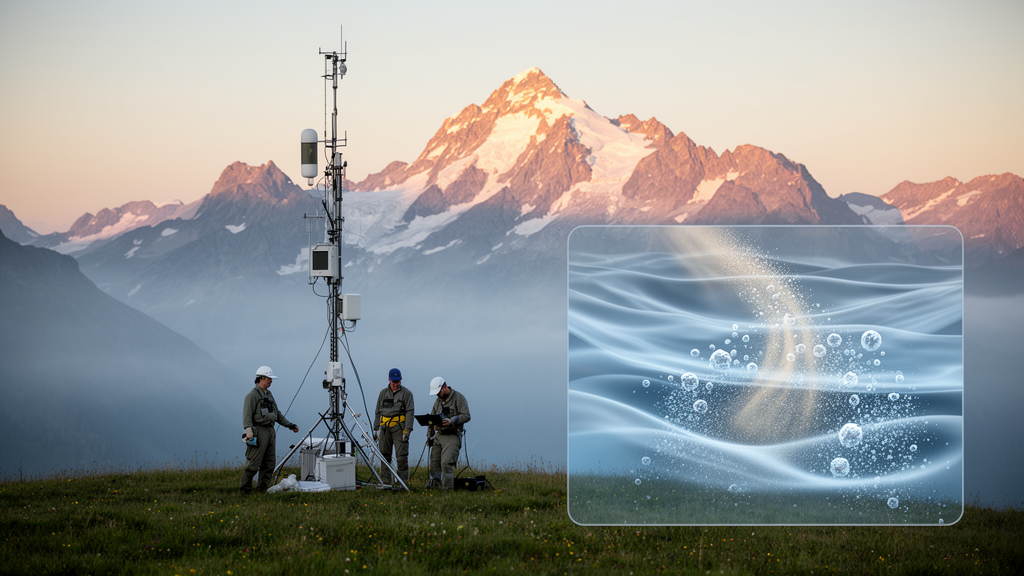
Particles lofted from the land surface can trigger the formation of ice in clouds, and a new preprint posted in Aerosol Research Discuss. reports a direct estimate of how many of these ice nucleating particles, or INPs, are emitted from the surface of the Alps into the atmosphere above. The study, led by Annika Einbock of the University of Basel with colleagues from the University of Basel and the Australian Nuclear Science and Technology Organization, is currently under peer review. Its central result is a set of median emission flux densities for INPs active at temperatures of -10 °C or warmer, a class the authors denote INP-10, quantified during summer days when thermally driven mountain winds dominate the exchange of air between the boundary layer and the free troposphere.
The methodological core of the work is the radon tracer method, or RTM, a technique originally developed to estimate fluxes of greenhouse gases such as carbon dioxide. By combining radon measurements with concurrent observations of a target species, in this case INP-10 concentrations, the method allows an apparent surface flux density to be calculated. The authors applied two implementations of the RTM: one based on the traditional formulation using two different radon exhalation maps, and a second that models the flux in a Bayesian framework. A distinctive feature of the study is that the measurements were made at a high-altitude site in central Europe, so the flux estimates apply directly at an altitude where INPs can influence clouds, rather than being extrapolated upward from valley-level observations.
The resulting numbers differ noticeably between the implementations. The traditional RTM, using the two different radon exhalation maps, yielded median emission flux densities of approximately 360 INP-10 m-2 h-1 and 250 INP-10 m-2 h-1, respectively. The Bayesian implementation produced a higher median estimate of about 720 INP-10 m-2 h-1. These values were obtained during conditions dominated by thermally driven planetary boundary layer intrusion events, when air masses that have recently touched the terrestrial surface are drawn up toward the site, in contrast to baseline conditions characteristic of the free troposphere. The site’s location means atmospheric conditions regularly alternate between these two regimes, which is precisely what makes the radon tracer approach applicable there.
Perhaps the most consequential finding is a negative one. The authors’ initial estimates indicate that thermally driven transport on fair-weather summer days makes only a relatively small contribution to the annual export of biological INPs above the Alps. In other words, while sunny summer days with strong upslope winds may visibly connect the surface to the cloud level, they appear to account for a limited share of the yearly total of biological ice nucleating particles exported above the mountain range. The short summary accompanying the preprint frames the work as an estimate of the flux of biological INPs from the source region of the high-altitude site, obtained by applying two new implementations of a method originally developed for greenhouse gas flux determination.
Beyond the specific flux numbers, the authors argue that their approach has broader utility. By relating the calculated flux densities to other kinds of observations, they demonstrate that top-down approaches investigating mean INP flux densities on local to regional scales, under particular meteorological conditions, can contribute to an improved understanding of INP dynamics at cloud height. The motivation is clear from the abstract: the spatiotemporal variability of tropospheric INP concentrations, driven by a combination of surface sources and atmospheric transport, distinctly modulates their effect on clouds, yet limited understanding of INP emission patterns currently impedes predictions of that variability, particularly for INPs active at little supercooling. Because the work is a preprint under review, the flux estimates should be read as initial results that may be revised during peer review, and the authors themselves describe the annual-export conclusion as a preliminary indication rather than a settled finding. Even so, the study offers a concrete, altitude-relevant benchmark for how much biological ice nucleation activity is being fed from Alpine surfaces into the atmosphere during the meteorological conditions most favourable to such transport.
Subject of Research: Estimating ice-nucleating particle emission fluxes over the Alps using radon tracer methods at a high-altitude site.
Article Title: Ice nucleating particle flux density estimated with radon tracer methods during conditions dominated by thermally driven mountain winds
Article References: Einbock, A., Conen, F., Griffiths, A. D., & Chambers, S. D. (2026). Ice nucleating particle flux density estimated with radon tracer methods during conditions dominated by thermally driven mountain winds. https://doi.org/10.5194/ar-2026-41
Image Credits: AI Generated
DOI: 10.5194/ar-2026-41
Keywords: ice nucleating particles, radon tracer method, INP-10, Alps, planetary boundary layer, biological aerosols, cloud ice formation, flux density, Bayesian modelling, high-altitude site, Aerosol Research preprint, surface emissions
Cite Scienmag News
Russell Cooper. (October 27, 2026). Radon tracer method tracks ice-nucleating particle fluxes over the Alps. Scienmag. https://scienmag.com/radon-tracer-method-tracks-ice-nucleating-particle-fluxes-over-the-alps/
Russell Cooper. "Radon tracer method tracks ice-nucleating particle fluxes over the Alps." Scienmag, 27 October 2026, https://scienmag.com/radon-tracer-method-tracks-ice-nucleating-particle-fluxes-over-the-alps/. Accessed 27 October 2026.
Russell Cooper. "Radon tracer method tracks ice-nucleating particle fluxes over the Alps." Scienmag. October 27, 2026. https://scienmag.com/radon-tracer-method-tracks-ice-nucleating-particle-fluxes-over-the-alps/


