


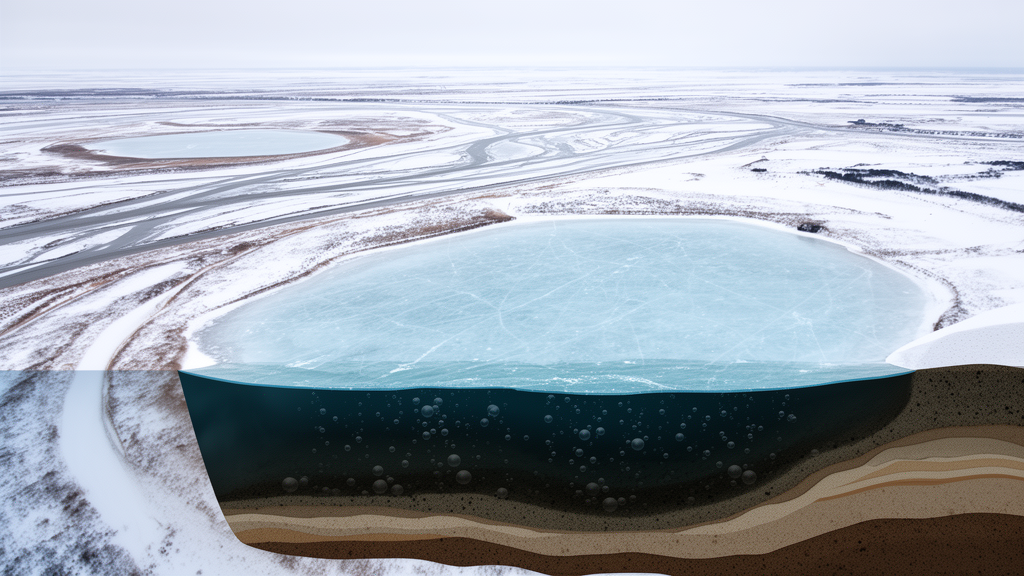
Two shallow lakes in Canada’s Mackenzie Delta refused to follow the textbook. Despite being only 1.7 and 3.2 meters deep, neither lake fully mixed when its ice cover broke up in spring, according to a new study published in Frontiers in Earth Science. Instead, dense layers of salty water built up during the winter — a process called cryoconcentration — formed chemoclines that physically resisted spring turnover, keeping anoxic, methane-rich bottom water isolated from the atmosphere well into the open water season.
The finding challenges a long-standing assumption in limnology: that cool, shallow lakes readily mix vertically during open water because their water density changes little with temperature, and because lake temperatures typically cross the temperature of maximum density, 4 degrees Celsius, during freezing and thawing. Small, shallow Arctic lakes have generally been classified as polymictic, meaning they mix repeatedly. But recent work, including this study, shows that even very shallow Arctic lakes can develop persistent stratification, and that the Mackenzie Delta’s roughly 45,000 lakes behave in ways that set them apart from their tundra counterparts.
Hannah Harrison of Simon Fraser University, together with Sally MacIntyre of the University of California, Santa Barbara, and Lance Lesack of Simon Fraser University, deployed moored sensor arrays in two lakes located about 5.8 kilometers southwest of Inuvik in the Northwest Territories. The lakes, designated L56 and L280, have similar surface areas — 3.1 and 2.4 hectares respectively — but differ sharply in depth. The arrays measured water temperature, conductivity, and dissolved oxygen, while additional sensors logged sediment temperature. The first deployment ran from 8 June to 4 August 2023, and the second from 11 August 2023 to 8 June 2024, spanning a full winter under ice.
The sensors told a story of two lakes that diverged after ice-off. At the start of the first deployment, roughly ten days after ice-off in 2023, L56’s water column was already thermally stratified, and dissolved oxygen at 1.2 meters was depleted to less than 0.5 milligrams per liter — evidence that the lake had not been significantly oxygenated at depth since the ice left. Specific conductance in the bottom water was elevated to nearly the same level as it would later reach during the late under-ice period the following year, implying that the lake had not mixed during or in the days following ice-off. After an initial period of density-driven resistance to mixing, L56 did mix at depth routinely through the open water season, often with daily thermal stratification driven by diurnal heating and cooling. The lake reached a surface temperature of 25.9 degrees Celsius on 7 July.
L280, the deeper of the two, behaved very differently. It was thermally stratified at the start of the open water deployment and remained so until sometime in early August, when it mixed between the two deployment periods. Bottom water was very cool, below 5 degrees Celsius, at the beginning of open water. During fall cooling the lake became fully mixed at depth and stayed that way until ice-on, likely because the actively mixing layer deepened at the same time that the water level dropped by 18 centimeters over the summer, jointly allowing mixing forces to overcome the residual winter-derived density of the bottom waters. Even at ice-off in June 2024, L280 never became isothermal: a persistent cool, dense patch remained at 2.65 meters while surface waters warmed, so open water thermal stratification formed without any turnover.
The mechanism behind the resistance to mixing lies in what happens under the ice. As lake ice grows, it excludes dissolved solutes, concentrating them in the shrinking volume of liquid water below. Shallow L56 lost about 60 percent of its liquid volume to ice during the 2023–2024 winter, roughly 17,000 cubic meters, giving a water concentration factor of 2.49. The deeper L280 lost about 29 percent, or about 11,000 cubic meters, with a concentration factor of 1.40. The resulting cryoconcentration produced a strong chemocline at the bottom of each lake. Notably, the estimated end-of-winter conductance from cryoconcentration alone underestimated the actual change in water column conductance by about 29 percent in L56 and 25 percent in L280, suggesting that another process — possibly organic matter decomposition — contributed roughly a quarter to a third of the solute increase under ice.
The oxygen regimes that followed were unexpected. In L280, dissolved oxygen at the start of the open water deployment was already above 4 milligrams per liter despite the apparent lack of turnover, and over the summer the bottom waters gradually accumulated oxygen until they became supersaturated, reaching 11 to 13 milligrams per liter — higher than the 9 to 10 milligrams per liter in the overlying water that was exposed to the atmosphere. Because densimetric data indicated no complete mixing at ice-off, the researchers attribute this deep oxygenation to in situ oxygen production by the lake’s dense macrophyte communities, which colonize the entire lakebed in these nutrient-rich, relatively clear delta lakes. The isolated, oxygen-rich bottom layer creates oxidizing conditions favorable for methanotrophy, the microbial consumption of methane. Consistent with this, dissolved methane concentrations in L280’s bottom waters were lower than those at the surface during open water, and concentrations dropped drastically, to under 4 micromoles per liter, following ice-off in 2023.
L56, by contrast, remained anoxic after ice-off in both 2023 and 2024, and when it finally became oxygenated in 2023 the change was abrupt — a jump to over 7 milligrams per liter on 10 June, coinciding with isothermy and deepening of the actively mixed layer, implying oxygen introduced from the atmosphere via lake turnover rather than gradual in situ production. The lake later became supersaturated in oxygen as well, peaking at 20 milligrams per liter on 28 August. The methane consequences were stark: before ice-off in 2023, L56 held 1,208 micromoles per liter of dissolved methane at depth, six times the 197 micromoles per liter in L280, and it continued to accumulate to 1,331 micromoles per liter before declining in late June. Under ice, L56 reached anoxia at 1.4 meters in just 12 days, versus 83 days in L280 at a comparable depth, giving the shallower lake a longer anoxic, methane-producing period. Even days after ice-off in 2024, both lakes still retained high dissolved methane — 517 and 803 micromoles per liter in L280 and L56 respectively.
The study also uncovered a curious diurnal pattern in non-temperature-corrected conductance in L280, peaking in the late night and early morning and troughing around solar noon, a rhythm absent from L56. The authors propose that daytime photosynthesis raises pH, causing calcium carbonate to precipitate out of solution and lower conductance, while nighttime acidity redissolves it. The pattern was confined to the water above the thermocline, possibly because the high solute levels in the isolated bottom waters preclude such precipitation and dissolution cycles.
The broader implication, the authors argue, is that methane emissions from the Mackenzie Delta may have been overestimated, because lakes like L280 can retain their winter-derived methane stores below a seasonal thermocline and transform them via oxidation in the hypolimnion rather than releasing them to the atmosphere. The lack of complete turnover at ice-off also delays the timing of methane off-gassing from lakes that do eventually mix, as seen in L56, where full methane evasion was delayed by weeks. The researchers caution that their meteorological data came from a nearby, slightly smaller and more sheltered lake, and that lake-specific weather data were unavailable. They also note that the combined impact of lake depth and light penetration is likely an important control on gas fluxes, and that further biogeochemical investigation is needed to confirm how macrophyte-driven oxygenation offsets methane emissions. Still, the message is clear: in this vast delta, even lakes barely deeper than a person is tall can defy the simple mixing paradigm, and understanding their hidden water column structure is essential for accurate greenhouse gas accounting in the Arctic.
Subject of Research: Mixing dynamics, oxygen regimes and methane retention in shallow Mackenzie Delta lakes
Article Title: Shallow Arctic delta lakes develop open water stratification, sub-thermocline oxygen supersaturation, and winter chemoclines that resist mixing at ice-off
Article References: Harrison, H. N., MacIntyre, S., & Lesack, L. F. W. (2026). Shallow Arctic delta lakes develop open water stratification, sub-thermocline oxygen supersaturation, and winter chemoclines that resist mixing at ice-off. Frontiers in Earth Science, 14, Article 1934359. https://doi.org/10.3389/feart.2026.1934359
Image Credits: AI Generated
DOI: 10.3389/feart.2026.1934359
Keywords: Arctic lakes, Mackenzie Delta, stratification, chemocline, cryoconcentration, methane, dissolved oxygen, macrophytes, ice-off mixing, greenhouse gases, limnology, methanotrophy
Cite Scienmag News
Violet Maxwell. (October 27, 2026). Shallow Arctic delta lakes resist mixing, trapping winter methane below dense chemoclines. Scienmag. https://scienmag.com/shallow-arctic-delta-lakes-resist-mixing-trapping-winter-methane-below-dense-chemoclines/
Violet Maxwell. "Shallow Arctic delta lakes resist mixing, trapping winter methane below dense chemoclines." Scienmag, 27 October 2026, https://scienmag.com/shallow-arctic-delta-lakes-resist-mixing-trapping-winter-methane-below-dense-chemoclines/. Accessed 27 October 2026.
Violet Maxwell. "Shallow Arctic delta lakes resist mixing, trapping winter methane below dense chemoclines." Scienmag. October 27, 2026. https://scienmag.com/shallow-arctic-delta-lakes-resist-mixing-trapping-winter-methane-below-dense-chemoclines/


