


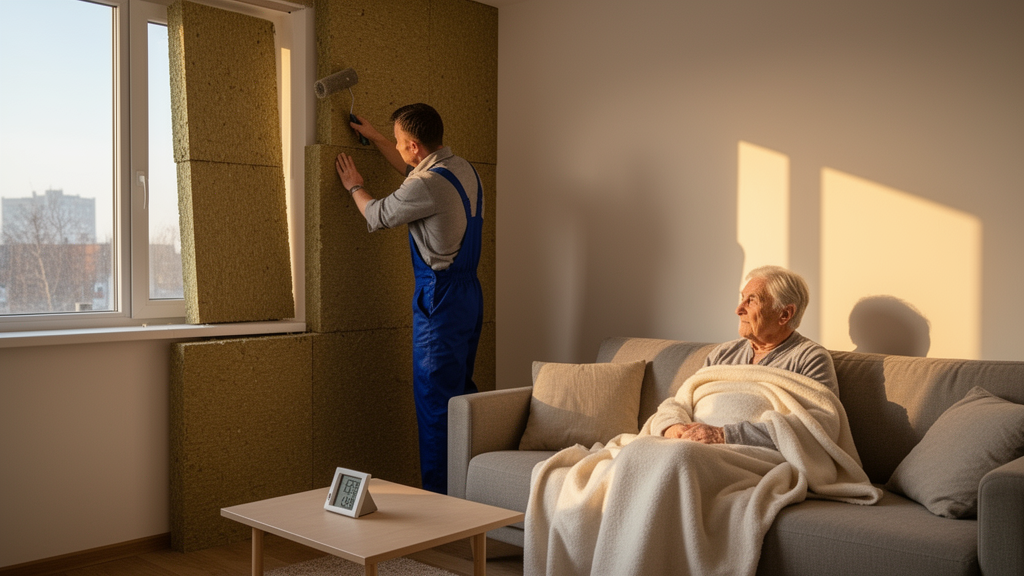
Structural interventions to address energy poverty delivered the most substantial improvements in thermal comfort and health among participants in a large European study, while small home measures and energy advice alone showed little, if any, measurable effect. The findings come from WELLBASED, a research project that evaluated urban interventions to reduce energy poverty in six European cities: Valencia in Spain, Heerlen in the Netherlands, Leeds in the United Kingdom, Edirne in Turkey, Obuda in Hungary and Jelgava in Latvia. The study, published in Nature Energy, also found that direct financial support had clear positive effects on health and energy-saving practices, and that when financial support fluctuated, so did participants’ living conditions.
This categorisation allowed the researchers to differentiate between the energy poverty and health impacts of each category. The study was designed in response to a gap in the evidence base: interventions to address energy poverty have expanded following the 2021 to 2023 energy crisis, but evidence on their effectiveness for improving health and living conditions remains limited.
The sample was recruited through convenience sampling. In total, 1,350 participants were initially recruited to the project, of whom 1,260 completed questionnaires. Among these, 792 participants received interventions through WELLBASED via national or local government schemes or funded privately, while 468 received no interventions during the period of observation. The results presented in the paper are based on the analysis of self-reported questionnaires where information was available on all variables used in the analysis, giving an analytical sample of 1,094 participants.
Data collection followed a longitudinal design. Participants completed an initial baseline questionnaire between June and September 2023, and then completed questionnaires at six-month intervals, providing data at six months, twelve months and a final follow-up at fifteen to eighteen months after baseline. Data collection finished by September 2024. The questionnaires collected information on health and well-being, energy poverty and energy efficiency, as well as any energy efficiency interventions participants had received during the previous six months, whether through WELLBASED or not. The types of intervention received varied by country, and interventions ranged from advice to structural measures.
Methodologically, the analysis took an unusual approach to longitudinal data. Rather than averaging change across the cohort, the researchers explored change over time by aggregating individual experiences. Variables at each time point were coded to represent each participant’s position in the timeline, and these were combined to produce a timeline of experience or behaviour for each participant. The resulting categories captured negative change, such as homes becoming cold or people starting or increasing an unhealthy coping behaviour; positive change, such as homes becoming warm or people stopping such behaviours; no change, which could itself be negative or positive; and, importantly for energy poverty, fluctuations where there was no consistent pattern in people’s experiences.
The analysis proceeded in two stages. The first stage used exploratory cross-tabulations to examine relationships between different elements of energy poverty, coping practices and health with intervention type and financial support, with the strength and significance of associations measured using Cramer’s V. The second stage focused on a key issue for people in energy poverty: the ability to keep a home comfortably warm in winter. Two binary variables were created to focus on the two extremes of experience, and two logistic regression models were run. Model 1 identified where things had got worse, exploring the likelihood of struggling to keep a home warm in winter, while Model 2 identified where things had got better, exploring the likelihood of people becoming able to keep their home warm.
The results revealed a clear pattern linking the level of intervention to the extent of its effects. Advice alone and small measures had limited effects, whereas structural measures had a more positive impact on participants’ lives. Structural interventions resulted in a wide range of positive experiences for those who received them, including being able to achieve thermal comfort in winter, being less likely to be in debt or to engage in unhealthy coping practices, and better health. The researchers note that this group was more likely to be in a worse position at the outset, with more space for improvement, but they nonetheless conclude that the work clearly suggests the need for more investment in structural measures.
For participants receiving only advice, the effect was not statistically significant. The authors caution against reading this finding as evidence that energy advice is worthless. Instead, they argue it supports the assertion that advice can help to partially ameliorate energy poverty but that its impacts are limited by structural factors beyond the immediate influence of advisers or individual citizens. They also observe that advice is likely to play an important supporting role alongside structural interventions: 71 percent of those receiving structural measures also received advice. Recent work from England showing that current advice provision is geographically inconsistent, may exacerbate inequalities, and is resourced in a way that makes continuity of service difficult, suggests there is also a need for more attention to the nature and consistency of advice provided.
The effects of financial support emerged as more complex. Being in receipt of financial support did not resolve all challenges, as people still struggled to achieve thermal comfort, though the researchers note that it could be precisely because people cannot afford to heat their home adequately that they are eligible for support in the first place. A clear pattern in the data showed that when financial support was withdrawn, people’s situations worsened. This supports a longstanding recognition that people are likely to move in and out of energy poverty over time as their circumstances change, and the link between the presence or absence of financial support and fluctuating experiences of energy poverty suggests that consistency of support is important. Another financial aspect, the presence of energy bill arrears, was also strongly linked to the ability to keep warm, which suggests that policy needs to address energy debt to ensure effective outcomes.
The precariousness of energy poverty was also visible in the fluctuation of people’s energy-saving practices, such as limiting when and where heating is used. The data showed that such practices increased both the likelihood of achieving thermal comfort and the likelihood of struggling to keep warm. The authors speculate that limiting heating may help manage utility bills but reduce thermal comfort, whereas keeping heating on will achieve thermal comfort but may push people into arrears. These nuances, they argue, show that energy poverty is a complex process and that policy interventions need to pay attention to unhealthy coping practices and financial circumstances. The links between being able to keep a home warm and mental and physical health were also important: the researchers could not track causation, but when people were cold in winter, results indicated they were more depressed and stressed, and when people were warm in winter, stress, pain and discomfort were reduced. The authors describe this as a helpful confirmation of the links between health and energy poverty and further evidence that addressing health in this context is another important strand of policy.
The study had limitations that the authors acknowledge. The sample was recruited through convenience sampling, and some participants did not report problems associated with energy poverty in the baseline data, which is likely to influence the extent to which they were eligible for, or sought out, measures to improve thermal comfort. The mixed results for those not receiving any intervention may in particular reflect the polarity within that group, where some people may have already had an intervention before the period of observation, while others may not have had one because they could not afford it or because, as tenants, such measures were the responsibility of their landlord. The questionnaire dataset generated and analysed in the study is not publicly available because it contains sensitive participant information that cannot be fully anonymized without compromising its scientific value; the data are stored at Erasmus Medical Centre and can only be accessed within the governance framework established for the original project. Ethics approval was received from review boards in all six participating countries, and informed consent was collected on paper by a research assistant. Based on their findings, the authors recommend that governments should invest in a range of measures, with the recognition that structural measures and consistent financial support are the most effective.
Subject of Research: Comparative effectiveness of structural, small-scale, advisory and financial interventions for energy poverty on thermal comfort and health in six European cities
Article Title: Structural improvements to address energy poverty had most substantial thermal comfort and health effects
Article References: Searle, B. A., Middlemiss, L., van Grieken, A., & Stevens, M. (2026). Structural improvements to address energy poverty had most substantial thermal comfort and health effects. Nature Energy. https://doi.org/10.1038/s41560-026-02145-z
Image Credits: AI Generated
DOI: 10.1038/s41560-026-02145-z
Keywords: energy poverty, thermal comfort, WELLBASED, structural interventions, financial support, energy advice, health outcomes, longitudinal study, Europe, fuel poverty, energy debt, housing policy
Cite Scienmag News
Denise Maddox. (October 27, 2026). Research report: Structural improvements to address energy poverty had most substantial thermal comfort and health effects. Scienmag. https://scienmag.com/research-report-structural-improvements-to-address-energy-poverty-had-most-substantial-thermal-comfort-and-health-effects/
Denise Maddox. "Research report: Structural improvements to address energy poverty had most substantial thermal comfort and health effects." Scienmag, 27 October 2026, https://scienmag.com/research-report-structural-improvements-to-address-energy-poverty-had-most-substantial-thermal-comfort-and-health-effects/. Accessed 27 October 2026.
Denise Maddox. "Research report: Structural improvements to address energy poverty had most substantial thermal comfort and health effects." Scienmag. October 27, 2026. https://scienmag.com/research-report-structural-improvements-to-address-energy-poverty-had-most-substantial-thermal-comfort-and-health-effects/


