


The work focused on two closely related sibling species: the greater mouse-eared bat, Myotis myotis, and the lesser mouse-eared bat, Myotis blythii. Both belong to the family Vespertilionidae and coexist across parts of Europe and the Middle East. While the International Union for Conservation of Nature lists both species as Least Concern, they are protected in Europe under the Agreement on the Conservation of Populations of European Bats, and in Bulgaria both are classified as Near Threatened in the country’s Red List of Protected Species.
On the Balkan Peninsula, these bats live almost exclusively in caves, occasionally in mines, where they form mixed maternity and hibernation colonies. The two species avoid competing with each other mainly through habitat selection and different foraging strategies. Myotis myotis predominantly hunts in forests and agricultural land with open, accessible ground, while M. blythii tends to forage in steppe-like habitats with dense grass and small shrubs. Both species use echolocation for catching prey in the air, but they also employ passive listening to snatch prey off the ground and vegetation. When gleaning, M. myotis listens for the rustling sounds of large walking prey, whereas M. blythii eavesdrops on the mating songs of bush-crickets.
The diet of M. myotis has been extensively studied throughout its range using morphological methods, but far less is known about what M. blythii eats. These earlier studies covered much of the geographical and ecological variation in the two species’ diets, yet they suffered from low taxonomic resolution, often identifying prey only to the level of order. Recent metabarcoding studies have offered much finer resolution, but only two had investigated the diet of M. myotis, and only one had examined M. blythii, and that study had to treat both species as a single species complex due to methodological limitations.
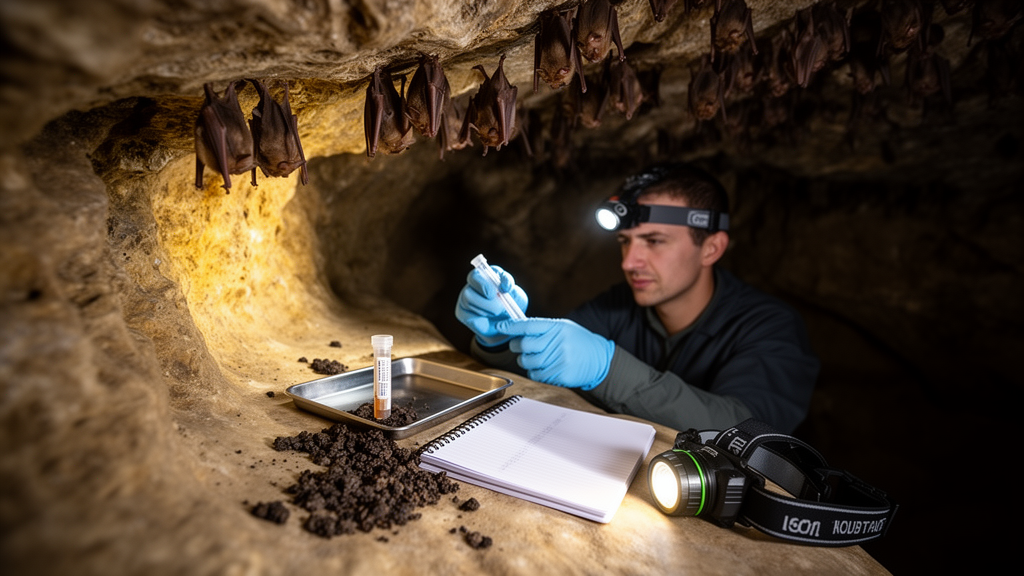
To build the new dataset, the researchers collected faecal samples from 113 individual bats, 60 M. myotis and 53 M. blythii, at the entrance of Orlova Chucka cave in the Dve Mogili District of Bulgaria. The cave hosts 15 bat species year-round, but in summer it is dominated by mixed maternity colonies of the two mouse-eared bats, along with the horseshoe bats Rhinolophus euryale and Rhinolophus mehelyi. Because mouse-eared bats are highly mobile, hunting within roughly 23 kilometres of the cave, the effective sampling area covered approximately 1600 square kilometres, a large proportion of which lies within protected areas including NATURA 2000 sites and the Rusenski Lom Natural Park.
Sampling took place from June to August in 2017 and 2018, covering the lactation and post-lactation period when female bats must forage more actively to feed both themselves and their pups. Bats were captured in the morning as they returned to the roost, using a harp trap placed at the cave entrance. The trap was emptied every five to ten minutes to minimise defecation inside it and reduce the risk of cross-contamination between individuals, although the researchers acknowledge that a small proportion of cross-contamination may still have occurred. Each bat was placed in an individual cotton bag, previously washed at 90 degrees Celsius with bleach, until it defecated. To avoid misidentification, the team applied a conservative approach, classifying individuals as M. myotis only if the upper jaw length from canine to third molar exceeded 9.4 millimetres and forearm length exceeded 61 millimetres, and as M. blythii if those measurements were below 9.0 and 59 millimetres respectively. Guano pellets were stored in 2-millilitre tubes with 98 percent ethanol at minus 18 degrees Celsius.
In the laboratory, conducted at the AIM Lab in Leipzig, Germany, DNA was extracted using a commercial faecal and soil microbe kit, with six empty vials run through the procedure as negative controls to detect contamination artefacts. The team used high-throughput sequencing with mini-barcode primers targeting the mitochondrial COI-5P region, sequencing on an Illumina MiSeq platform. The bioinformatics pipeline involved merging paired-end reads, removing adapter sequences, quality filtering, dereplication, chimera detection and clustering into operational taxonomic units using the SWARM algorithm. To reduce false positives, the researchers excluded read counts below 0.01 percent of a sample’s total and removed OTUs whose read numbers fell below the maximum observed in negative controls.
Identifying what the sequences represented required a careful consensus approach. OTU sequences were compared against both a local copy of the NCBI nucleotide database and a custom database built from the Barcode of Life Data System, filtered to European animal records with available BIN information. As an additional check, OTUs were also classified with a naive Bayesian classifier trained on a cleaned COI dataset of arthropods and chordates. Taxonomic assignments from the three reference systems were then reconciled, with confidence thresholds tied to sequence identity: above 97 percent for species-level assignments, 95 percent for genus, 90 percent for family and so on down the hierarchy. Where a BIN was shared between two or more species, species-level information from the BOLD match was disregarded to avoid overconfident identifications.
The results reveal striking differences between the two bat species that mirror their known foraging styles. Insects made up the largest proportion of detected species. The relative read abundance of carabid beetles was 46 percent in M. myotis samples but only 7 percent in M. blythii samples, consistent with the greater mouse-eared bat’s reliance on large walking prey detected by rustling sounds. Orthoptera showed a particularly telling split: in M. myotis samples, most orthopteran species belonged to the family Gryllidae, the crickets, while in M. blythii samples the records came primarily from the family Tettigoniidae, the bush-crickets, including genera such as Tettigonia, Phaneroptera, Pholidoptera, Decticus, Poecilimon and Isophya. This pattern matches the two species’ hunting strategies, with M. myotis tracking cricket rustles and M. blythii homing in on bush-cricket mating calls.
The dataset also captured an unexpected layer of the food web. Beyond the bats’ direct prey, the samples contained reads from various ecto- and endo-parasites, including ticks of the genus Ixodes, mites from the groups Mesostigmata and Sarcoptiformes, and roundworms from the orders Strongylida and Rhabditida. Molluscs and annelid worms also appeared, including the species Pomatias rivulare, Lumbricus rubellus and Eisenia fetida, which the researchers interpret as likely having been consumed by predatory carabid beetles or other arthropods that were then eaten by the bats, meaning the data may contain information on second-order trophic interactions. The presence of roundworms from the genus Steinernema, known to parasitise mole crickets and other bat prey, further suggests the dataset holds parasites of the prey themselves. The researchers stress that relative read abundance should be treated only as a visual guide to taxonomic diversity, not as a measure of consumed biomass, since sequence counts do not necessarily correspond to the biomass in the original sample. They recommend complementing the metabarcoding data with biologging, behavioural experiments and ecological studies, and they hope the openly shared dataset will support meta-analyses, investigations of predator-prey and host-parasite interactions, and the management of protected areas.
Subject of Research: A metabarcoding dataset of prey and parasite species in the faeces of greater and lesser mouse-eared bats from Bulgaria
Article Title: DNA metabarcoding data from faecal samples of the lesser ( Myotis blythii ) and the greater ( Myotis myotis ) mouse-eared bats from Bulgaria
Article References: Hubancheva, A., Bozicevic, V., Morinière, J., & Goerlitz, H. R. (2023). DNA metabarcoding data from faecal samples of the lesser (Myotis blythii) and the greater (Myotis myotis) mouse-eared bats from Bulgaria. Metabarcoding and Metagenomics, 7, Article e106844. https://doi.org/10.3897/mbmg.7.106844
Image Credits: AI Generated
Keywords: DNA metabarcoding, bats, Myotis myotis, Myotis blythii, faecal samples, Bulgaria, diet analysis, parasites, COI barcode, Krona charts, trophic interactions, conservation
Cite Scienmag News
Margaret Porter. (October 27, 2026). Faecal DNA from Bulgarian cave bats reveals over a thousand prey and parasite species. Scienmag. https://scienmag.com/faecal-dna-from-bulgarian-cave-bats-reveals-over-a-thousand-prey-and-parasite-species/
Margaret Porter. "Faecal DNA from Bulgarian cave bats reveals over a thousand prey and parasite species." Scienmag, 27 October 2026, https://scienmag.com/faecal-dna-from-bulgarian-cave-bats-reveals-over-a-thousand-prey-and-parasite-species/. Accessed 27 October 2026.
Margaret Porter. "Faecal DNA from Bulgarian cave bats reveals over a thousand prey and parasite species." Scienmag. October 27, 2026. https://scienmag.com/faecal-dna-from-bulgarian-cave-bats-reveals-over-a-thousand-prey-and-parasite-species/


