


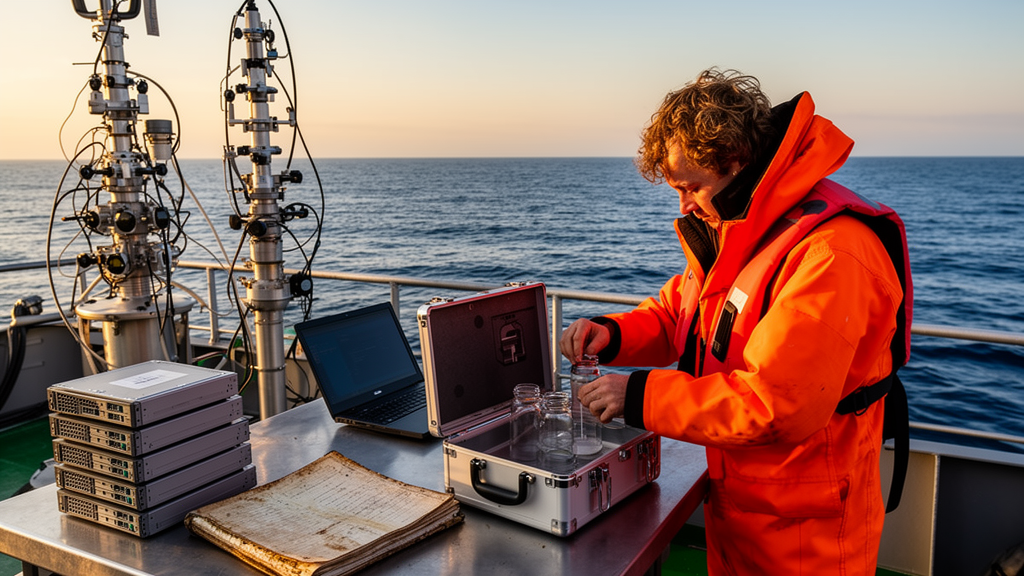
Vast amounts of ocean data flowing into European repositories are still missing something basic: a persistent, citable link to the methods used to collect and process them. A new assessment published in Frontiers in Marine Science finds that even among institutions that provided detailed methodological information, fewer than one in five supplied a resolvable persistent identifier pointing to formal method documentation in the Ocean Best Practices System (OBPS), a UNESCO Intergovernmental Oceanographic Commission programme that archives ocean methods and assigns DOIs to them. The study, led by El Khalil Cherif of the IEEE France Section and Instituto Superior Técnico in Lisbon, with Antonio Novellino, Jay Pearlman and René Garello, offers one of the first empirical measurements of how well the ocean observing community connects its data records to the procedures behind them.
The work grew out of a collaboration launched in 2024 between OBPS and the Physics thematic pillar of the European Marine Observation and Data Network (EMODnet), an open-access portal that aggregates physical oceanographic data from national and regional observing programs across European and global seas. The goal was to extend the EMODnet Physics metadata model so that data records could be linked to method descriptions using persistent identifiers assigned to methods in OBPS. The assessment covered June 2025 to January 2026 and examined the state of those linkages, the gaps that remain, and possible routes to improvement.
The starting point was the EMODnet Physics inventory of institutions and platforms. After cleaning and deduplication, the researchers compiled 925 institution–platform records spanning 25 platform categories, from tide gauges, moorings and drifting buoys to gliders, profiling floats, HF radar stations, research vessels, instrumented marine animals and river stations, representing 582 unique institutions. The team then contacted the technical contacts behind these records with standardized emails requesting methodological documentation such as standard operating procedures, quality control workflows and processing descriptions.
Engagement with data collectors and managers yielded 134 responses. After quality screening, 88 were retained as usable methodological responses, meaning each contained at least one identifiable methodological element tied to the reported platform or parameter, such as a named procedure, a quality control workflow or a persistent reference. The remaining 46 were excluded for lacking sufficient methodological detail or complete supporting information. The researchers note that this reduction from inventory to analyzable replies is itself informative: it suggests that detailed methodological information is not consistently available in a readily shareable or standardized form, even after direct outreach.
The headline finding concerns persistent citation. Of the 88 usable responses, only 16, or 18.2 percent, included a resolvable OBPS DOI or URL, with a 95 percent Wilson confidence interval of 11.5 to 27.5 percent. Measured against all 134 collected responses, the same 16 responses correspond to 11.9 percent. Yet nearly all of the usable responses could be mapped to at least one recognizable program, method or methodological framework. In other words, the community has broadly embraced programmatic alignment and methodological documentation, but it has not yet normalized citing methods as persistent, machine-actionable research objects.
The picture varied sharply by platform community. Argo/Profiler responses, drawn from the internationally coordinated Argo program of autonomous profiling floats, showed the highest linkage prevalence, with 8 of 12 responses linked to a persistent OBPS reference, or 66.7 percent. Tide gauge responses showed an intermediate level, with 4 of 14 linked, or 28.6 percent, while responses from other platforms showed 4 of 39, or 10.3 percent. No OBPS-linked responses were identified for moorings, gliders or drifting buoys in the analyzed subset. A chi-square test of independence found a statistically significant association between platform group and OBPS linkage, with an effect size of Cramér’s V of 0.55, indicating a moderate-to-strong association, though the authors caution that several grouped categories still contain small counts and the results should be read alongside the descriptive confidence intervals.
Delving deeper, the team identified 453 methodological entries from the usable responses, which were consolidated into 374 individual method entries linked to institutions and platforms. These were harmonized into 37 broader methodological frameworks defined by common objective, operational stage and platform type. The most widely shared frameworks included Argo quality control procedures, adopted by eight institutions, and HF radar data processing, drifting-buoy operations and tide-gauge data processing, each reported by seven. Most exact method entries, however, were reported by only one institution: 327 of the 453 entries appeared in a single institution, 42 in two, and only five in three or more. This points to a small shared methodological core surrounded by a long tail of local, institution-specific practice.
Persistent citation remained the exception across the board. Of the 374 individual method entries, only 30, or 8.0 percent, had an associated DOI, representing 22 unique identifiers, and 17 of those, or 4.5 percent, were explicit OBPS DOIs of the form 10.25607/OBP. When methods were grouped into the 37 frameworks, 11, or 29.7 percent, had at least one DOI, including 10 with at least one OBPS DOI, with Argo-related and tide-gauge frameworks accounting for the largest share. The authors emphasize that the low citation rate should not be read as evidence of methodological fragmentation: the usable responses converged around a limited set of international programs and frameworks, led by GLOSS, Argo, WMO/OceanOPS, the Copernicus Marine Service and the Global Drifter Program, and the clustering of frameworks with their expected platform types provided an internal check on the coding.
The study also reveals a more nuanced documentation landscape than a simple DOI count would suggest. Of the 453 method entries reviewed, 47 had a direct DOI or OBPS link, 124 were connected through related OBPS references, 269 through external public sources, and 13 lacked any public linkage at all. The authors interpret this as evidence that methodological knowledge is more widely available than persistent citation alone implies, but that much of it remains weakly standardized, weakly linked or insufficiently persistent. They further note that the presence of a persistent identifier does not guarantee that the underlying documentation is standardized or machine-actionable, since much of it remains embedded in human-readable PDFs and free text.
Based on these findings, the authors recommend three concrete actions. First, data-submission workflows at aggregation infrastructures such as EMODnet should support dedicated method DOI or persistent identifier fields, so that citing methodological documentation becomes a routine step rather than an afterthought. Second, methodological documentation should move beyond persistent linkage alone toward structured, machine-readable formats that support comparison, interoperability and automated discovery. Third, institutions and observing communities should treat methodological documentation as a routine research and operational output, reinforced where relevant by minimum metadata requirements at the point of data acceptance. The authors also flag limitations: the analyzed responses represent a self-selected subset in which institutions with better documentation practices may be over-represented, coverage across platform categories was uneven, and the study did not perform a record-by-record audit of all datasets linked through EMODnet. If the recommended actions are implemented, the authors argue, ocean data systems will move closer to a model in which data and methods are linked as complementary research objects, allowing users to interpret observations and reuse both datasets and workflows with greater confidence.
Subject of Research: An empirical assessment of persistent methodological linkages between EMODnet Physics data records and OBPS method documentation across ocean observing platform communities.
Article Title: Bridging the traceability gap: an empirical assessment of methodological links between EMODnet data and OBPS practices
Article References: Cherif, E. K., Novellino, A., Pearlman, J., & Garello, R. (2026). Bridging the traceability gap: an empirical assessment of methodological links between EMODnet data and OBPS practices. Frontiers in Marine Science, 13, Article 1909271. https://doi.org/10.3389/fmars.2026.1909271
Image Credits: AI Generated
DOI: 10.3389/fmars.2026.1909271
Keywords: EMODnet Physics, OBPS, ocean observing, methodological traceability, persistent identifiers, DOIs, FAIR principles, metadata interoperability, Argo, tide gauges, quality control, ocean data provenance
Cite Scienmag News
Violet Maxwell. (October 27, 2026). Ocean Data Often Lack Persistent Links to the Methods Behind Them. Scienmag. https://scienmag.com/ocean-data-often-lack-persistent-links-to-the-methods-behind-them/
Violet Maxwell. "Ocean Data Often Lack Persistent Links to the Methods Behind Them." Scienmag, 27 October 2026, https://scienmag.com/ocean-data-often-lack-persistent-links-to-the-methods-behind-them/. Accessed 27 October 2026.
Violet Maxwell. "Ocean Data Often Lack Persistent Links to the Methods Behind Them." Scienmag. October 27, 2026. https://scienmag.com/ocean-data-often-lack-persistent-links-to-the-methods-behind-them/


