


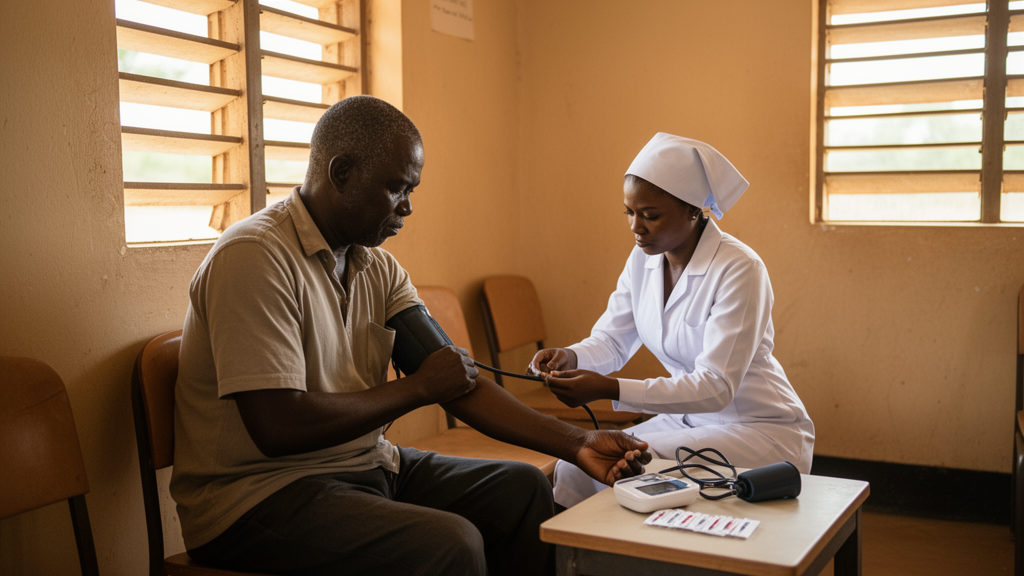
Adults across Sub-Saharan Africa who take antiretroviral therapy built around dolutegravir appear to carry a substantial burden of cardiometabolic disease, according to a systematic review and meta-analysis published in BMC Infectious Diseases. The work pooled prevalence figures for diabetes mellitus and hypertension among people on dolutegravir-based regimens and compared the risk of newly developing hypertension against those on older, non-dolutegravir treatments.
Dolutegravir-based therapy is the preferred regimen across Sub-Saharan Africa, but concerns have emerged about its cardiometabolic effects. The review team searched eight bibliographic databases, Google Scholar and grey literature covering 1 January 2018 to 30 May 2026, following PRISMA 2020 reporting guidance. They used DerSimonian–Laird random-effects models to pool prevalence and comparative estimates, combining risk ratios and hazard ratios as a pragmatic approximation, and rated certainty of evidence with GRADE.
Twenty-nine studies made it into the final synthesis. The pooled prevalence of diabetes or hyperglycaemia, including prediabetes, drew on five studies covering 1,841 participants and came out at 23.9 percent, with a 95 percent confidence interval of 10.7 to 40.2 percent and an I-squared of 98.3 percent, signalling extreme statistical heterogeneity.
That heterogeneity traces largely to how studies defined abnormal blood sugar. Reported estimates ranged from 7.7 percent, when diabetes was diagnosed by strict American Diabetes Association criteria, up to 55.9 percent in a study using random blood sugar-based hyperglycaemia. When the random blood sugar-based study was excluded, the pooled estimate settled at 17.1 percent, with a 95 percent confidence interval of 11.4 to 23.7 percent, suggesting that diagnostic-threshold differences contribute substantially to the variation.
Hypertension told a steadier story. Across three studies totalling 1,289 participants, the pooled prevalence was 19.7 percent, with a 95 percent confidence interval of 13.1 to 27.2 percent.
The comparative analysis focused on incident hypertension. In four studies with poolable published estimates, dolutegravir was associated with a higher risk of newly developing hypertension than non-dolutegravir regimens, with a pooled risk ratio or hazard ratio of 1.23 and a 95 percent confidence interval of 1.13 to 1.34, and no heterogeneity between studies. The association held after exclusion of the largest study, at which point the pooled estimate rose to 1.34, with a 95 percent confidence interval of 1.13 to 1.59.
One important caveat tempers that finding. A large multi-country cohort known as AFRICOS, with approximately 3,250 participants, reported no positive association between dolutegravir and incident hypertension, but it could not be pooled because its adjusted estimate was available only in conference material. The authors note that the pooled ratio of 1.23 reflects only the published, quantitatively poolable studies and may overestimate the true association for that reason.
Incident diabetes was synthesised narratively rather than pooled, with reported rates ranging from 0.29 to 9.8 per 100 person-years. The authors are careful to state that single-arm prevalence estimates do not show that dolutegravir caused these diseases; prevalence figures describe the burden among people on the regimen, not a causal effect.
Certainty of evidence ranged from very low to moderate across the outcomes. Even so, the authors conclude that the burden of hyperglycaemia or diabetes and hypertension among adults receiving dolutegravir-based therapy in Sub-Saharan Africa is substantial, and that the findings support risk-based cardiometabolic monitoring within HIV care alongside standardised diagnostic definitions in future studies.
The review arrives at a moment when dolutegravir underpins first-line HIV treatment across much of the region, making the distinction between measured burden, comparative risk and causation central to interpreting the results. The published analysis appears as an open-access article dated 27 October 2026.
Subject of Research: Cardiometabolic risk, diabetes and hypertension among adults on dolutegravir-based antiretroviral therapy in Sub-Saharan Africa
Article Title: Cardiometabolic risk following dolutegravir-based antiretroviral therapy in Sub-Saharan Africa: a systematic review and meta-analysis of diabetes mellitus and hypertension
Article References: Belay, S. A., & Molla, Y. D. (2026). Cardiometabolic risk following dolutegravir-based antiretroviral therapy in Sub-Saharan Africa: a systematic review and meta-analysis of diabetes mellitus and hypertension. BMC Infectious Diseases. https://doi.org/10.1186/s12879-026-14703-7
Image Credits: AI Generated
DOI: 10.1186/s12879-026-14703-7
Keywords: dolutegravir, antiretroviral therapy, HIV, diabetes mellitus, hypertension, Sub-Saharan Africa, systematic review, meta-analysis, cardiometabolic risk, AFRICOS cohort, hyperglycaemia, GRADE certainty
Cite Scienmag News
Ophelia Keating. (October 27, 2026). Diabetes and Hypertension Risk Weighed for Widely Used HIV Drug Regimen in Africa. Scienmag. https://scienmag.com/diabetes-and-hypertension-risk-weighed-for-widely-used-hiv-drug-regimen-in-africa/
Ophelia Keating. "Diabetes and Hypertension Risk Weighed for Widely Used HIV Drug Regimen in Africa." Scienmag, 27 October 2026, https://scienmag.com/diabetes-and-hypertension-risk-weighed-for-widely-used-hiv-drug-regimen-in-africa/. Accessed 27 October 2026.
Ophelia Keating. "Diabetes and Hypertension Risk Weighed for Widely Used HIV Drug Regimen in Africa." Scienmag. October 27, 2026. https://scienmag.com/diabetes-and-hypertension-risk-weighed-for-widely-used-hiv-drug-regimen-in-africa/


