


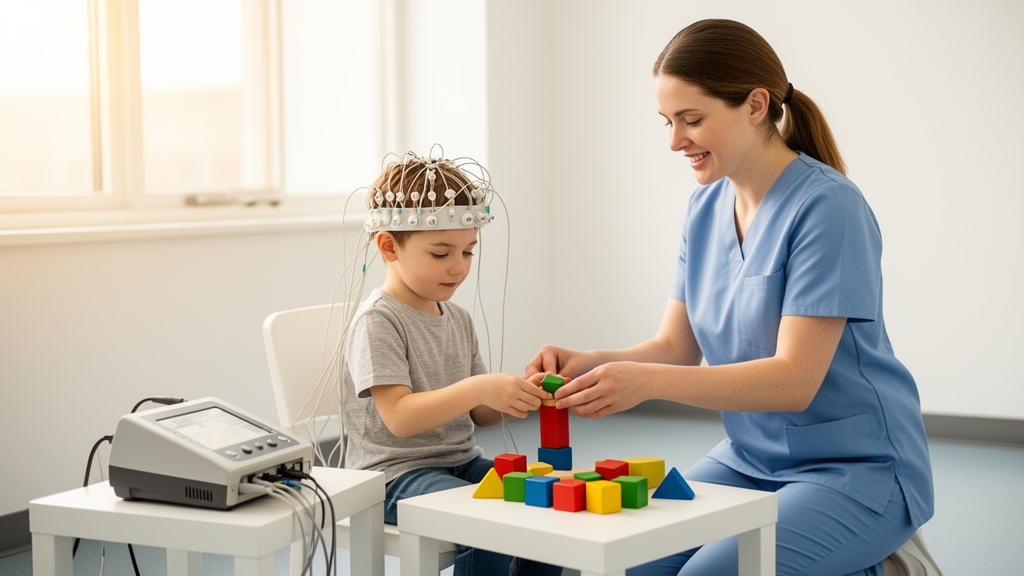
Children with cerebral palsy may one day add a new tool to their rehabilitation toolkit: gentle, non-invasive stimulation of the brain. A narrative review published in Frontiers in Pediatrics on 27 October 2026 pulls together the current evidence on two techniques—transcranial direct current stimulation (tDCS) and repetitive transcranial magnetic stimulation (rTMS)—as add-ons to conventional rehabilitation in children with cerebral palsy. The verdict is cautiously encouraging. When paired with intensive, task-specific training, both methods show small to moderate positive signals for gross motor function, gait, selected balance measures, and upper limb manual function, with acceptable short-term safety. But the authors, led by researchers at Kunshan No. 4 People’s Hospital and affiliated institutions in China, are explicit that the evidence base remains insufficient to support broad clinical recommendations, and that most studies so far are small, heterogeneous, and short in follow-up.
Cerebral palsy is not a single condition but a group of neurodevelopmental disorders originating in the fetal or infant period, caused by non-progressive disturbances or lesions in the developing brain. Its hallmark is persistent impairment of movement and posture that limits activity, and international consensus emphasizes that it is far more than a motor disorder: sensory, cognitive, and communication impairments, epilepsy, and secondary musculoskeletal complications are common. Prevalence is estimated at roughly 1.5 to 3.0 per 1,000 live births in most countries. Current management centers on multidisciplinary rehabilitation—physical, occupational, and speech therapy, orthotics, and medication—which has moderate-level evidence for improving gross motor function, muscle tone, and some daily activities. Yet systematic reviews show that most therapies require long-term, high-frequency training to achieve clinically meaningful gains, and traditional rehabilitation often plateaus for complex domains such as higher-order motor control, cognition, and communication.
That plateau is precisely where brain stimulation enters the picture. The pediatric brain is characterized by heightened plasticity, which theoretically gives neuromodulation an advantage in promoting neural network reorganization. tDCS delivers low-intensity direct current through scalp electrodes, slightly depolarizing or hyperpolarizing neuronal membranes in a polarity-dependent way and altering the probability of firing during stimulation; its after-effects can persist for tens of minutes to hours and are commonly linked to NMDA receptor-dependent mechanisms resembling long-term potentiation and depression. rTMS, by contrast, uses electromagnetic induction to deliver repetitive magnetic pulses, with low-frequency protocols generally reducing cortical excitability and higher-frequency protocols increasing it, though responses vary considerably across individuals and clinical phenotypes.
The rationale for where to aim the stimulation comes from decades of neuroimaging and electrophysiology. Diffusion tensor imaging studies show that children with spastic cerebral palsy commonly exhibit reduced fractional anisotropy in the corticospinal tract, and the severity of these alterations tracks abnormal muscle tone, co-contraction, and gross motor deficits. In hemiplegic cerebral palsy, transcranial magnetic stimulation studies reveal increased transcallosal inhibition from the contralesional primary motor cortex onto the injured hemisphere’s motor cortex, an asymmetry associated with poorer function of the affected limb. This has produced two complementary stimulation strategies: enhance the ipsilesional motor cortex with anodal tDCS or high-frequency rTMS, or suppress the overactive contralesional cortex with cathodal tDCS or low-frequency rTMS. Beyond motor circuits, children with cerebral palsy also show atypical development of frontoparietal executive networks and language-related circuitry, providing a rationale for targeting the dorsolateral prefrontal cortex and Broca’s area in cognitive and communication work.
On the motor side, the evidence is strongest for lower limb function. In a double-blind randomized controlled trial, Duarte and colleagues randomized 24 children with spastic cerebral palsy, aged 5 to 12 years, to anodal tDCS over the lesioned side motor cortex plus treadmill training, or sham plus the same training, for 10 sessions over two weeks. The active group showed greater improvements in Pediatric Balance Scale scores and postural sway measures, with partial maintenance at one-month follow-up. Related trials using 1 to 2 mA for 20 minutes per session combined with treadmill or gait training reported improvements in gait speed, step length, and six-minute walking distance with favorable safety profiles. Systematic reviews and meta-analyses suggest that anodal motor cortex tDCS combined with lower limb training yields small to moderate improvements in gait and gross motor function, while effects on balance are less consistent.
For the upper limb, studies commonly pair constraint-induced movement therapy or structured training with stimulation over the motor cortex. In a sham-controlled trial, Gillick and colleagues applied cathodal tDCS over the non-lesioned motor cortex alongside constraint-induced therapy; both groups improved, but the stimulation group showed larger effect sizes in selected fine motor and bimanual coordination tasks, with neurophysiological signals consistent with increased corticospinal excitability in the lesioned hemisphere. In preschool children with unilateral cerebral palsy, Wu and colleagues applied inhibitory low-frequency rTMS over the contralesional motor cortex combined with modified constraint-induced therapy and reported improvements in the Assisting Hand Assessment with no serious adverse events. Notably, a 2025 systematic review of randomized trials found that stimulation alone did not reliably improve upper limb motor activity; combined protocols with intensive training showed more favorable signals, and heterogeneity limited confidence in the findings.
Spasticity outcomes, though usually secondary endpoints, offer another signal. Systematic reviews suggest that tDCS—commonly anodal stimulation over the motor cortex or cerebellum combined with physical therapy—may reduce Modified Ashworth Scale scores in the short term and improve muscle stiffness and joint range of motion, though heterogeneity limits conclusions about dose response. Network meta-analysis findings suggest that low-frequency rTMS over the contralesional motor cortex may be more favorable for reducing muscle tone and improving hand function, whereas high-frequency rTMS over the ipsilesional cortex may be more favorable for gross motor recovery. These distinctions matter clinically, because they hint that the direction and frequency of stimulation could eventually be matched to a child’s specific rehabilitation goal rather than applied uniformly.
Cognitive and communication applications are younger but intriguing. In children with cerebral palsy and comorbid cognitive impairment, a pilot sham-controlled trial of 13 children found that anodal dorsolateral prefrontal tDCS plus cognitive training was feasible and well tolerated and was associated with within-group improvements in cognition, activities of daily living, and language-related measures—although between-group differences were not significant, and the small sample limited conclusions. A separate randomized trial combining anodal motor cortex tDCS with cognitive-motor dual task training in 30 children reported greater improvements than sham in functional activity capacity, selected cognitive measures, and cortical excitability, with persistence at one month and no serious adverse events. A small prospective study also reported that left prefrontal tDCS combined with augmentative and alternative communication training improved Communication Matrix levels and spontaneous expressive behaviors, with generally mild transient adverse effects. The authors stress that these findings remain exploratory.
Equally important is what the evidence does not cover. The review notes that most therapeutic studies have enrolled children with spastic cerebral palsy, particularly those with unilateral involvement and ambulatory participants within Gross Motor Function Classification System levels I to III. Evidence for dyskinetic, ataxic, mixed, and more severe non-ambulatory presentations remains limited, and because dyskinetic cerebral palsy involves basal ganglia and thalamocortical abnormalities rather than the corticospinal tract and interhemispheric imbalance that motivate motor-cortex protocols, findings from unilateral spastic populations should not be directly generalized. The review itself is a narrative synthesis informed by a structured literature search of PubMed, Embase, Web of Science, and Google Scholar covering database inception to 25 December 2025, but it conducted no formal risk-of-bias assessment, certainty grading, or quantitative meta-analysis.
Looking forward, the authors call for large multicenter randomized controlled trials that standardize stimulation parameters, model dose response, and clarify the optimal timing of stimulation relative to task-based training. They propose that neuroimaging and neurophysiological markers—diffusion measures of corticospinal tract integrity, functional connectivity within motor and frontoparietal networks, and transcranial magnetic stimulation measures of interhemispheric inhibition—could guide target selection and protocol matching for individual children. Outcome assessment, they argue, should extend beyond impairment scales to participation, real-world dual task performance, quality of life, caregiver burden, and long-term pediatric safety monitoring. For now, the message to families and clinicians is measured: non-invasive brain stimulation is generally safe and well tolerated in children with cerebral palsy within recommended parameters, and it may meaningfully augment intensive rehabilitation—but the field is still building the evidence needed to say exactly who benefits, how much, and for how long.
Subject of Research: Non-invasive brain stimulation as an adjunctive rehabilitation therapy for children with cerebral palsy
Article Title: Applications of non-invasive brain stimulation in the treatment of children with cerebral palsy: a narrative review
Article References: Wang, C., Jia, Y., Ding, X., Wang, D., Shi, Q., Zhan, S., Bao, Z., & Huang, L. (2026). Applications of non-invasive brain stimulation in the treatment of children with cerebral palsy: a narrative review. Frontiers in Pediatrics, 14, 1867739. https://doi.org/10.3389/fped.2026.1867739
Image Credits: AI Generated
DOI: 10.3389/fped.2026.1867739
Keywords: cerebral palsy, transcranial direct current stimulation, repetitive transcranial magnetic stimulation, pediatric neurorehabilitation, motor cortex, dorsolateral prefrontal cortex, neuroplasticity, gait and balance, upper limb function, spasticity, interhemispheric inhibition, narrative review
Cite Scienmag News
Cassandra Pierce. (October 27, 2026). Brain Stimulation Shows Modest but Real Promise for Children with Cerebral Palsy. Scienmag. https://scienmag.com/brain-stimulation-shows-modest-but-real-promise-for-children-with-cerebral-palsy/
Cassandra Pierce. "Brain Stimulation Shows Modest but Real Promise for Children with Cerebral Palsy." Scienmag, 27 October 2026, https://scienmag.com/brain-stimulation-shows-modest-but-real-promise-for-children-with-cerebral-palsy/. Accessed 27 October 2026.
Cassandra Pierce. "Brain Stimulation Shows Modest but Real Promise for Children with Cerebral Palsy." Scienmag. October 27, 2026. https://scienmag.com/brain-stimulation-shows-modest-but-real-promise-for-children-with-cerebral-palsy/


